There is!
The breech lock mount on the original Praktisix
and Pentacon Six cameras
and copied on the Kiev 60 involves inserting the lens with
the index screw
in the “12.00 o’clock” position, and then rotating a
ring on the front
of camera body to lock the lens in place. The
lens itself is not rotated. However, with the
Brenner
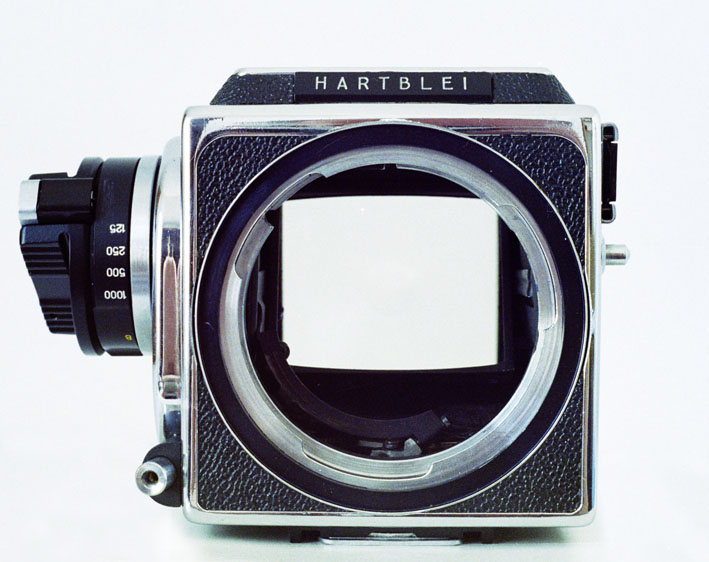
and Hartblei versions of the Kiev 88, the lens itself
has to be rotated. If it were possible to
design a mount on Kiev 88 cameras in which it was not
necessary to rotate the lens, machining a mount that takes
all the Schneider Exakta 66 lenses
should be easier. But as the lens-to-film-plane
distance on the Kiev 88 is greater than
on the Pentacon Six (82.1mm, compared with 74.1mm for the
Pentacon Six), there is just not space
on the Kiev 88 to add such a breech lock ring on
the front of the body.
However, ingenious engineers in Kiev have overcome this
problem by recessing
the locking ring within the front
on the Kiev 88.
Problem: if the locking ring is sunk within the
front of the camera: there is no way to get one’s fingers
in there to rotate the
ring!
Solution: attach a slim lever to the ring,
terminating above the front surface of the camera body
mount,
just behind the lens. Swing the lever, and you can
operate the breech
lock ring. Brilliant!
This camera was given a new name: the Kiev 88 CM
The Kiev 88 CM
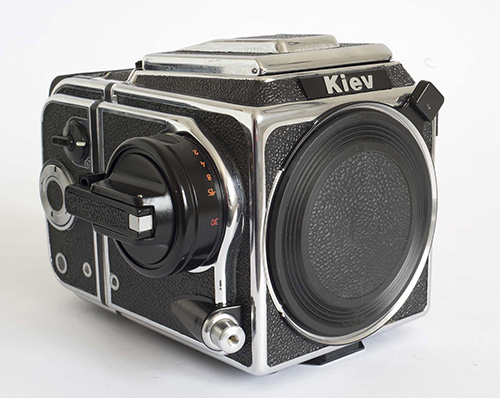
A Kiev 88CM
[88CM_01.jpg]
|
|
It seems to me that the “CM”
in “Kiev 88CM” probably stands for the Russian
for “Six mechanism”, i.e., the mechanism that
used to mount lenses on the Pentacon Six, with
a rotating locking ring, since the letter “C”
in the Cyrillic alphabet corresponds to the
letter “S” in the Roman or Latin
alphabet. (The same reason probably also
explains the naming of the Kiev 6C.)
The lever for the locking ring is just visible
at “1.00 o’clock” on
this image.
If we look at Brenner’s 1990s version of the Kiev
88, front-on, compared with the Kiev 88 CM, we
will easily be able to see some of the key
differences in the lens mount. Of
course, twenty years after I bought my
first-generation “Kiev-B.i.G.”, Brenner may now
be offering the Kiev 88CM.
|
|
[C223_35s.jpg]
|
|
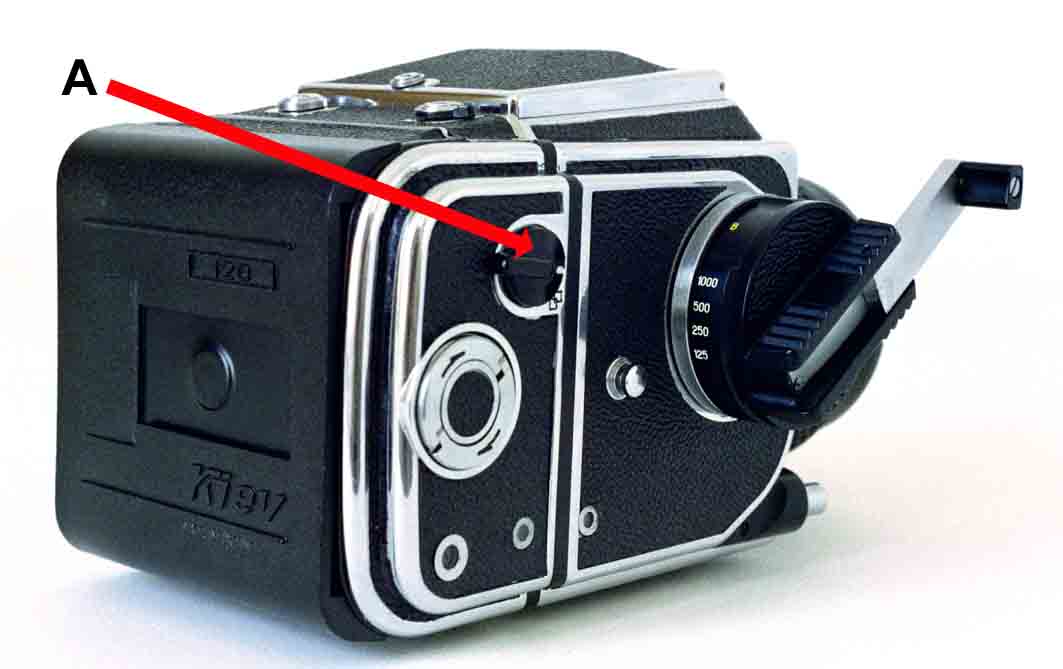
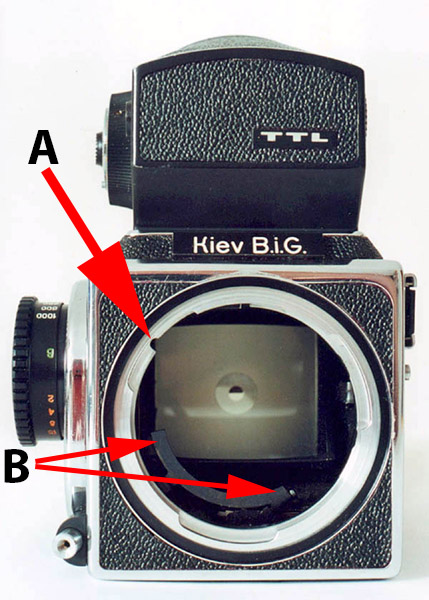
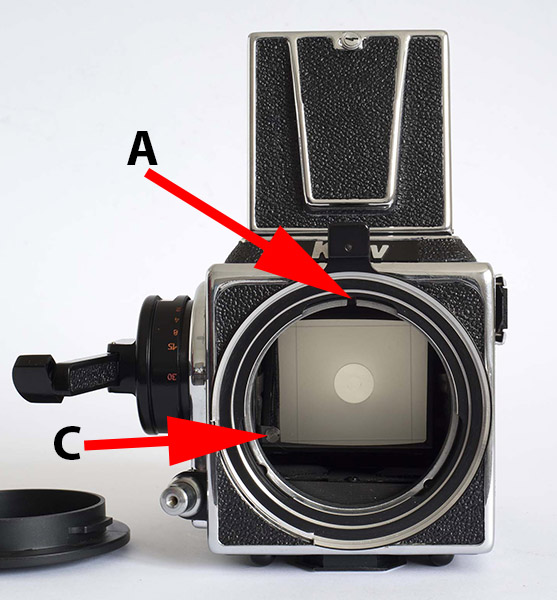
On the left we have the Brenner
“Kiev B.i.G.” that I purchased in the 1990s.
On the right we have a Kiev 88CM. On both of
these pictures I have marked with an arrow and
letter “A” the index point where the top of the
Pentacon Six lens must be inserted. On the
Kiev B.i.G. this is at approximately “10
o’clock”. It will be clear that the lens
will need to be rotated clock-wise to reach the
vertical position and so lock in place. On
the Kiev 88 CM, the index point is at “12 o’clock”
– the same as on a Pentacon Six! Therefore,
the lens does not have to be rotated.
Instead, the lever that is here top centre is
pushed to the right, rotating the locking
ring on the camera, so that it
securely grasps the lens.
On the Kiev B.i.G., as it is the lens
that has to be rotated, there is an arc-shaped
metal bar in the camera throat, which I have
arrowed near each extremity and marked with a
letter “B”. This intercepts the
automatic-aperture control pin on the back of the
lens and depresses it to open the lens
aperture. When the shutter is fired, this
metal arc moves backwards within the camera body,
to allow the lens aperture to stop down to the
selected value.
On the Kiev 88CM, as the lens is not rotated
during mounting on the camera, there is no need
for this arc-shaped metal bar. Instead,
there is a lever at approximately “8 o’clock” that
aligns with the aperture pin on the lens and holds
the aperture open, moving back into the camera
body when the shutter is fired, to allow the lens
aperture to stop down to the selected value.
I have arrowed this and marked it with a letter
“C”. This is therefore closely equivalent to
the situation in the throat of a Pentacon Six or
an Exakta 66 (1984-2000).
|
|
[88CM_04s.jpg]
|
It was not possible to mount most
Schneider-Kreuznach lenses for the Exakta 66 onto the
the original Kiev B.i.G. because all of the Schneider
lenses other than those with a maximum aperture of f/2.8
have at the back of the lens an extra pin (or in the
case of the Schneider 2× converter, two
pins) to communicate the value of the maximum aperture
of the lens to the metering prism, and the original
shape of the lens mount on the Kiev B.i.G. could not
accommodate this pin/these pins. You can see an
example of one of these pins here.
All of the Schneider lenses for the Exakta 66 also
all have a spring-mounted cam that communicates the
value of the selected aperture to the metering prism.
You can see examples of these cams here.
Can the Kiev 88CM accommodate these pins and this
cam?
|
[88CM_11s.jpg]
|
|
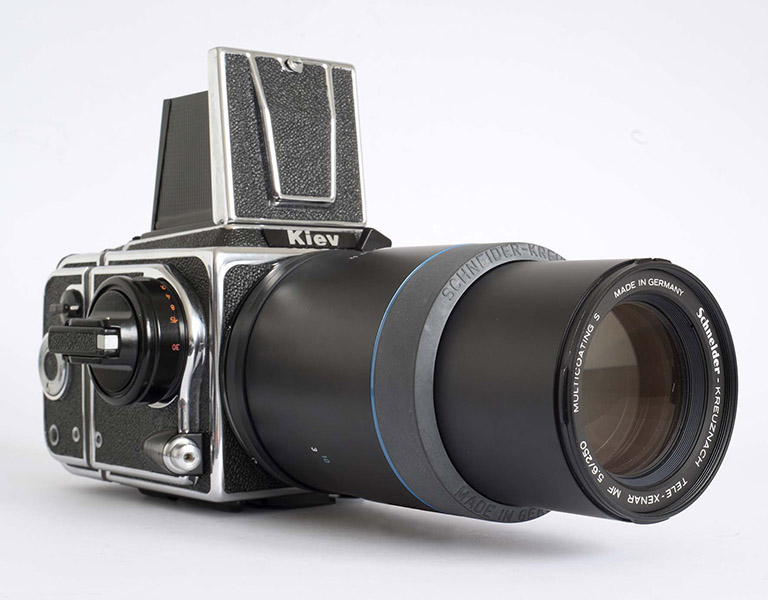
Here is the answer: By way
of example, I have here mounted the
Schneider-Kreuznach 250mm Tele-Xenar with the
Exakta 66 mount onto my Kiev 88CM. This lens
naturally has the extra pin that is used to convey
the value of its maximum aperture (f/5.6, in this
case) to the Exakta 66 metering prism, and – like
all the Schneider lenses for the Exakta 66 – it
has the spring-mounted cam. Both of these
components are right at the back of the lens,
behind the aperture ring. In fact, the cam
is mounted on the rear surface of the aperture
ring and moves with it.
Getting this lens onto the Kiev 88CM required
care, and the cam was depressed somewhat on its
springs, but it was possible to mount the lens
onto the camera, and the aperture ring can be
turned – at least, with the particular Kiev 88CM
that I have, so it looks as though the clever
people in Kiev have solved this compatibility
problem with this version of the Kiev 88.
Well done!
Among other improvements on the original Kiev 88
and even on the Kiev B.i.G., the Kiev 88CM
replaces the metal curtains of the focal plane
shutter with rubberised cloth, in line with the
vast majority of classical cameras with focal
plane shutters. It also has a much sturdier
base-plate and tripod socket, and it comes with
the shutter and film-winding crank (fold-out
lever) as standard.
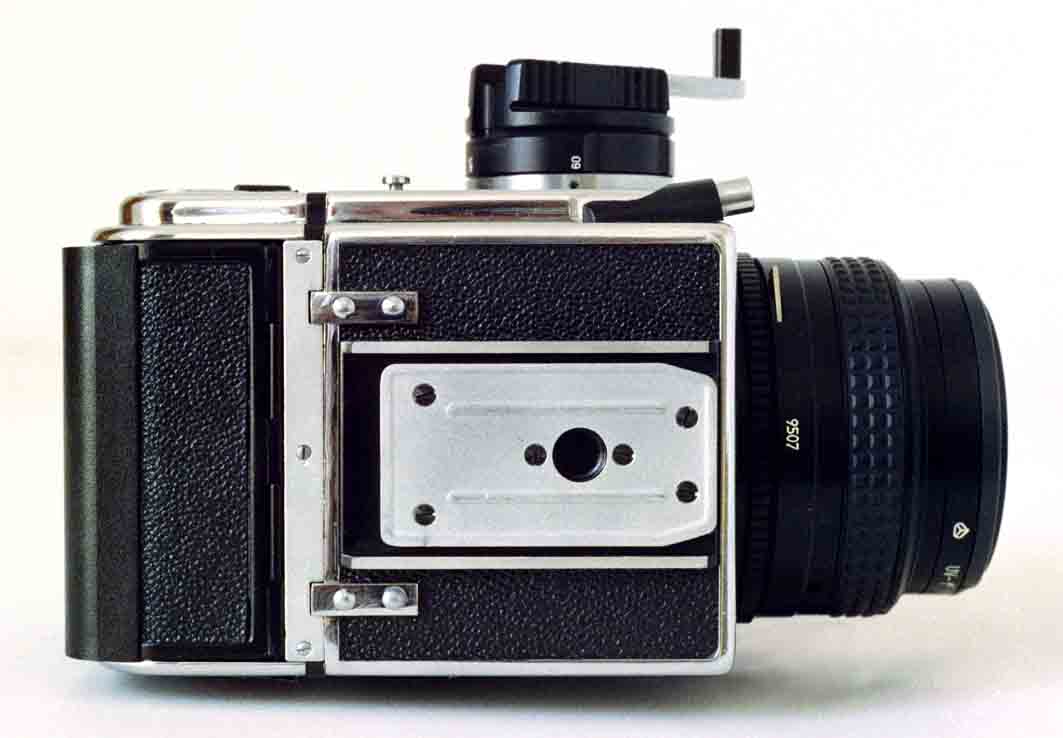
This camera is generally available new from
the following sources:
I have had very positive experiences buying from
all of these vendors, and recommend them.
|
|