The Kiev B.i.G.
A review written in
1998
by TRA
The
Lens Mount
This is the biggest change to the Kiev 88 camera introduced by the
Kiev B.i.G., and the main reason I bought the camera (along with
the availability of the Polaroid back). The standard Kiev 88
has a now-unique coarse thread mount that was in the first
Hasselblads. The Kiev B.i.G. adopts the Pentacon Six mount.
The Pentacon Six
The Praktisix and the Pentacon Six (+TL) were manufactured
in the former East Germany between 1956 and about 1990, and
although dealers who never supplied it were unstinting in their
criticism of it, claiming it was extremely unreliable, its users –
including me! – have found it to be utterly reliable. With
regular heavy amateur use over the past forty-three years(!), my
Pentacon Sixes have never let me down, although other cameras that
I have owned (e.g., Minolta, Olympus) occasionally have.
The East German manufacturers achieved a level of design and
consistently maintained a high quality of production never
approached by factories in the former Soviet Union. A wide
range of superb Carl Zeiss Jena and Pentacon lenses from 50mm wide
angle to 1000mm mirror telephoto were produced, all manufactured
within strict tolerances, and bellows and sets of automatic
extension tubes were available and can still now be obtained
fairly easily within Germany, as well as from specialist shops in
a number of countries including England and the USA. A 2x
converter was also made by the Japanese firm Panagor.
I believe that no bellows or tubes were ever produced for the
standard, unmodified Kiev 88 (although the lens elements can be
removed from the 2x converter to produce a single extension tube).
However, as the Salyut/Zenit 80/Kiev
80/Kiev 88 adopted the lens mount of the Hasselblad 1600F
and 1000F, the Novoflex bellows for those cameras may
be usable with these cameras, too. For more details,
see here.
With a Pentacon Six mount, you should be able to use the East
German or Exakta 66 bellows for details see here).
The Pentacon Six mount, which was also adopted by the Arsenal
Works for their Kiev 60 and Kiev 90 cameras, is a breech-lock
bayonet similar to the Canon mount used in the 1960s and 70s, but
with the breech-lock ring on the camera body. It is fast and
easy to use, and avoids any wear on the key surfaces affecting
focus: the back of the lens mount and the front of the lens throat
on the body. Any wear on the locking ring (not that I have
observed any in twenty-eight years of constant use!) is
compensated for by rotating the locking ring fractionally further.
The Exakta 66
Significantly, in 1986, the major West German lens manufacturer,
Joseph Schneider of Bad Kreuznach, released the Exakta 66, which
was based on a Pentacon Six body and prism to which electronic
circuitry for metering had been added, as well as a finish that
was cosmetically different. To go with this new camera,
Schneider designed a range of outstanding lenses from 40mm to
250mm, including a perspective-control 55mm lens, a 2x converter
and the two Variogon zooms that they also supply for the
Hasselblad and some other medium format cameras.
Unfortunately, the 40mm Curtagon has apparently never been
produced, but all the other lenses, as well as automatic bellows,
are available new from specialist dealers in several countries.
(For more information on the Schneider 40mm lens, click here.)
There is almost complete inter-changeability between Exakta 66
and Pentacon Six lenses and accessories: the front of the Exakta
66 metering prism prevents fitting the 500mm Pentacon lens or the
1000mm Carl Zeiss mirror lens while the prism is in place, but as
the contacts on this prism do not engage with the Pentacon Six
lenses, they can be used without it. All other Pentacon Six
lenses can be used on the Exakta 66, and vice-versa.
Brenner announced that as well as the range of Ukrainian lenses
from 30mm fish-eye to 250mm telephoto, all Carl Zeiss Jena,
Pentacon and Schneider lenses would fit the Kiev B.i.G.
Unfortunately, this is not quite true, as we shall see.
Compatible or not?
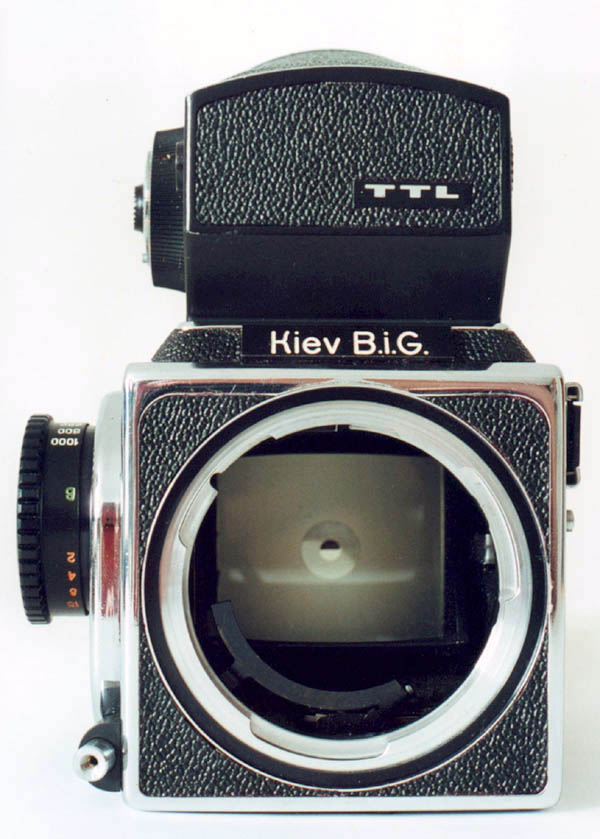 [C223-35: The modified Pentacon Six mount on
the Kiev B.i.G.
[C223-35: The modified Pentacon Six mount on
the Kiev B.i.G.
The arc-shaped piece of metal within the throat at the
bottom
actuates the lens diaphragm pin.]
|
|
To enable Pentacon Six and Kiev 60/90 lenses to focus on
infinity on the Kiev 88 body, it has not been possible to
add the standard Pentacon Six lens-mount onto the
front of the body.
This is because the register distance of
Pentacon Six mount lenses (the distance between the rear
flange of the lens mount and the film) is 74.10mm,
while the register distance of the Kiev 88 (and
Hasselblad 1000/1600) is 82.10mm, so the lens has to sunk
within the camera body, or it would not be
possible to achieve infinity focus.
So, a different mount accepting Pentacon Six lenses has
been designed. Instead of aligning the lens to the
body in vertical (or “12 o’clock”) position, as on all
the other compatible cameras, and then rotating a
locking ring on the body, the lens is inserted into the
throat of the body at “10 o’clock” position, and then
rotated to the normal “12 o’clock” position, at which
point it locks in place. There is no breech lock
ring, and theoretically there could be wear on the back
of the lens mount/the front of the body, and even
conceivably on the automatic diaphragm pin, as it glides
along a curved track within the throat of the mirror
box.
|
What are the immediate consequences
of these differences?
If the lens has its aperture ring set very close to the back of
the lens, it is slightly less accessible than on all the other
bodies, as the mount on the Kiev B.i.G. is recessed. More
significantly, the Kiev 88/ Kiev B.i.G. body does not have a
stop-down lever for the lens aperture. Fortunately, all the
Zeiss, Pentacon and Schneider lenses have their own stop-down
lever. As well as giving a depth-of-field preview, this is
the quickest way to meter and fire. Unfortunately, this
lever is set behind the aperture ring on most Zeiss lenses, making
access to it extremely difficult (but not impossible) when the
lens is mounted on the Kiev B.i.G. Some of the Ukrainian
lenses do not have a stop-down lever.
Lenses by Joseph Schneider
| Schneider lenses with a maximum aperture other than
f/2.8 all have an additional tiny pin outside the mount,
designed to engage with the Exakta 66 metering
prism. This little pin does not cause any
compatibility problems when the lenses are mounted on the
Pentacon Six or the Kiev 60 (I don’t have a Kiev 90 to try
them on). Unfortunately, due to the differences
between the Kiev B.i.G.’s recessed mount and the original
Pentacon Six mount, it is not possible to mount these
Schneider lenses on the Kiev B.i.G. Brenner’s
publicity now states that “some” Schneider lenses can be
used on the Kiev B.i.G. In practice, only the 80mm
lenseses (of which there are three) can be used.
Not being able to mount Schneider’s zoom lenses on the
Kiev B.i.G. is a big and unexpected minus point.
Unfortunately, the aperture stop-down levers on the
Exakta 66 mount Biometar (“III”) and Exakta 80mm lenses
are behind the lens aperture ring and are for all
practical purposes inaccessible when either lens is
mounted on my Kiev “B.i.G”. As I find stop-down
metering the best way to work, this makes these lenses
unusable in my normal operating mode for me.
However, others who wish to use an Exakta 66 standard
lens on their Kiev 88-6/“B.i.G.-Six” might find this
possibility worthwhile, by using the full aperture
metering approach.
|
|
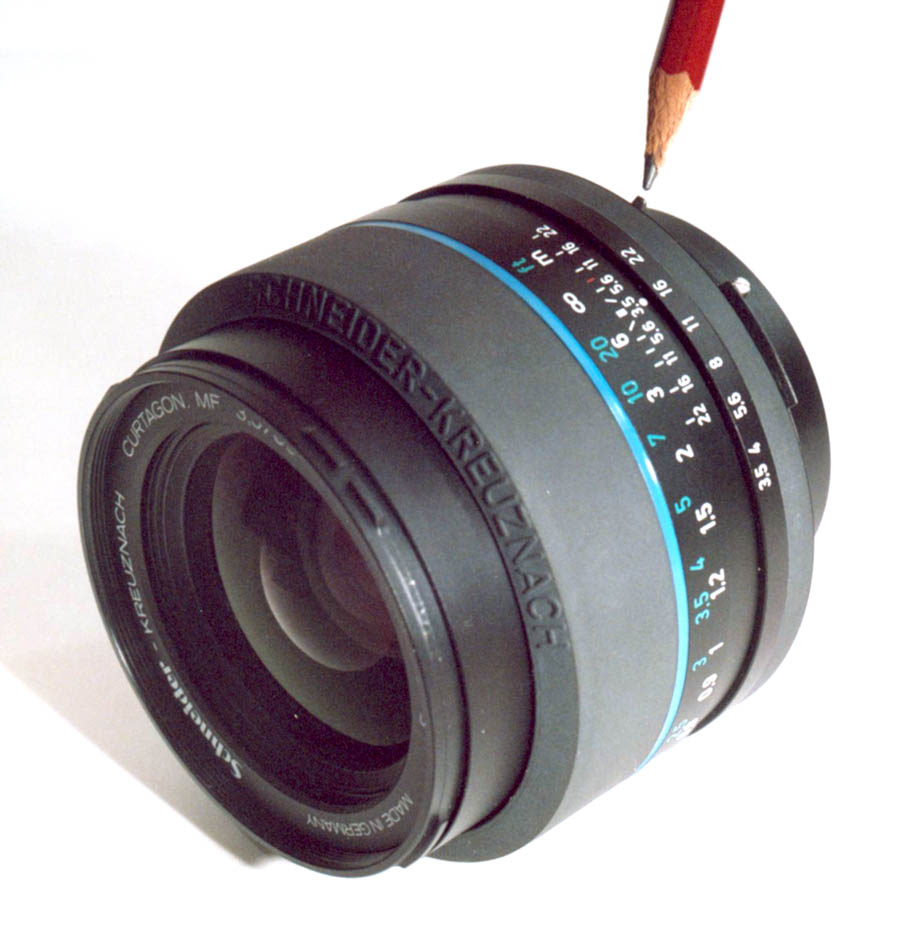 [C232-58: The metering pin on the back of
the Schneider
[C232-58: The metering pin on the back of
the Schneider
Curtagon 60mm wide-angle lens]
|
(Note added in September 2005: The
Schneider Xenotar MF standard (80mm) lens has the stop-down
lever at the bottom of the lens, and it is possible that someone
with exceptionally long finger nails might be able to activate
it while it is mounted on a Kiev 88 body with a Pentacon Six
mount. I am able to operate the stop-down lever with the
cap of a ball-point pen, but this is hardly a practical way of
working.)
To go on to the next section, click below.
Next section (Kiev B.i.G. Close-up)
To go back to the beginning of the Kiev B.i.G. review, click
below and then choose the section that you want to read about.
Back to beginning of the Kiev B.i.G. review
Home
© TRA February 2002, Latest revision with minor improvements:
July 2020