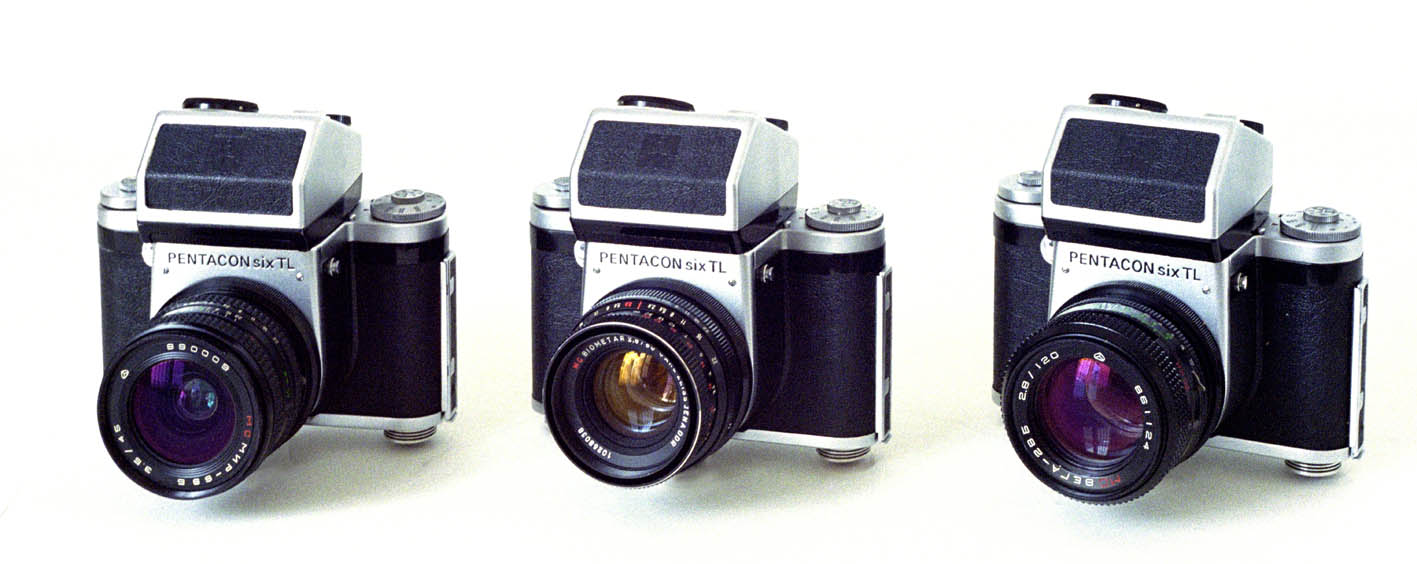
|
The following wide-angle lenses were included in the
original test:
- 45mm f/3.5 Arsenal Mir-26B.
This particular lens was manufactured in 1990, and
does not appear to be multi-coated.
- 50mm f/4 Carl Zeiss Jena MC
Flektogon
- 60mm f/3.5 Joseph Schneider MC
Curtagon
- 65mm f/3.5 Arsenal MC Mir 38B
plus, for comparison purposes, the 40mm
f/4 Carl Zeiss Oberkochen Distagon in Hasselblad
mount.
Since the original tests, most of
which were completed in 2001, I have been able to
add four key wide-angle lenses to my outfit:
- the 40mm f/4 Joseph Schneider
Curtagon
- the 45mm f/3.5 Arsenal Mir-69B
- the 55mm f/4.5 Arsat shift lens
- the 65mm f/2.8 Carl Zeiss Jena
Flektogon
Results of tests with these lenses are
now included, although I was not able to return to
Hitchin town square to shoot comparative shots.
The 40mm Curtagon lens can best be
described as “extremely rare”. To read the
story of this lens click here.
For a review of a one-off
modification of a Zenza Bronica 40mm lens to
Pentacon Six mount, see here.
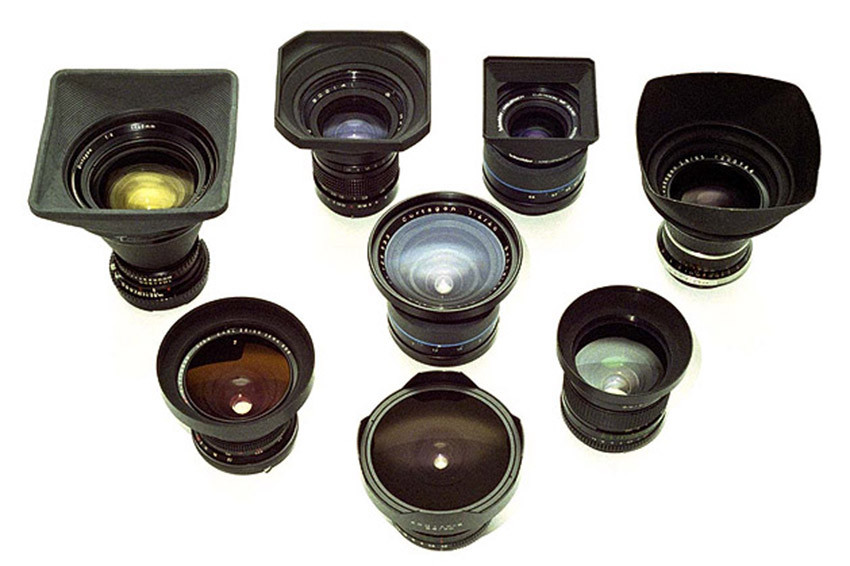
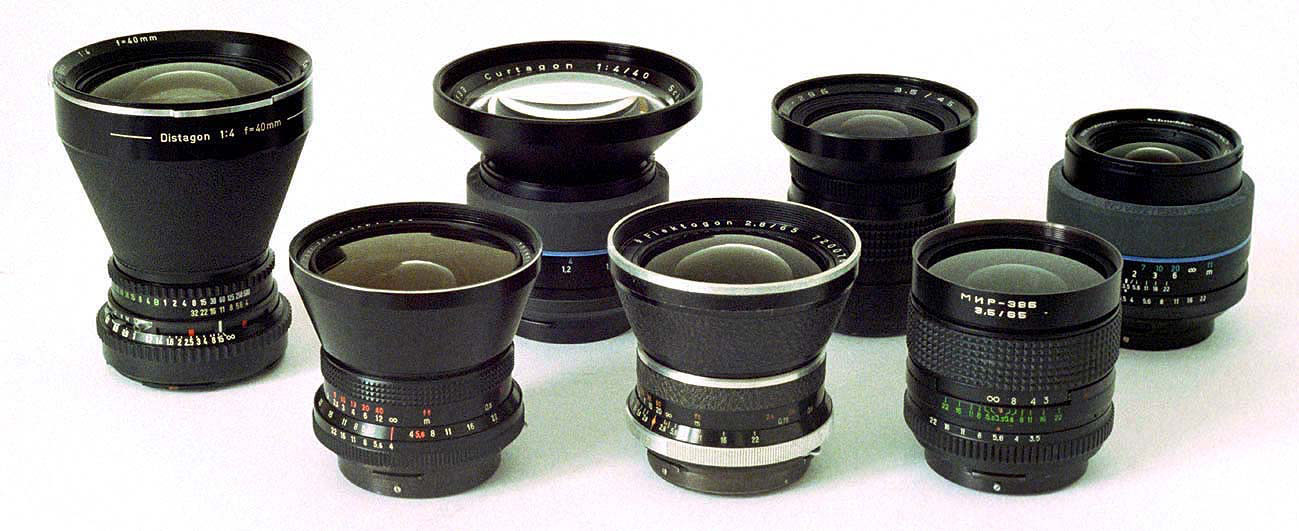
The wide-angle
lenses, together with the 30mm Zodiak, with lens
hoods attached
[C373-4A]
The results
40mm
The 40mm f/4 Carl
Zeiss Oberkochen Distagon lens fully deserves its
high reputation. At its maximum aperture the depth
of field is relatively shallow, even for this
wide-angle lens, and the cobblestones of the road
surface near to the camera are out of focus.
However, in this shot a banner at the very edge of
the shot within the plane of focus is beautifully
sharp. At f/11 the increased depth of field
renders the whole image sharp into the corners.
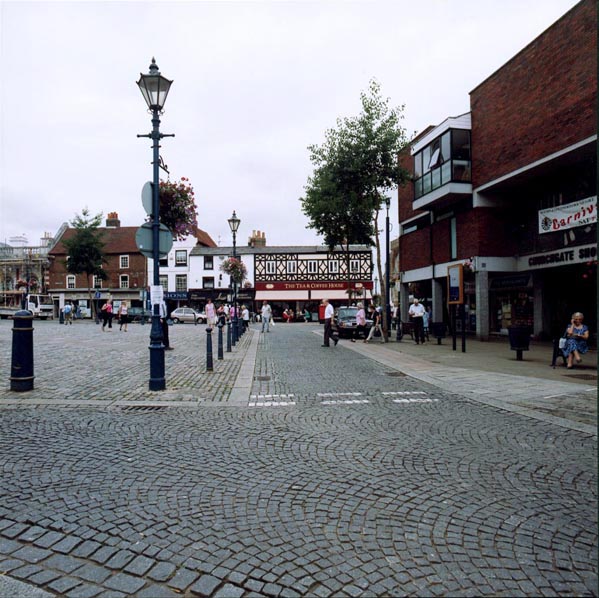
40mm Distagon at f/11
[C299-5]
To read a review by me of the rare
40mm Joseph Schneider Curtagon lens click here.
45mm:
Mir-26B
This is the Ukrainian 45mm lens
that you are most likely to find available for
sale. At the maximum aperture of f/3.5,
the Mir-26B produced an image that was only
sharp in the very centre. This is not just the
effects of depth of field. The shop sign
“Visions”, about one third in from the left and
exactly half way down the frame, is quite fuzzy.
At f/11 we benefit not only from increased depth
of field; the whole image sharpens up
tremendously.
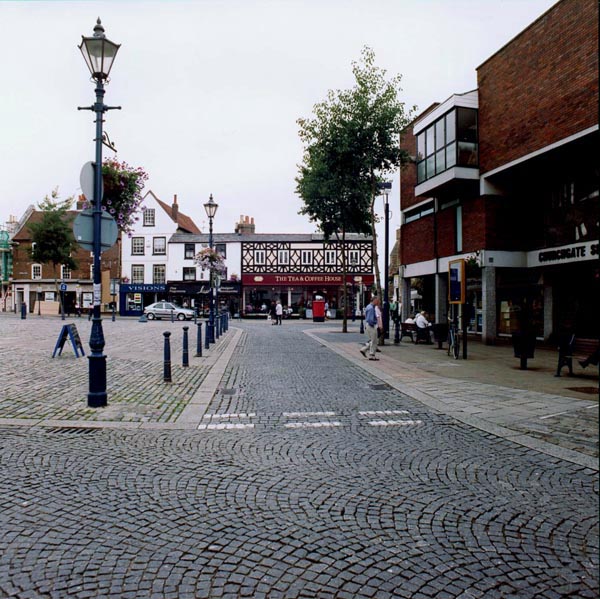
45mm Mir-26B at f/11
[C303-3]
This lens suffers from slight barrel
distortion at the edges. In many shots –
including this one – that distortion is not
noticeable, but sometimes it can be seen, as in
the following two images.
|
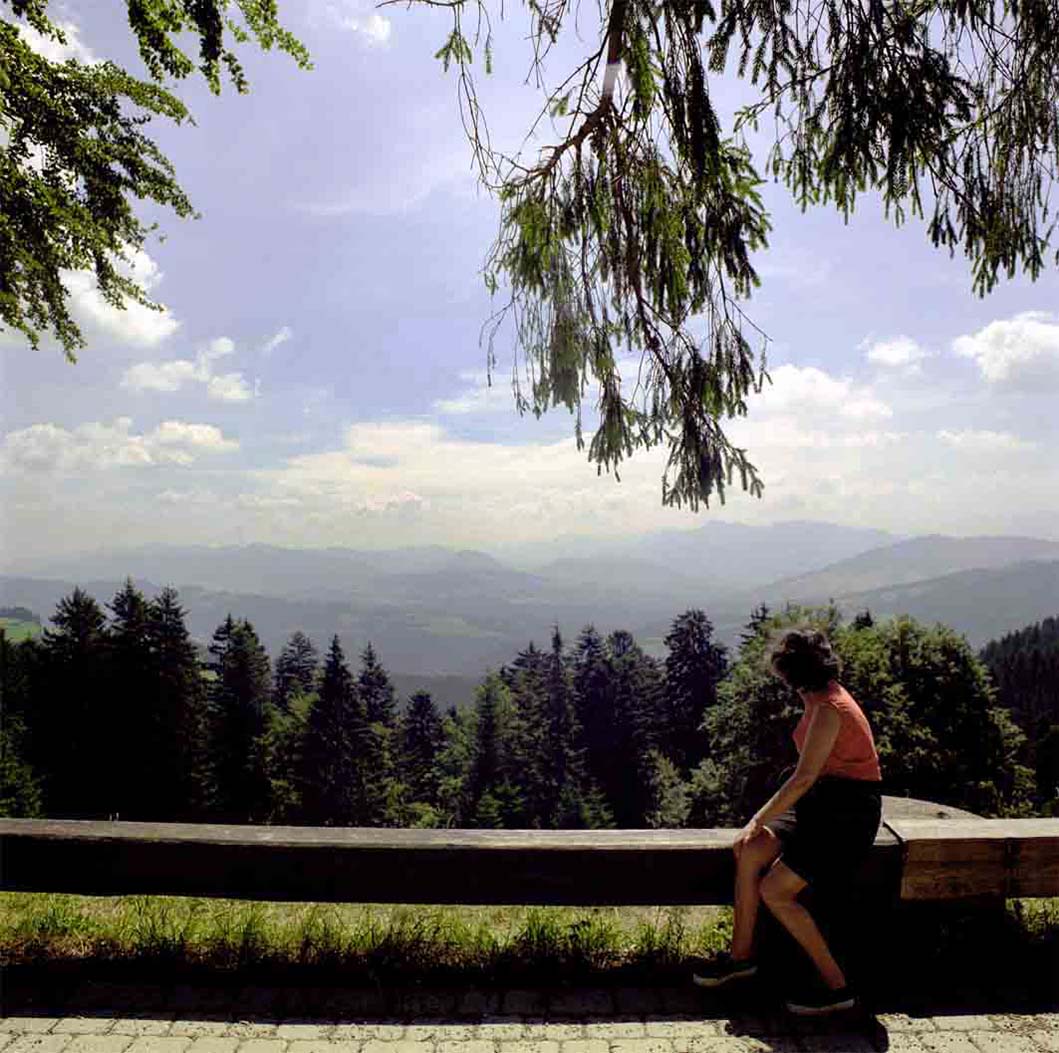 45mm Mir 26B 1/250 f/11
focussed at hyperfocal distance Kodak
Portra 160 ISO Pfänder, Austria
45mm Mir 26B 1/250 f/11
focussed at hyperfocal distance Kodak
Portra 160 ISO Pfänder, Austria
I’m sure that bench didn’t sag in the
middle.
[C344-6] |
|
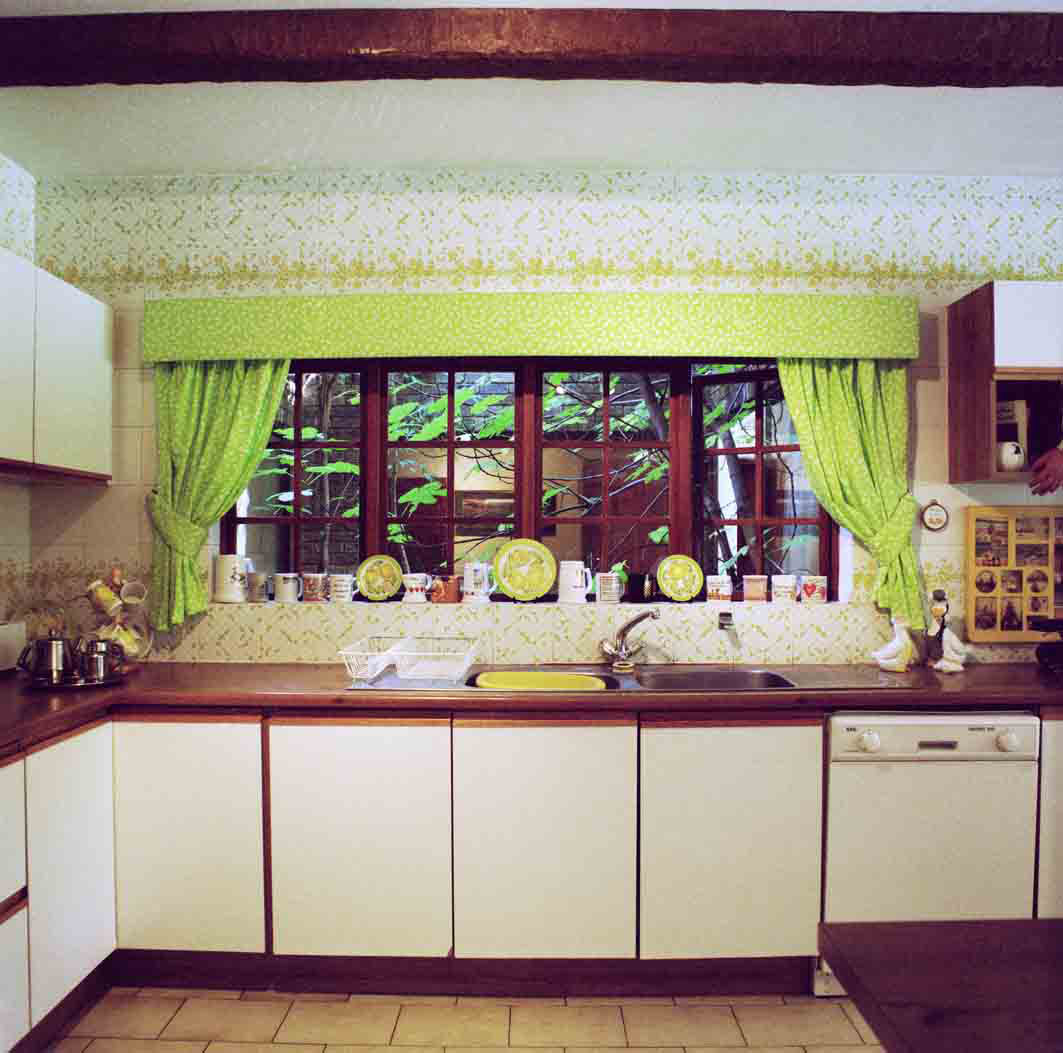
Mir 26B 1/30 f/6.3 Fuji 400 ISO film
The ceiling beam and the floor tiles
definitely were straight (though I think
that the door next to the dishwasher was
either crooked or not properly shut).
[C237-4] |
|
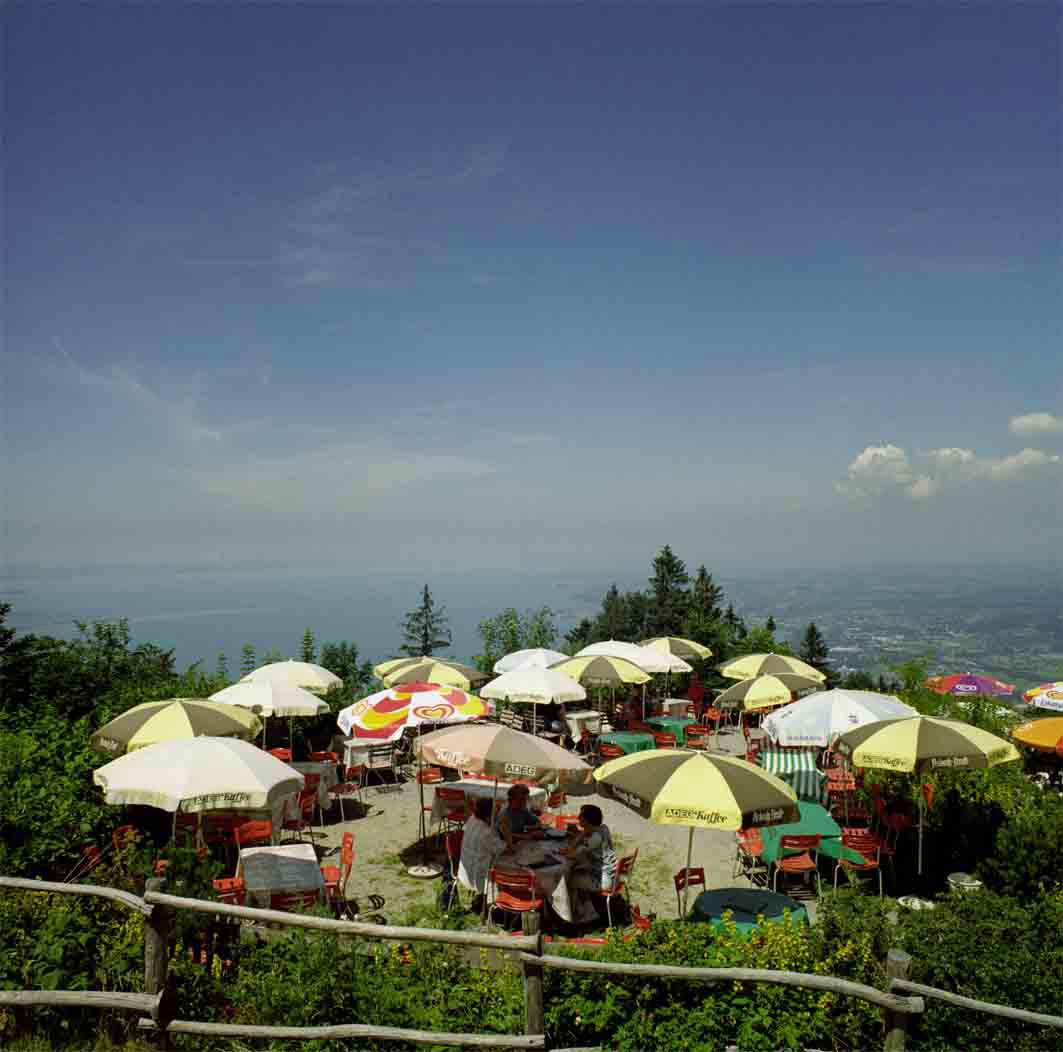 Pfänderspitze,
Austria. 1/250 f/19 Fuji NPH 400
Pfänderspitze,
Austria. 1/250 f/19 Fuji NPH 400
[C345-1]
|
|
From a compositional
point of view, this shot needs cropping,
but I am including the entire frame here
to show that with the 45mm Mir lens
there is a total absence of vignetting –
often a problem with wide angle
lenses. In this image the slight
barrel distortion produced by this lens
is also not noticeable.
(The banding in the sky is caused by the
jpeg compression!)
|
Sample
Variation
It is frequently stated
that the optical design
of Soviet lenses is good; it is the manufacturing
or the quality control
that is bad.
I hope that the results
of tests reported on this website give
some indication of how far the optical
design is good or not good. If a
lens has significant, clearly visible
barrel distortion, that
is not good. The same applies to
chromatic aberrations
(colour fringeing) and other defects
with a few lenses that are described
elsewhere on this website.
As regards poor
manufacturing tolerances
or poor quality control,
I received in July 2011 the following
report from website visitor Lionel in
Canada:
“I've been amazed by your
pictures taken with the Mir lens,
especially with the Mir-26. I had the
same issue with this lens, bad
sharpness at infinity, which is also
reported on the Kievaholic web site.
Whereas the Mother of the Lens test
page reported great results. My Arsat
80 is also not top notch.
I've tried the lens on
film, with a Kiev 60 and on a Pentacon
Six. I have even tried with a
DSLR. And I've checked everything:
mirror placement, focusing screen
adjustment ... And finally after
dismantling the lens trying to figure
out why on two Mir-26 lenses and on
the Arsat. I've found two major
problems [with the Mir 26]:
- screw length of the
Mir-26 aperture tab varies and the tab
itself is not plane.
- the spacer between the
lens mount and the focus unit can vary
by 0.5-1 mm between my two Mir-26
lenses.
After quite a [lot of]
work this winter, I obtain sharp
results, even wide open, with my
Mir-26 lenses.”
Lionel wisely first
checked other possible sources of
problems (in the cameras), but in his
experience it was not his cameras that
were faulty but the lenses were.
By adjusting his lenses in a
way that should have been done
in the factory! he
has obtained sharp results with the
Mir-26. Readers with lenses that
appear cosmetically and mechanically
in good condition - but that deliver
poor results - may wish to send their
lens to a lens specialist such as Tom
Page in England or Peter Olbrich in
Germany. And such specialists may
be able to improve the lens
substantially - although this cannot
be guaranteed, as it depends on what
they find when they open the lens up -
and they do not usually have spare
parts for these lenses!
|
45mm: Mir-69B
This extremely rare Ukrainian
lens was apparently produced in tiny quantities
between 1989 and 1991. According to some
sources, probably less than 20 examples of this
lens were produced. The price of the lens
when found therefore reflects this
scarcity. However, what is this lens like,
and what is the quality of the images that it
produces?
Technical specifications of this
lens can no longer be found, so unless one
strips a lens down, it is impossible to be sure
how many elements and groups it contains.
According to one rumour, it “contains more
elements than the 30mm Zodiak fish-eye
lens”. Most data published by Arsenal in
the 1980s does not specify the numbers of
elements and groups in lenses. However,
according to one report this lens contains 9
elements in 7 groups (one element more than the
Mir-26). The same report states that its
resolving power is also better than that of the
Mir-26: 55 line pairs per mm at the centre and
21 lp/mm in the corners, compared with 45 lp/mm
in the centre and 16 lp/mm in the corners for
the Mir-26. This is a clear improvement on
the more common lens.
Here is the Mir-69, placed beside
the Mir-26 to give a clear size comparison:
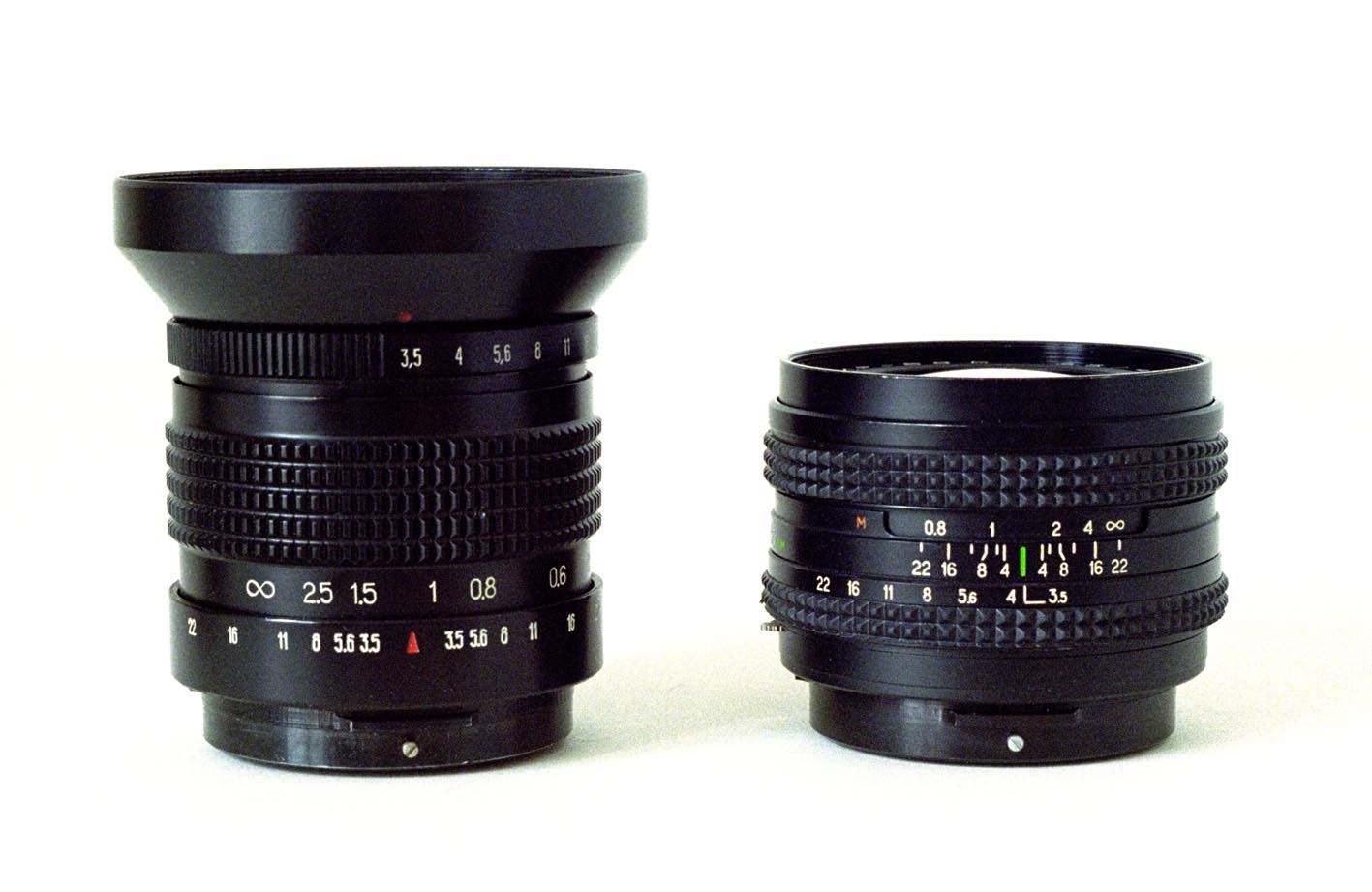
The two Ukrainian 45mm lenses:
the more common Mir-26B on the left, and the
rare Mir-69B on the right
The Mir-69 45mm seems to have
exactly the same angle of view as the Mir 26B 45mm
(as should be the case!). It is virtually
identical in size to the Vega 28B 120mm lens,
which means that the front of the Pentacon Six
case won’t quite close with it on the camera, but
it is massively smaller than the 26B, takes 67mm
filters instead of the 82m filters of the 26B and
is little more than two-thirds of the weight of
the 26B.
|
|
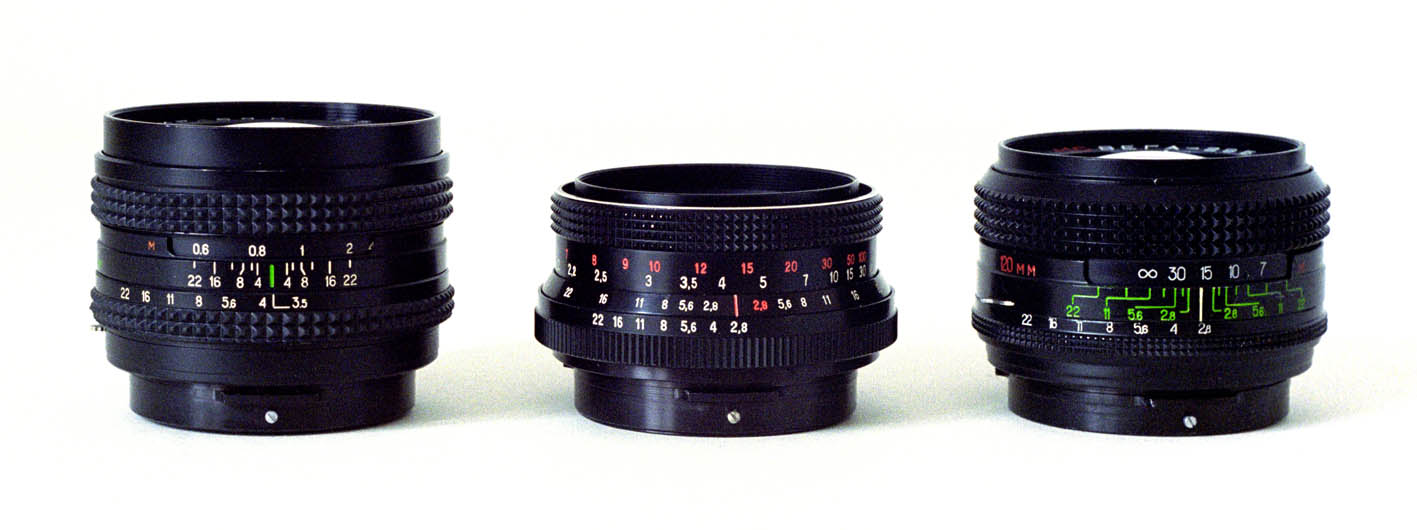
Size comparison (2):
L to R: Arsenal Mir-69 45mm lens,
Carl Zeiss Jena Biometar 80mm lens
and Arsenal Vega-28B 120mm lens
[mir69bmvega.jpg]
|
|
|
|
The Mir-69 has rubber studded grips
for the focussing and aperture rings. The
aperture ring on this example is somewhat stiff,
although the aperture itself snaps closed very
fast and with no problems. There is a
stop-down lever in the usual place, helpful for
stop-down metering on a Pentacon Six or Kiev 88
(on the Kiev 60 or 6C it is possible to use the
stop-down lever on the camera body). Closest
focus is 0.5 metres, the same as the Mir 26B, and
tests confirm that they are virtually
identical. The aperture ring is close to the
body, with the focussing ring further forward, as
is normal with most lenses (though the Mir 26B has
it the other way round, with the aperture ring
near the front of the lens!).
The direction of rotation of the
aperture ring is the same as on
the Vega 120mm lens (therefore the opposite to
the Mir 26B). The direction of rotation of
the focussing ring is the opposite to
the Vega 28B 120mm lens (which is the same as
the Mir 26B), which just shows that they didn’t
bother to standardise these things!
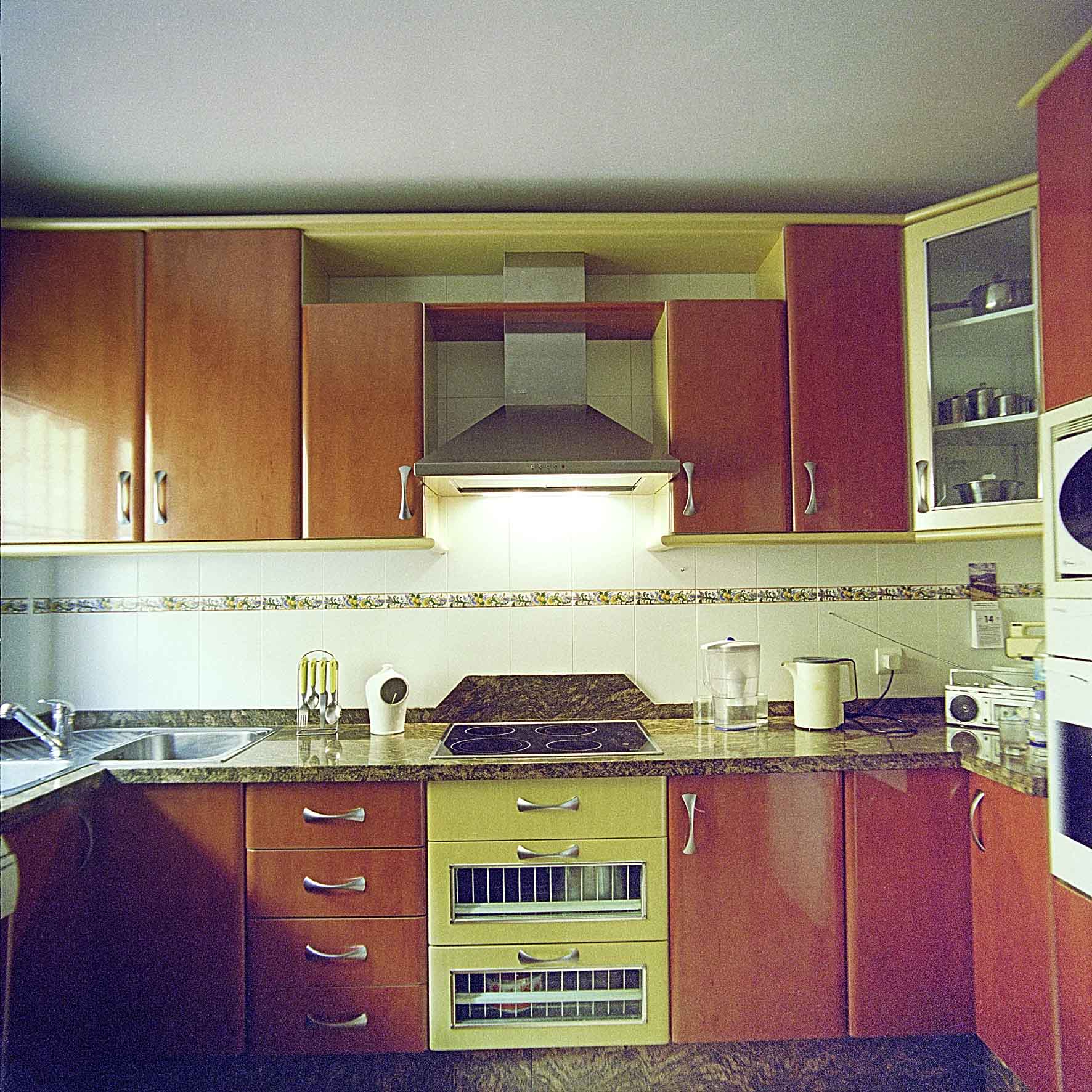
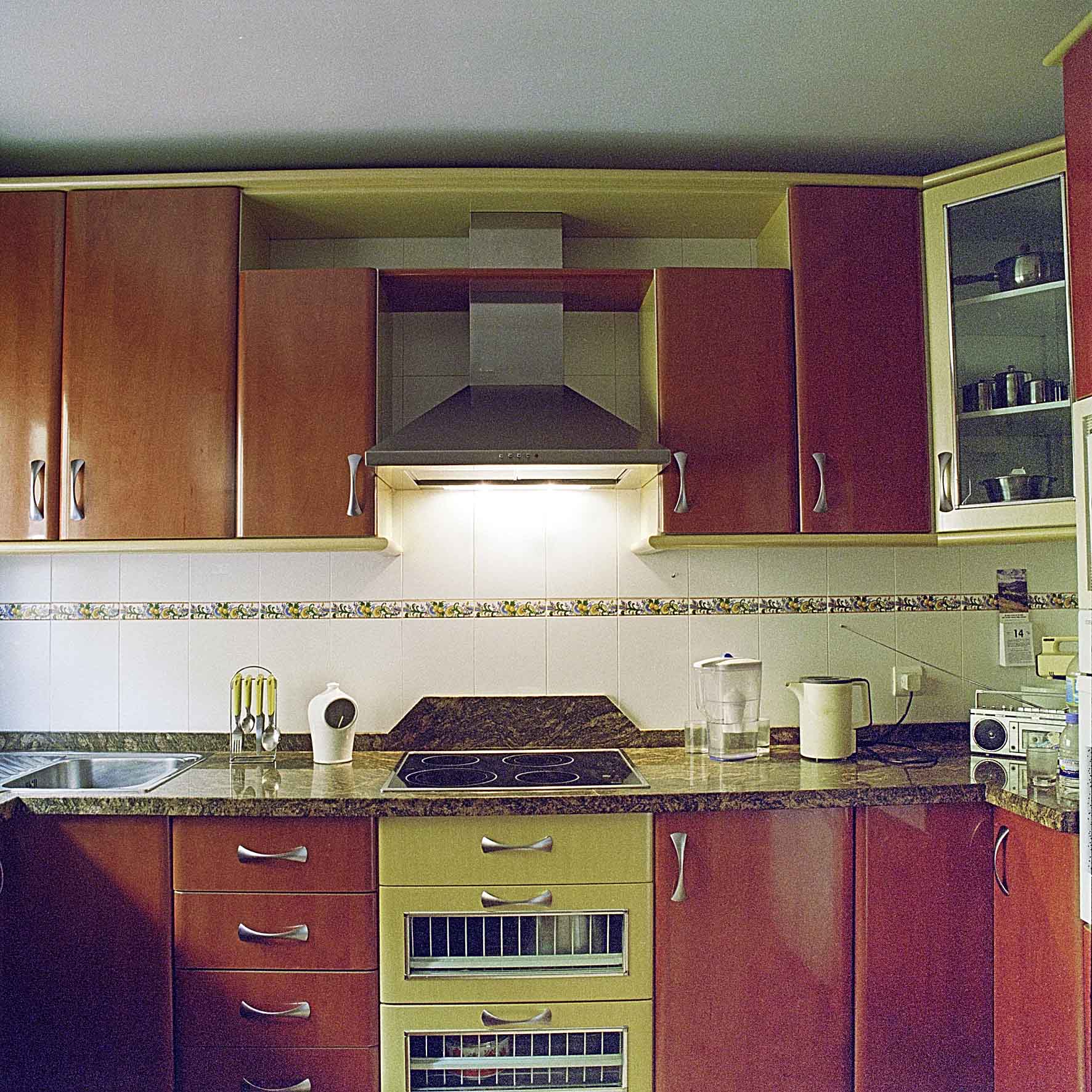
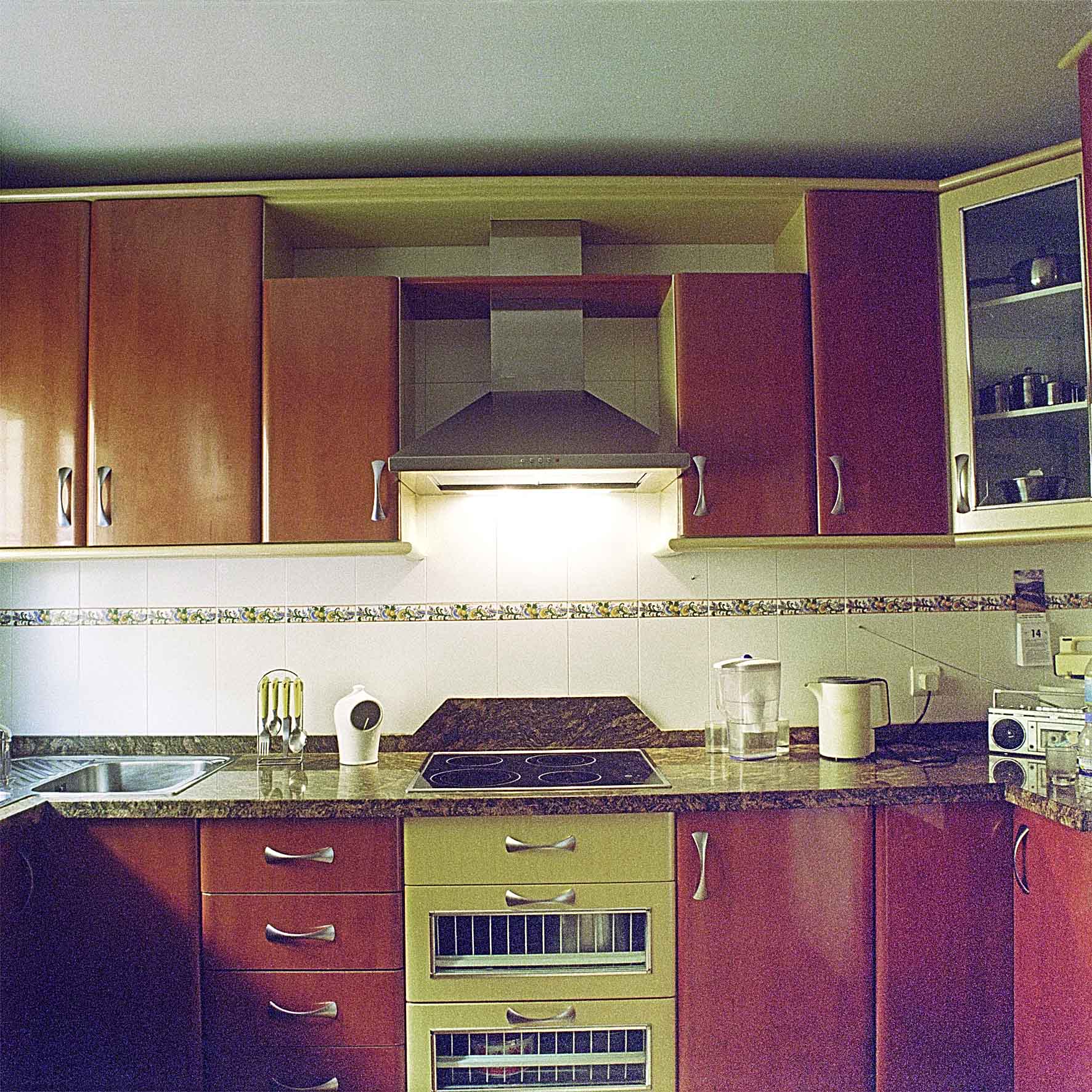
The more-common Mir-26B presents
one problem that is described in detail above:
barrel distortion. How does the newer
Mir-69B compare? Is it better, the same, or
worse? I decided that it was time for some
more kitchen shots, though I wasn’t able to cross
continents to visit the kitchen illustrated
above! Here are the first results:
Perhaps (using one body only!) this
could be an ideal outfit – although I would add
the lightweight 250mm f/5.6 Arsat or Telear lens
to bring in more distant detail. It is a
pity that the Mir-69B 45mm lens was first
developed during the final days of the communist
command economy of the Soviet Union.
Otherwise it might have gone into serial
production and might even have replaced the much
larger and heavier Mir-26B 45mm f/3.5 lens.
In my first tests, optically it looks just as good
(it is probably better!), and the reduction in
size and weight is of course extremely welcome.
I bought this particular lens
from Gevorg Vartanyan of Araxfoto,
with whom it is always a pleasure to do
business. Recommended!
[C461-12s.jpg]
|
|
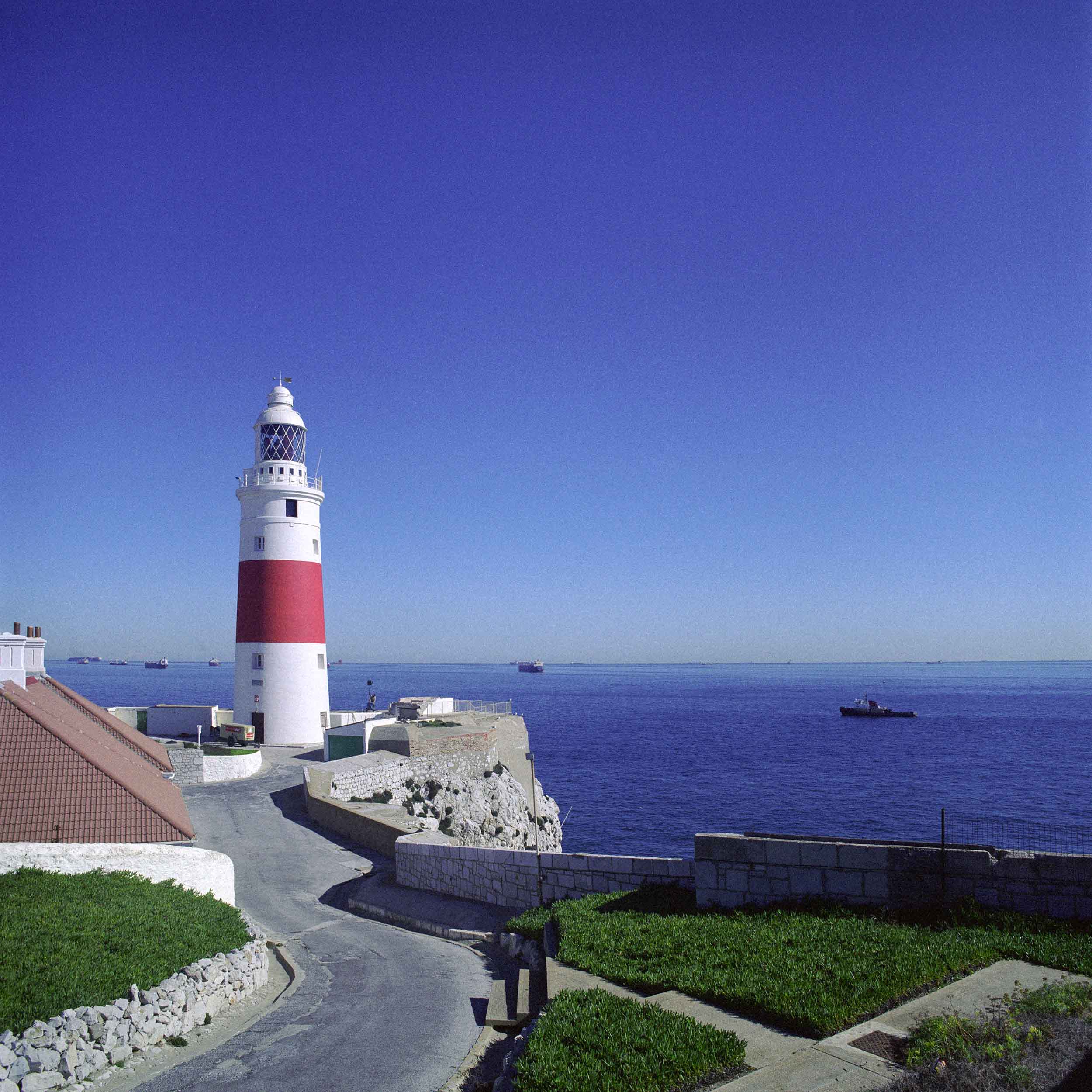
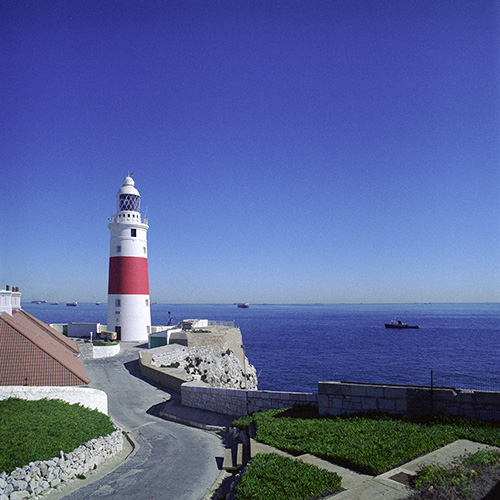
This picture
of Europa Point, Gibraltar was taken with
this Mir-69 45mm lens on a Pentacon Six
loaded with Fuji NPS160 film. The
exposure was 1/250 at f/14. Scanned
at 300 pixels per inch, the negative
generated a file of over 323 megapixels,
90cm wide × 90cm high. In that scan
one can see the individual blades of
grass! Unfortunately, it is
necessary to reduce the size substantially
for viewing via the internet. Even
so, it looks very good.
Clicking on the image reveals a larger
version of it (and with most browsers, a
second click should enlarge the image
further still). |
50mm
The 50mm Flektogon reveals a
sharp, contrasty image at its maximum aperture
of f/4. At f/11 there is (of course!) a further
improvement in definition at the very edge of
the frame, plus a slight increase in contrast, I
think, but even with 8" × 8" prints the
difference is not that obvious. A 7× loupe does
confirm the improvement in definition. A great
increase in depth of field at f/11 also brings
the nearest cobblestones into sharp focus.
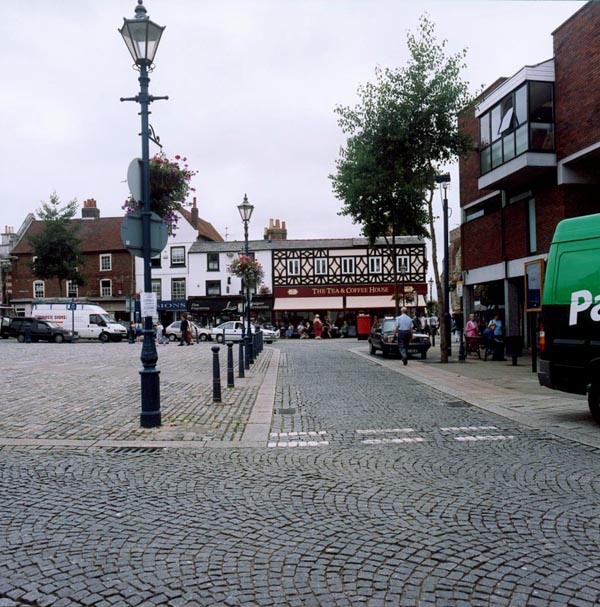 50mm Flektogon at f/11
[C296_1-2.jpg]
Some people are
concerned about the white dots that can be
seen within the internal mount of some of the
50mm Flektogon lenses, but this contrasty
image was taken with just such a lens!
The lens used for this shot can be seen here.
|