Medium Format
Lenses with
the Pentacon Six Mount
A comparative test
by TRA
The wide angle
lenses (3)
55-65mm
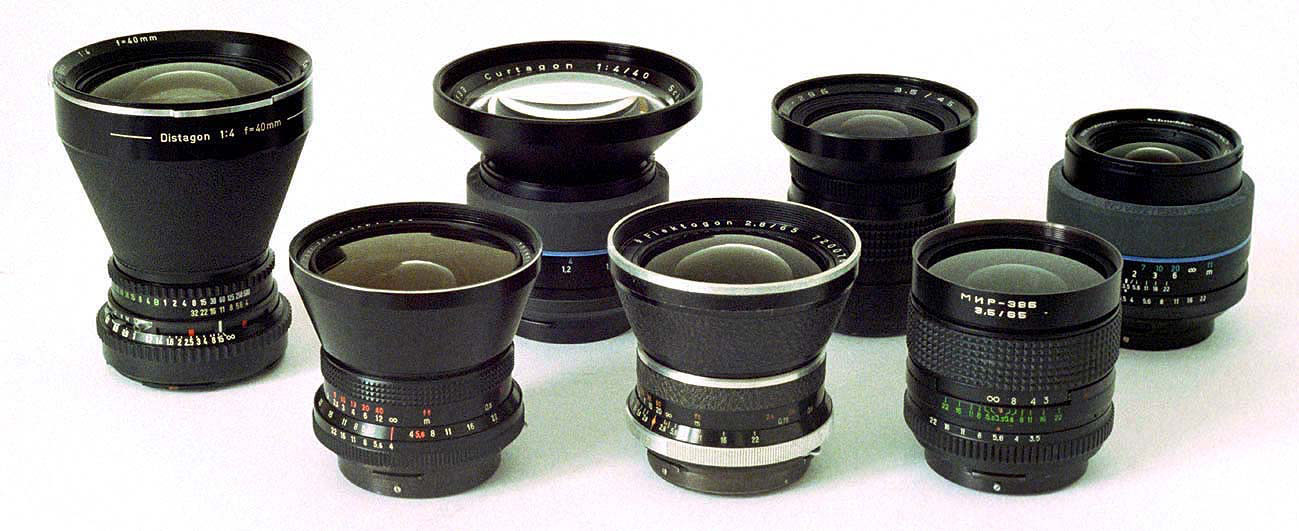
[C373-0A] The wide-angle lenses, from L to R: 40mm Distagon,
50mm Flektogon,
40mm Curtagon,
65mm Flektogon, 45mm Mir 26, 65mm Mir, 60mm Curtagon
55mm
Since completing the original tests in Hitchin Town Square I have
been
able to test the 55mm Arsat shift lens. Like most shift
lenses, this
has a pre-set (non-automatic) aperture. Initial results
indicate
that this is an outstandingly good lens. Details of the
results of
my tests can be seen here (scroll
down to
bottom of page).
60mm
Wow! At f/11 the Schneider Curtagon is sharp and high in
contrast! But
at f/3.5 it is no match for the 50mm Flektogon at full aperture.
It is
less sharp and less contrasty than the Flektogon at f/4.
At f/11 sharpness increases considerably.
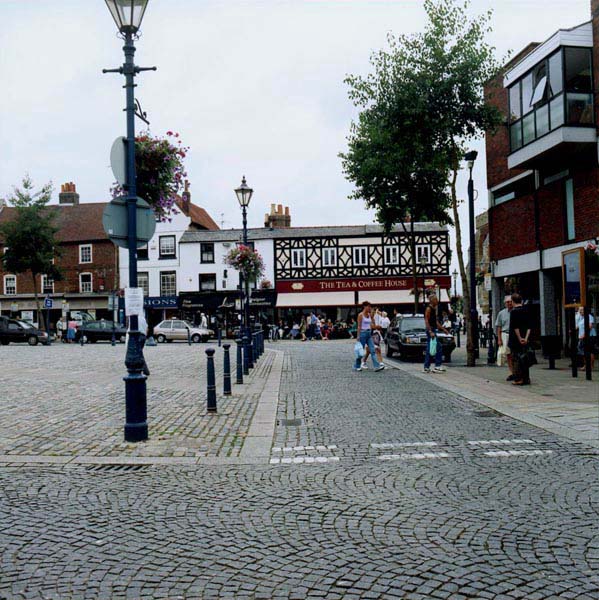
[C296-3: 60mm Curtagon at f/11]
65mm
The 65mm Mir 38B is superbly sharp and contrasty into the corners
at
f/11 – at least as good as the 60mm Curtagon, possibly a hint
better than
it, although the difference is so slight that it could be down to
the lab.
The 50mm Flektogon beats it by the tiniest fraction, as revealed
by the
definition and contrast of the “No Exit” sign near the left-hand
edge of
the image. At f/3.5, the reduction in definition is very
slight.
This truly is an excellent result that the scan has not done
justice to.
Remember that at full aperture the cobblestones near the camera
are beyond
the limits of the depth of field, and will therefore be out of
focus.
This is a fact of optical life, not a lens fault.
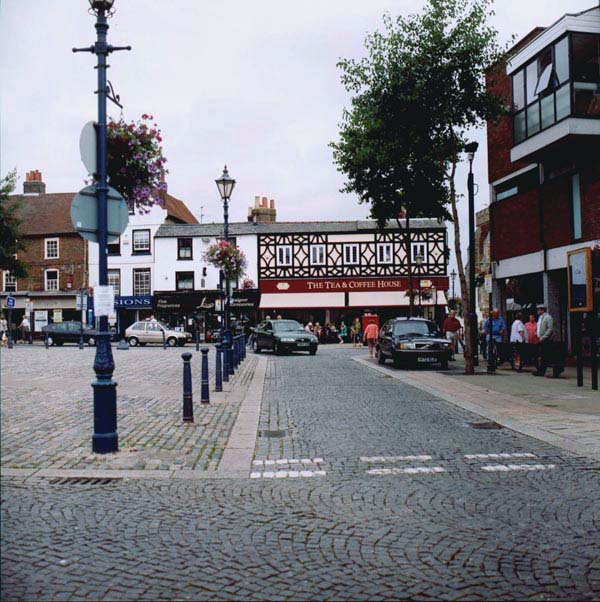
[C296-10: 65mm Mir 38B at f/3.5]
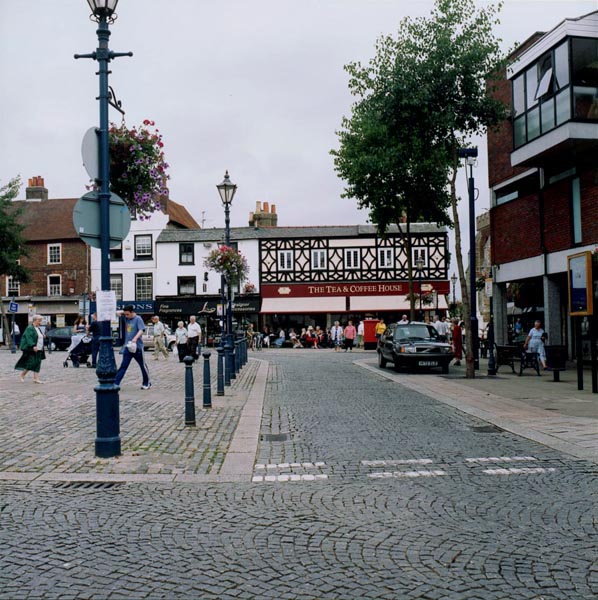
[C296-9: 65mm Mir 38B at f/11]
The aperture on my 65mm Mir (an eBay purchase!) does not always
stop
down beyond f/11 when I rotate the aperture ring. My repairman has
looked
at it, and was shocked at the poor quality of some of the
machining. It
generally does now (in 2002) stop down properly with the added
impetus
that comes when the shutter is released and it is moving fast from
full
aperture to the selected value.
| It might be better to use a 65mm Carl Zeiss Jena
Flektogon. But production
of this f/2.8 lens stopped towards the end of the 1960s,
as far as I can
determine, and it is in consequence relatively rare.
However, the ancient 65mm f/2.8 Flektogon illustrated
on the right reveals
a smoothness of operation that my 1992 Mir 38B doesn’t
come near to: movement
of aperture ring, focussing, diaphragm stop-down pin – all
are far superior to the Arsenal product.
The 65mm Flektogon was no doubt produced in various
finishes.
(See the page on lens cosmetic finishes here.)
However, the last style in which it was produced appears
to have been the
so-called “Zebra” style, and an example of this lens in
that style can
be seen on the page given in the above link. The
lens illustrated
there was produced in May 1967, and the 65mm Flektogon
appears to have
been manufactured for the last time in February 1969,
the highest serial
number for it being 8,415,309 – unless a visitor to this
website has one
with a higher serial number, of course!
That was before multi-coating was introduced by Carl
Zeiss Jena, starting
in 1976, in consequence of which all 65mm Flektogons
will be single-coated
(unless multi-coating has subsequently been added by
another company, which
is not impossible but is extremely unlikely).
|
|
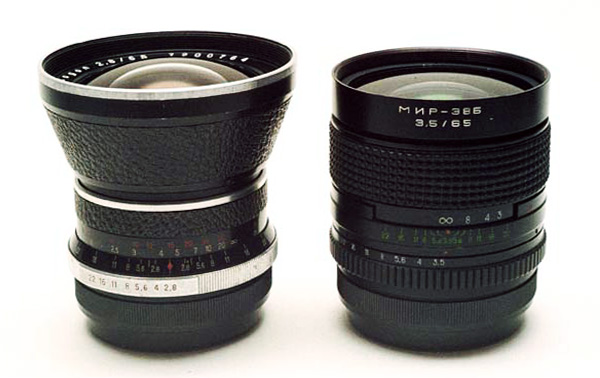 [C308-32: On the left: a 65mm f/2.8 Carl Zeiss
Jena Flektogon produced
in December 1965.
[C308-32: On the left: a 65mm f/2.8 Carl Zeiss
Jena Flektogon produced
in December 1965.
On the right for comparison: the 65mm f/3.5 Arsenal Mir
38B]
|
Identical shots that I have made at f/11 using
the above Mir-38B and the 65mm Flektogon illustrated beside it
have produced images that were indistinguishable in 8"×8"
(200mm×200mm) prints.
An image taken with a "zebra" 65mm Flektogon can
be seen here, at the bottom of
that page.
| Mir Construction
Quality
However, while sitting quietly in its
case, the 65mm Mir
decided to stop operating its aperture at all, so that
then it only worked
at f/3.5! I had to send it off for repair, and
was glad that I had
bought the Carl Zeiss, which was still silky smooth,
reliable and faultless.
March 2006:
I
recently sent the Mir 38B 65mm lens to Foto-Service
Olbrich in Görlitz,
Germany. There, Herr Peter Olbrich confirmed
that although “Russian”
(in this case, Ukrainian) lenses are often optically
excellent, mechanically
they
are very poor. This lens was no exception, and
contained broken screws
and broken screw threads. He carried out the
best-possible repair
– and to my eyes the lens now seems to operate
perfectly – but he complains
of considerable play in the aperture control, a
consequence of the way
it was constructed. To see the contact details
for Foto-Service Olbrich,
click here.
|
Kevin Ing found his 65mm Flektogon “definitely much
sharper than the 65mm Mir”. See his “Kievaholic”
website here.
In his very rigorous tests, some of his results were quite
different from
mine. As he said to me in an e-mail, “Perhaps it really
depends a
lot on sample variation and what has happened to these lenses
since they
were manufactured.” With a second-hand lens, one never
knows when
it has been disassembled, cleaned and then incorrectly
re-assembled by
a well-meaning DIY repairer.
The dimensions of the 65mm Flektogon are almost identical to
those of
the 50mm Flektogon, although it weighs considerably less.
Conclusion
In conclusion: the 50mm Carl Zeiss Jena Flektogon and the
65mm Arsenal
Mir are very sharp – at least as sharp as the 60mm Schneider
Curtagon –
and at maximum aperture, the 50mm Flektogon beats the Curtagon!
The 45mm
Arsenal Mir-26B is, however, much less sharp and contrasty.
To go on to the next section, click below.
On to the standard lenses
To go back to the beginning of the lens tests, click below and
then
choose the focal length that you want to read about.
Back to beginning of lens tests
Home
© TRA January 2002. Latest revision: July 2015