Why shoot
macro in this age of scanners?
Scanners are fine for:
- two-dimensional objects, such as
paper with printing on
- still objects
- items up to a maximum size of A4
But they are not very good for:
- three-dimensional objects
- living creatures (insects, small
reptiles etc)
- wet items (e.g. frogs!)
- shooting plant or animal life in its
natural environment or habitat.
This is why macro photography is still very
much alive – and once you have a macro outfit, you may
well find that you enjoy using it for two-dimensional
objects, too, because you can control the exposure
and framing much more easily than on a scanner.
Set-up for
macro photography
In macro photography, depth of field is
usually very small, sometimes tiny. Even finding
the object in the viewfinder can at times be
difficult. It is therefore necessary to work with
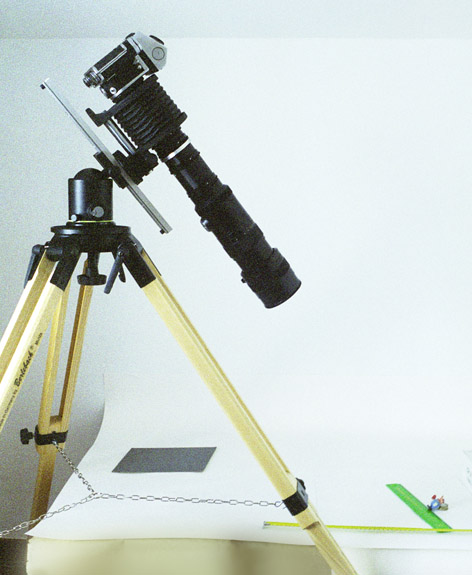
a good tripod or a copying stand, preferably with a focussing slide (scroll
down).
Methodical working is essential, and the
taking of detailed notes will pay dividends in
subsequent sessions. There is a lot of extremely
helpful information on this website that can save you
time – for instance, by telling you at what distance
from your subject you will need to work with different
lenses and bellows extensions or combinations of tubes.
New information and examples, April
2017
You can see examples of depth of field in macro
photography in a new page here.
Factors
affecting exposure times in macro photography
As well as the amount of light
illuminating the subject, two other factors affect
exposure times in macro photography:
- It is generally necessary to stop
down the lens as much as possible, in
order to increase the depth of field.
(For an explanation of depth of field, see here.) I recommend
an aperture of at least f/14 for most occasions.
This does of course have the undesirable but
unavoidable side-effect of reducing substantially the
amount of light reaching the film.
- There is also another reason why the
intensity of the light reaching the film is greatly
reduced in macro photography. The further the
lens is moved from the film, which is what happens
when it is mounted on bellows or extension tubes, the
larger the image that it projects towards the
film. The larger the projected image, the dimmer
it is. Of course, only the central area of the
projected image reaches the film. But the
intensity of the light that composes that projected
image can be quite low. In consequence, the
photographer will either need to work at very slow
shutter speeds or to have a lot of light illuminating
the subject being photographed. Even so,
exposures of 10 or 20 seconds are not unusual in macro
photography for “still life” subjects.
Light sources
Naturally, all normal light sources can
be used:
- daylight
- studio lighting
- flash
Daylight is of course beyond your
control, other than in choosing the angle from which you
will work. Make sure that your body/your equipment
does not cast a shadow on your subject.
Studio lighting has the advantage
of giving you more control of the direction of the
lighting, to improve modelling and increase or decrease
contrast, and you may be able to adjust the brightness,
by one of three methods:
- by moving the lights nearer to or
further from the subject
- by adjusting the brightness level
electrically
- by turning on/off some of the
lighting.
Flash
photography with macro
Using flash for macro photography can
allow very small apertures (where the slow sync speed of
the Pentacon Six will not be a problem).
This will:
- increase depth of field
- freeze most movement
Position of the flash is important. In
most “traditional” positions (above or beside the camera)
it can cast a shadow of your lens/bellows/tubes onto your
subject. It is worth considering the twin flash
outfits that mount on a ring screwed into the front of
some lenses, or ring flash.
For macro flash photography, you are
better off using a lens with a fully-automatic diaphragm
pin (most Pentacon Six lenses), instead of a macro lens,
where it is necessary to stop down the lens manually
before firing the shutter. With wildlife, the
appearance of your hand in front of your camera (to
adjust the aperture) may startle your subject and lose
you the shot.
Limitations
on suitable lenses
While any lens with a Pentacon Six mount
will fit onto the bellows or tubes, not every lens is
suitable for macro work or for use with long tubes or a
large bellows extension.
With the longer lenses, the image-forming
“cone” of light projected by the lens is wider at the
point where it enters the camera throat than with the
shorter lenses. This can result in the aperture
pin lever in the camera throat casting a shadow in the
image area. There can also be some vignetting
(darkening of the corners of the image).
|