The Pentacon Six
System
by TRA
Lens Data Summary
Joseph Schneider
lenses for the Exakta 66
 A comprehensive Exakta 66 outfit:
From the left: carrying strap & cradle with locking nut, 4
auto extension tubes
60mm Curtagon (at back) with 2× converter in front of it
75-150mm Variogon with 40mm Curtagon in front, 140-280mm
Variogon with 80mm Biometar “III” in front
Mk III body with metering prism, angle finder, bellows and
80mm Xenotar MF lens, with two close-up
bellows lenses in front, Mk II body with plain prism and 80mm
Exakta lens, with waist-level finder in front
On the far right: 250mm Tele-Xenar at the back, with 150mm
Tele-Xenar in front
Front row: interchangeable focussing screen, eye cup, shutter
extension, WLF lens and flash bracket
[C373_19ANewScanS.jpg]
Click on the image (twice, if necessary) to
see it larger.
Joseph Schneider of Bad Kreuznach in western Germany is another
of the great manufacturers of superb lenses, and many of their
medium format lenses are made for a range of prestigious cameras,
including Rolleis and Hasselblads. They announced the
following lenses for the Exakta 66, and all of them are reported
as having been seen at some point, although I believe that the
40mm Curtagon lens may have never entered serial production.
| Lens name |
Max aperture
& focal length |
Angle
of view
degrees |
Closest
focus
m |
Filter
thread |
Dimensions
(Diameter ×
length) mm |
Weight
g |
Comment |
| Curtagon MF |
f/4 / 40 |
89 |
0.5 |
104mm dia
outer bayonet |
104 × 109 |
700 |
There are doubts whether this lens ever entered
serial production. See more information here. |
| Super-Angulon MF |
f/4.5 / 55 |
71 |
0.5 |
104mm dia
outer bayonet |
104 × 157 |
1650 |
PCS Perspective
control & shift/swing |
| Curtagon MF |
f/3.5 / 60 |
66.5 |
0.6 |
M 67 × 0.75 |
81 × 84 |
570 |
. |
| Xenotar MF (1) |
f/2.8 / 80 |
52 |
0.6 |
M 67 × 0.75 |
84 × 72 |
500 |
. |
| Biometar (1) |
f/2.8 / 80 |
54 |
1.0 |
M 67 × 0.75 |
82 × 68 |
440 |
. |
| Xenotar E (1) |
f/2.8 / 80 |
54 |
1.0 |
M 67 × 0.75 |
82 × 68 |
440 |
. |
| Exakta (1) |
f/2.8 / 80 |
52 (?) |
0.95 |
M 67 × 0.75 |
83 × 74 |
450 |
. |
| Tele-Xenar MF |
f/4 / 150 |
29.5 |
1.5 |
M 67 × 0.75 |
84 × 101 |
760 |
. |
| Tele-Xenar MF |
f/5.6 / 250 |
18 |
3.0 |
M 67 × 0.75 |
84 × 168 |
900 |
. |
| Variogon MF (2) |
f/4.5 / 75-150 |
56.3-30 |
1.8 |
M 95 × 1 |
98 × 171 |
1770 |
Zoom |
| Variogon MF (2) |
f/5.6 / 140-280 |
31.3-16 |
2.5 |
M 86 × 1 |
95 × 240 |
2070 |
Zoom |
Notes
(1) 80mm lenses for the Exakta 66
 [C462-15s.jpg]
There is much debate about the origin of these four 80mm lenses for
the Exakta 66. The amount of information involved merits
consideration on a separate page, which can be found here.
(2) The lens designations are taken from the
original Exakta 66 publicity brochure, from about 1984. The
only Variogon lenses that I have seen in the Exakta 66 mount in
fact have the designation “M”, not “MF”, on the actual lens name
ring. The revised colour brochure from about 1990 does not
give any letter designation for any of the lenses. To see a
“square” filter system mounted on the two Variogon lenses, plus
closer views of these two lenses, click here.
2× converter
| Item name |
Multiplication
factor |
Optical
construction |
Aperture
operation |
Dimensions
(Diameter ×
length) mm |
Weight
g |
Comment |
| Tele-Converter |
× 2 |
7 lenses
in 5 groups |
Automatic |
74 × 100 |
700 |
Full transmission of lens aperture value to the Exakta
66 TTL prism |
This is an item with the maximum optical quality, as one would
expect from Schneider. Further details of its operation can
be found here and here. General information on
the use of tele-converters is here.
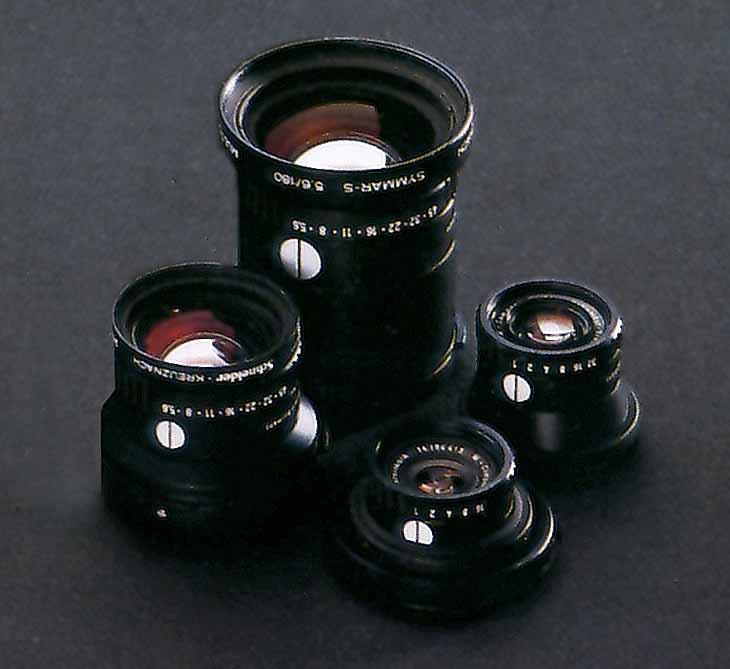
Bellows (macro) lenses
As well as the above lenses, which can (of course!) be fitted
directly to the Exakta 66 (or to the bellows unit), Schneider made
versions of some of their famous lenses exclusively for use on the
bellows unit. Here are the details:
| Lens name |
Max aperture
& focal length
mm |
Angle
of view
degrees |
Magnifi-
cation
range |
Filter
thread |
Dimensions
(Diameter x
Length) mm |
Weight
g |
Comment |
| Symmar-SF |
f/5.6 / 135 |
32 |
. |
M 49 × 0.75 |
59 × 50.5 |
250 |
. |
| Symmar-S |
f/5.6 / 180 |
24.5 |
. |
M 62 × 0.75 |
61 × 64 |
350 |
. |
| M-Componon |
f/4 / 28 |
. |
2.7-5.54 |
. |
39 × 25 |
65 |
Macro lens |
| M-Componon |
f/4 / 50 |
. |
1.04-2.54 |
. |
39 × 28 |
75 |
Macro lens |
| The two Symmar lenses already have a world-wide
reputation, and Exakta GmbH claimed that when they were
attached to the Exakta 66 bellows it would be possible to
focus them from infinity to ultra close up, although this
turns out not to be the case! Componon is the name on
Schneider’s top range of enlarging lenses, and the macro
versions of these lenses are designed to give the greatest
possible magnification of the tiniest objects. I
understand that in the macro versions of these lenses the
elements are mounted in reverse, as compared to the enlarger
versions.
To see a review of the bellows – or “macro” –
lenses click here.
|
|
 |
_________________________
The data in the tables above are based on published
sources. I do not have examples of all of these lenses (!),
and I have not measured or weighed all of those that I do have.
I note that Pentacon GmbH Foto- und Feinwerktechnik in Dresden
has two much newer products that use Joseph Schneider lenses in
the Pentacon Six / Exakta 66 mount: their scan 3000 and scan
5000 professional scanners. The 3000 brochure
that they were distributing at Photokina 2002 showed the 60mm
Curtagon MF on a scanner. It’s great seeing these lenses
living on into new technology, and an indication of the high
quality images that they produce.
For further details of the lenses – number of elements and
grouping of elements, variations of the lenses, etc, I refer you
to Nathan Dayton’s excellent website, www.commiecameras.com
Most of these lenses are illustrated and tested in the Lens Test
section of this website. To go to the lens test section,
click here.
To go on to the next section, click below.
Next section (80mm Lenses for the Exakta 66)
To go back to the beginning of the Lens Data section, click below
and then choose the range of lenses that you want to read about.
Back to beginning of the Lens Data section
Home
© TRA May 2002,
Latest revision: May 2026
