|
 |
Other Accessories
| September
2025 New adapter: see below! |
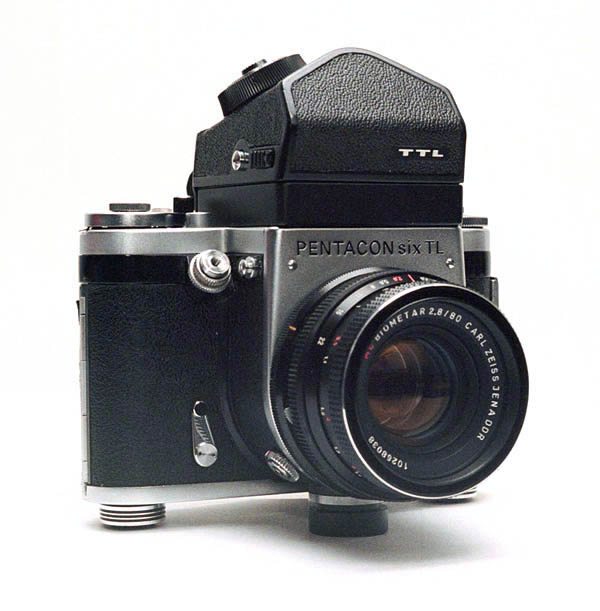
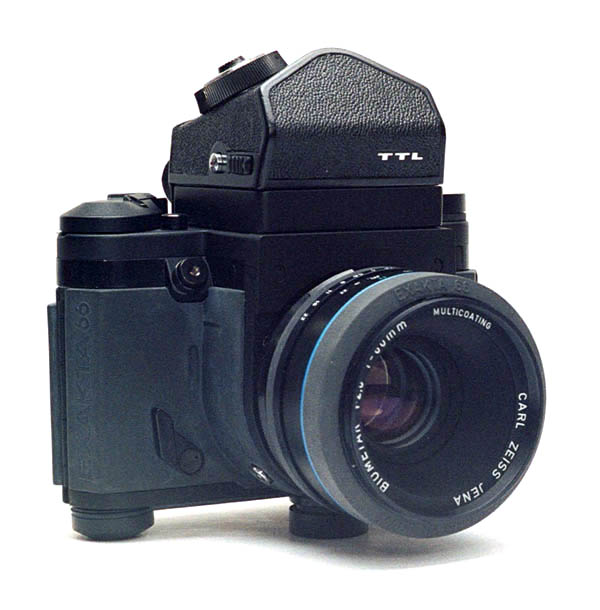
The Baierfoto viewfinder adapter
What a pity that the Kiev and Pentacon prisms and other finders are not interchangeable between the different cameras!
But now they are, thanks to Rolf-Dieter Baier in Germany, who has
made an adapter frame that enables the Kiev 60 TTL prism to be
mounted on the Pentacon Six and the Exakta 66! This has many
advantages:
No Kiev 88 prism can be mounted on a Pentacon Six and I do not believe that any adapter exists to make this possible. |
|
|
|
With the Baierfoto adapter, you can fit more than just the TTL prism onto the Pentacon Six and the Exakta 66; the Kiev 60 “waist level” finder – the best of the lot – fits either camera beautifully.
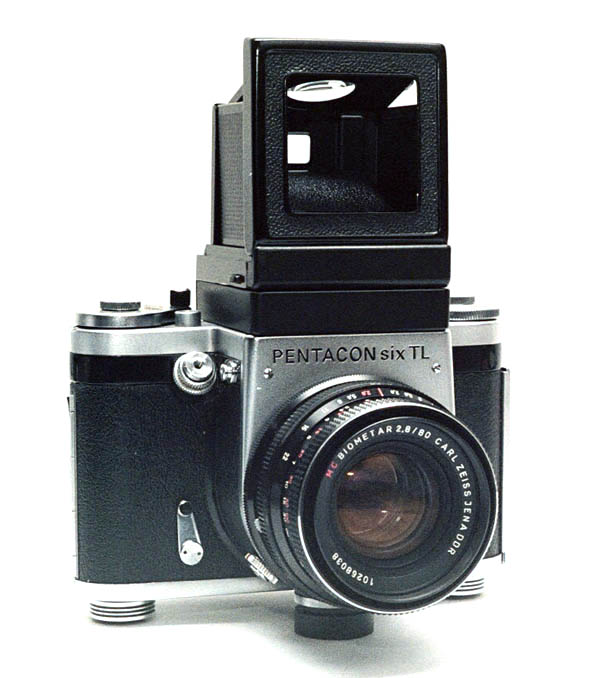
[C309-35: The Kiev 60 WLF fitted to the Pentacon Six via the
Baierfoto adapter.
Here the front section has been folded down to provide the
“sports finder” option
– see the detailed description of this, here.]
The only slight disadvantage is that when the Pentacon Six has a Kiev 60 prism, it isn’t possible to close the top of the ever-ready case. The Baierfoto adapter is available from Rolf-Dieter Baier in Germany. At the time of writing, he also has limited supplies of the Kiev 60 TTL prism, which he will calibrate at no cost to the focussing screen in your camera.
I do not advise using the Baierfoto adapter on the
Praktisix or the Praktisix II, as these do not have the viewfinder
locking pin that was introduced with the Praktisix IIA. In
consequence, the adapter, with its precious prism on top, could
slide off the camera – unless you can find an alternative way of
keeping it securely in place. (The Pentacon Six metering
prism will lock securely onto these older cameras, as it
has its own internal locking clips.)
| New information on using Kiev 60 viewfinders with the
Pentacon Six. (November 2011)
Peter from England writes, “I asked [Herr Baier] if the
adapter will allow full use of the [Kiev] WLFs. Well, I can use both old and new style Kiev WLF with the adapter but he is right in saying that the magnifying lens does not work very well. In bright conditions, the Kiev WLFs have a huge advantage over the Pentacon item in keeping out the light. So they make composing easier but not focusing.” This raises the fact that there are now two different waist level finders for the Kiev 60 - the original one and the “NT” version, which appeared on the market subsequent to the original composition of this page in February 2002. It looks as though for use with the Pentacon Six it is necessary to replace the magnifying lens within either of the Kiev waist level finders. Thank you, Peter, for your input! One of the advantages of the Exakta 66 waist level finder (described here) is that the magnifying lens is easily changeable to match the user’s eyesight. More details are available here. It might be possible to fit one of these Exakta 66 WLF magnifier lenses into a Kiev 60 waist level finder, but some adaption would be necessary and it would be difficult. It might even prove impossible without manufacturing a new holder for the magnifier. |
|
A few years ago Rolf-Dieter Baier closed his business, so the Kiev 60 to Pentacon Six viewfinder adapters are no longer available new from him. However, in September 2025 the company Ausgeknipst in Germany offers new 3D-printed adapters based on Baier's design. Their website can be found here. They explain that they did not design this part; it was designed by Thingyverse User "roggenschrotbrot", who made it available through a CC license. For those who have their own 3D printer, Ausgeknipst even offer a link to that design, so that users can print the adapter themselves! Brilliant support! Thank you! Here is the link: https://www.thingiverse.com/thing:4151167 I do not have a 3D printer, so I have not been able to print it and I cannot assess it from a technical standpoint, but it looks good. More information on the adapter and other Ausgeknipst products for the Pentacon Six can be found here. They have also produced a video on the adapter. It can be seen on YouTube, here.  Image of the adapter from the Ausgeknipst website [ausgeknipst_s.jpg] |
Pentacon Six Special
Pressure Plate
In the 1950s, when the Prakisix was launched onto the
market, it was still fairly common to shoot with cameras
that used photographic glass plates instead of film.
This had both advantages and disadvantages, compared with
film as a recording medium:
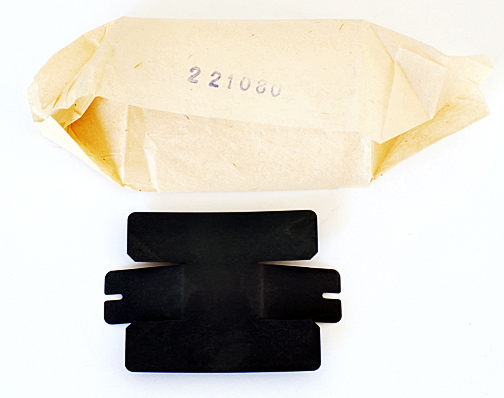
Being able to use photographic glass plates was viewed as a major positive feature, and indeed it may perhaps have been used regularly in scientific laboratories and possibly even in photographic studios, especially those that specialised in product photography. In either instance, a darkroom would have been to hand both for loading the camera and for processing the individual glass plates before proceeding to further exposures - a more sure and reliable result than making a Polaroid exposure (even if it had been available!), since a Polaroid exposure would be using different photographic material with a different speed rating and different image characteristics. It was intended that plates sized 6 × 9 cm should be used. As will be clear, photographic glass plates are thicker than photographic film, and so it was necessary to change the pressure plate in the Praktisix or Pentacon Six, for the purpose of which a “Spezialandruckplatte” or Special Pressure Plate was available - illustrated to the right with the paper in which it was supplied, from which the original order number can be seen. |
 [spezialan.jpg] |
The English and American standard for tripod screws has for over
60 years been ¼ inch. The German and Former Soviet Union
standard has on the whole been 3/8" (although the tripod socket on
the base of the Pentacon Six and Exakta 66 is ¼ inch). The
Kiev 6C and the Kiev 60 have a 3/8" tripod socket on their
base. More important, regardless of the camera that you
have, many longer lenses, including some from Pentacon and
Schneider-Kreuznach have 3//8" sockets. Your tripod is
likely to have a ¼ inch screw only. So an adapter is
required. These are usually called “tripod bush
adapters”. Any “old-fashioned” camera shop – if you can find
one! – is likely to have them.
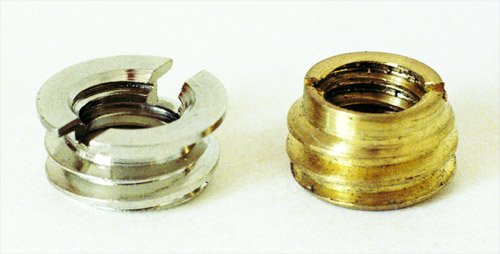 [C436-4] |
Notice the difference between these two tripod bush
adapters. The left-hand one was bought in England and has a “shoulder” at the top. The right-hand one was bought from Ukraine, and lacks the shoulder. Does it matter? In my experience, it does. The tripod socket in your camera or lens is usually far deeper than the adapter bush. Screw in one without a shoulder and it goes in and in, appearing to disappear inside somewhere. The attachment screw on your tripod may not even reach it! So the adapter bushes with a shoulder are in my opinion better. They go in and then lock when the shoulder is flush with the base of the unit. Your tripod screw goes in nicely, and can extend slightly beyond the end of the bush if necessary without causing any damage to your equipment (many tripod screws have a method of adjusting the depth of the screw, so check this before turning it too hard!). The tripod bush adapter should be screwed into your camera or lens with a very small coin. Don’t use a hefty screwdriver, or you’re likely to shear off at least one of the shoulders! |
Exakta 66 shutter
release extension
| The shutter release button on the
Pentacon Six is very close to the lugs that can take a
carrying strap – although most users carry the camera in the
bottom of its case, which has its own strap. When the Exakta 66 (1984 – 2000 version) was launched, it was decided to do two things to improve on this:
Here are pictures of the shutter release extension. This little accessory is very clever. It screws into the cable release socket on the camera’s shutter release button and can simply be pressed with the right forefinger, to fire the shutter in the normal way. However, at the front it also has a cable release socket, so it can if the user wishes be left permanently in place, and when it is desired to use a cable release, that can be screwed into the front of the shutter release extension. |
||
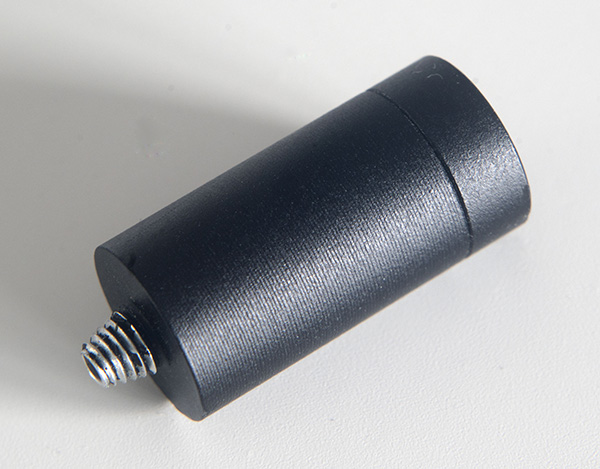 Here we clearly see the screw thread that goes into the cable release socket on the front of the camera’s shutter release button. [E66_shutter_rel_extn_01.jpg] |
On most computer screens, these two pictures will show the shutter release extension larger than life-size. |
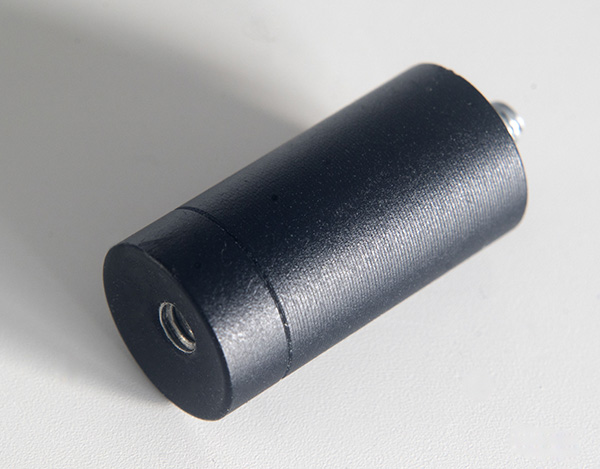 Viewed from the other end, we can see that the front of the shutter release extension there is a standard socket for a cable release. [E66_shutter_rel_extn_02.jpg] |
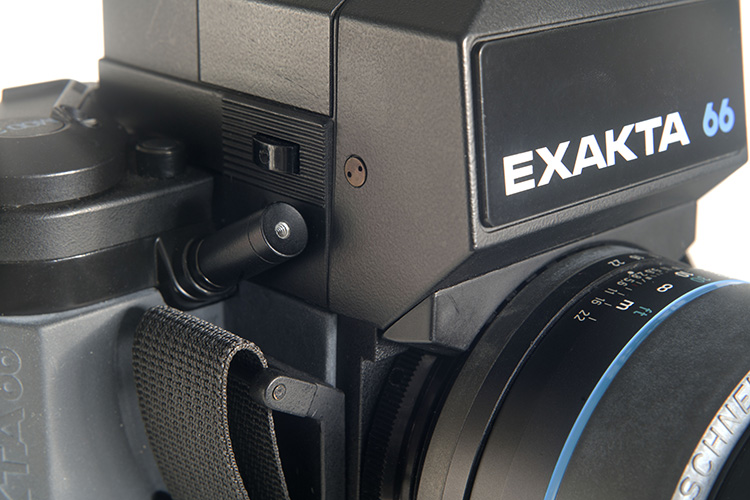 In this picture we see the shutter release extension in operational position. We can also see the top of the Exakta 66 carrying strap cradle, and a small part of the strap. [E66_shutter_rel_extn_03.jpg] |
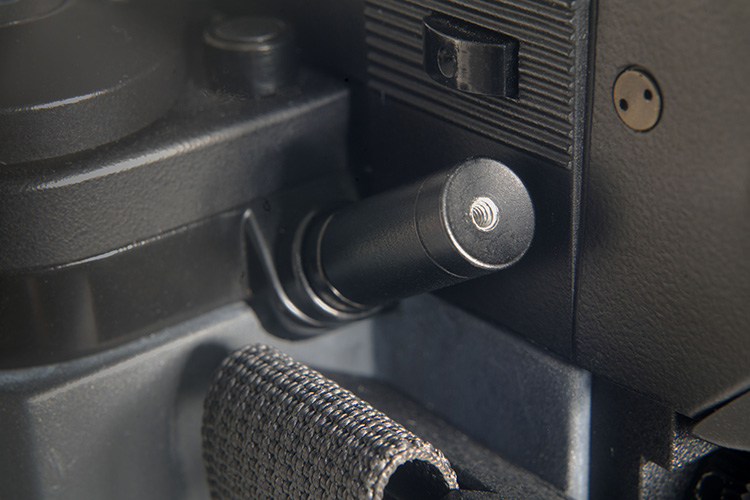 And this close up shows more detail. For these two pictures, the camera was sitting on a table, which has pushed the strap up in relation to the cradle. In normal use it fits snugly into the cradle. [E66_shutter_rel_extn_04.jpg] |
|
Camera lens adapters
|
With a covering area over three times that of 35mm
cameras, Pentacon Six lenses should perform well on 35mm
cameras, where only the centre of the image (the sharpest
part) will be used. Experience shows that the
adapter needs to be well designed, with adequate baffles,
to prevent the unused image area projected by the lens
bouncing around within the adpapter and/or camera mirror
chamber and degrading the image recorded on film.
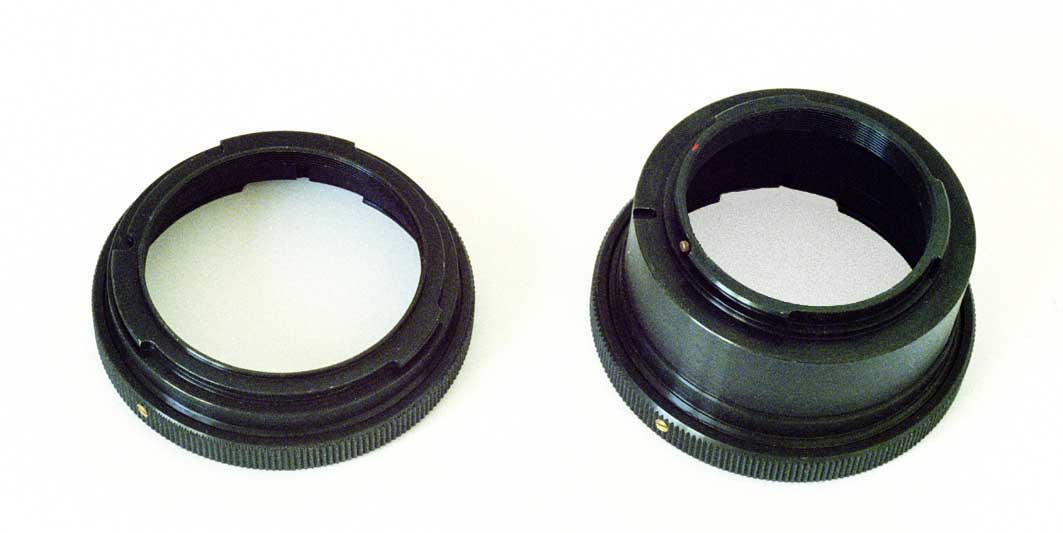
For years Carl Zeiss Jena produced adapters to mount the lenses on the Praktica range of 35mm cameras with the M42 screw mount. The last version of this adaptor included a pin to engage with a connecting fork on the 180mm and 300mm Sonnar lenses and transfer the aperture value via the “EDC” electrical contacts on the LLC, PLC and VLC cameras. With this adapter, the lens diaphragm was also stopped down automatically when firing the shutter on the Praktica 35mm camera. |
Arsenal in Kiev also made adapters to use its Pentacon Six mount lenses on cameras with the Pentax K mount or the Nikon mount, both of which mounts were used in 35mm cameras produced by them.
More recently, adapters have become available from various
sources for a wide range of cameras. Given the large image
circle produced by all Pentacon Six lenses when used on 35mm
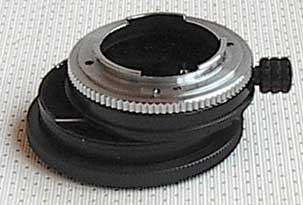
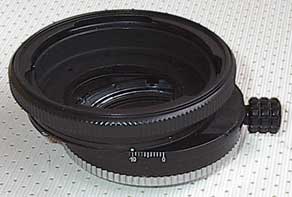
cameras, it is possible with a suitable mount to shift the lens or possibly even tilt
it when mounted on a 35mm camera. Ukrainian sources offer
Pentacon Six lens shift adapters to a wide range of 35mm camera
mounts, and Zörkendorfer in Germany make such adapters for a wide
range of cameras (though not at Ukrainian prices!)
 |
eBay seller grizzly33bear, who is based in
Ukraine and has an excellent reputation, offers Pentacon
Six to 35mm shift adapters in the following mounts: Nikon Canon EOS Canon FD Minolta Dynax / Maxxum / AF / Sony Alpha Minolta MD Pentax K Pentax M / Zenit / Praktica (m42) Contax / Yashica Rolleiflex / Leica R |
 |
Zörkendorfer are based in Munich, Germany. Their English-language website is here.
As the image area covered by lenses for the Pentacon Six is also substantially larger than the 6cm × 4.5cm format, these lenses can readily be adapted for use with some of these cameras, and (non-shift!) adapters exist for the Mamiya 645 (see image above), the Pentax 645, and possibly other cameras with this format. These adapters do not permit the automatic aperture pin on the lens to be operated by the camera, so the lens has to be stopped down manually before firing the shutter.
Camera cases
Information on the Pentacon Six camera case and some information on straps for the Pentacon Six and the Exakta 66 used to be on this page. That information has now been expanded and moved to here.
To go back to the beginning of the Accessories section, click
below and then choose the accessory that you want to read about.
Back to beginning of the Accessories section
To return to the instructions front page, click here.
© TRA February 2002 Latest update: September 2025