by TRA
Focussing Screens for the Pentacon Six
The technical German term for a focussing screen is a “Bildfeldlinse”, which in translation is an “image field lens”. This is of course correct, as the focussing screen is a condenser lens. However, one should not imagine a complex lens such as the objective lenses fitted to cameras. Its purpose is to provide a focussing surface for the image that is projected through the camera lens and the mirror.
Seven different focussing screens were
produced by Pentacon for the Pentacon Six (TL).
What were the differences between them and what type of
photography was each screen intended for? Here are
the answers. In the interests of people who either
are German speakers or who may wish to buy a focussing
screen from a German vendor, I am including on this page
the German titles for these screens and German
descriptions of them, where available.
| Introduction to the
focussing screens from a German-language
brochure
„Spezialbildfeldlinsen sind für
die Zwecke der Lupen-Mikro oder
Astroaufnahmnen, für die spektroskopische und
endoskopische Fotografie mit Klarfeld oder
unmattiert erhältlich, damit das
Scharfeinstellen mit größter Genauigkeit
direkt nach dem hellen Luftbild vorgenommen
werden kann. |
My English translation
“Special image field lenses are
available for the purposes of macro, micro or
astronomical photography, for spectroscopic
and endoscopic photography with a clear field
or clear glass, so that focussing can be
undertaken with greatest accuracy directly on
the bright aerial image. |
1) Standard
groundglass screen
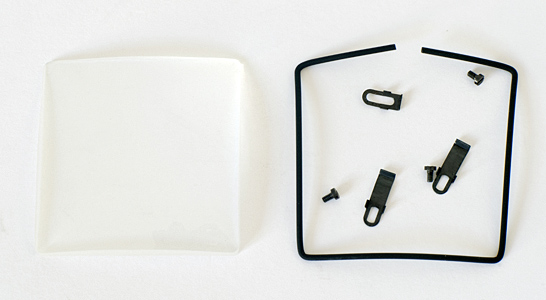 The standard screen with its retaining wire, screws and clips [stdscrn03.jpg] |
English description (from
1974 English catalogue) Standard screen supplied with camera (Part Number 207260) Intended use: “the simple fully ground-glass image field lens”. Deutsch (von „Pentacon
Zubehör für Spiegelreflexkameras“ 1975)
Vergesehene Benutzung:
(vom Prospekt „Pentacon Zubehör für
Spiegelreflexkameras“ 1975) |
Dimensions
The Pentacon Six standard screen is
approximately 50.69 mm wide by 50.66 mm from front to
back. (These dimensions are approximate, but were
derived from repeated measurements with an electronic
digital calliper.) It must be assumed that the
other Pentacon Six screens will have horizontal
dimensions that are for all practical purposes the
same. In at least one case (the fresnel screen),
the thickness of the screen is substantially different.
2)
Groundglass screen with Rangefinder wedges
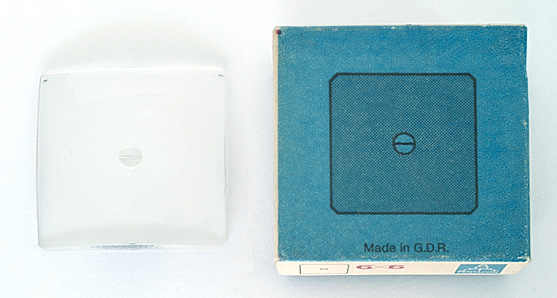 The groundglass screen with rangefinder wedges [rfscrn.jpg] |
English description (from
1974 English catalogue) Groundglass screen with range-finder wedges within the groundglass area (Part Number 207370) (subsequently re-numbered 207375) Intended use: “additional focussing aids (Rangefinder wedges)” (translation of the German below). Deutsch (von „Pentacon
Zubehör für Spiegelreflexkameras“ 1975)
Vergesehene Benutzung:
(vom Prospekt „Pentacon Zubehör für
Spiegelreflexkameras“ 1975) |
| Other information
W G Heyde, in seinem „Praktisix
Buch“ (1964) schreibt (page 26):
Auf der Seite 149 des selben
Buches beschreibt er diese Einstellscheibe auf
folgender Weise: In seinem Buch, „Pentaconsix
Praxis“ 3., verb. Auflage, Leipzig 1980
(Seite 194) schreibt er: |
My English translation
W G Heyde, in his „Praktisix
Buch“ (1964) writes (page 26):
On page 149 of the same
book he describes this particular screen as:
In his book „Pentaconsix
Praxis“ 3rd, improved edition, Leipzig
1980 (page 194) he writes: |
| Peter in the UK wrote to me
in November 2011: “I acquired an original Pentacon Six rangefinder screen and it has the best rangefinder split circle I have used on any camera. I own many 35mm SLRs and none of their RF screens comes close to the Pentacon screen. I ... do like RF screens especially for the longer lenses.” |
3)
Groundglass screen with clear field and hairline
cross
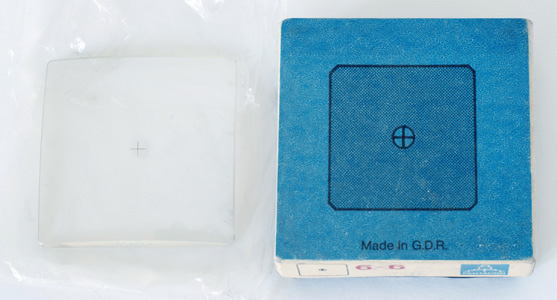 The groundglass screen with clear field and hairline cross [mattstkz.jpg] |
English description (from
1974 English catalogue) Groundglass area with clear field and hairline cross (Part Number 207330) (subsequently re-numbered 207335) Intended use: “Special focussing screen for Loupe, Microscope of astronomical (telescope) photographs, for spectroscopic and endoscopic (medical) photography, with a clear field so that focussing can be carried out with greater accuracy using the bright aerial image” (translation of the German below). Deutsch (von „Pentacon
Zubehör für Spiegelreflexkameras“ 1975)
Vergesehene Benutzung:
(vom Prospekt „Pentacon Zubehör für
Spiegelreflexkameras“ 1975) |
| Other information
W G Heyde, in seinem „Praktisix
Buch“ (1964) schreibt (page 149):
In seinem Buch „Pentaconsix
Praxis“ 3., verb. Auflage, Leipzig 1980
(Seite 188) schreibt er: Auf der Seite 194 desselben
Buches schreibt er: Ursula Petsch, in ihr
Buch „Pentacon Six“ (Leipzig, 1986),
schreibt (page 210): |
My English translation
W G Heyde, in his „Praktisix
Buch“ (1964), writes (page 149):
In his book „Pentaconsix
Praxis“ 3rd, improved edition, Leipzig
1980 (page 188) he writes: On page 194 of the same book he
writes: Ursula Petsch, in in her
book „Pentacon Six“ (Leipzig, 1986),
writes (page 210): |
4)
Groundglass screen with 10mm squares
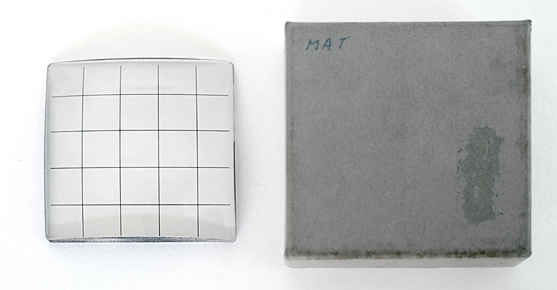 The ground glass screen with 10mm squares, with a sample of the grey boxes in which these screens were sometimes supplied [gg10mmbx.jpg] |
English description (from
1974 English catalogue) Groundglass area with 10mm squares (Part Number 207340) (subsequently re-numbered 207345) Intended use: “a grid with 10mm × 10mm squares to ensure the setting up of the camera to the exact angle (Reproduction) and to enable speedy confirmation of the reproduction scale in close up, loupe and micro photography” (translation of the German below). Deutsch (von „Pentacon
Zubehör für Spiegelreflexkameras“ 1975)
Vergesehene Benutzung:
(vom Prospekt „Pentacon Zubehör für
Spiegelreflexkameras“ 1975) |
| Other information
W G Heyde, in seinem „Praktisix
Buch“ (1964) (page 149) beschreibt diese
Einstellscheibe auf folgender Weise: In seinem Buch „Pentaconsix
Praxis“ 3., verb. Auflage, Leipzig 1980
(Seite 194) schreibt er: Ursula Petsch, in ihr
Buch „Pentacon Six“ (Leipzig, 1986),
schreibt (page 210): |
My English translation
W G Heyde, in his „Praktisix
Buch“ (1964) (page 149) he describes
this particular screen as: In his book „Pentaconsix
Praxis“ 3rd, improved edition, Leipzig
1980 (page 194) he writes: Ursula Petsch, in in her
book „Pentacon Six“ (Leipzig, 1986),
writes (page 210): |
5)
Groundglass screen with hairline cross and 5mm
graduation
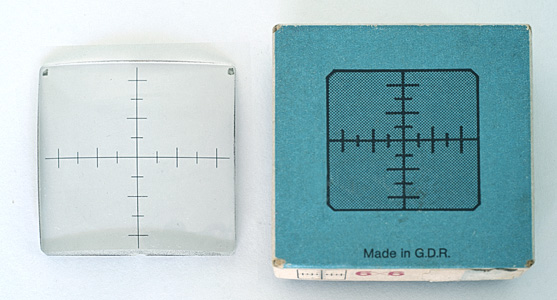 The ground glass screen with hairline cross and 5mm graduation [gg5mm.jpg] |
English description (from
1974 English catalogue) Groundglass area with hairline cross and 5mm graduation (Part Number 207360) (subsequently re-numbered 207365) Intended use: “5mm divisions for the setting up of the camera to the correct angle (Reproduction) and for the speedy visual confirmation of the reproduction scale in close up, loupe and micro photography” (translation of the German below). Deutsch (von „Pentacon
Zubehör für Spiegelreflexkameras“ 1975)
Vergesehene Benutzung:
(vom Prospekt „Pentacon Zubehör für
Spiegelreflexkameras“ 1975) |
| Other information
W G Heyde, in seinem „Praktisix
Buch“ (1964) schreibt (page 149):
In seinem Buch „Pentaconsix
Praxis“ 3., verb. Auflage, Leipzig 1980
(Seite 194) schreibt er: Ursula Petsch, in ihr
Buch „Pentacon Six“ (Leipzig, 1986),
schreibt (page 210): |
My English translation
W G Heyde, in his „Praktisix
Buch“ (1964) writes (page 149): In his book „Pentaconsix
Praxis“ 3rd, improved edition, Leipzig
1980 (page 194) he writes: Ursula Petsch, in in her
book „Pentacon Six“ (Leipzig, 1986),
writes (page 210): |
6) Clear
glass screen with hairline cross and 5mm
graduation
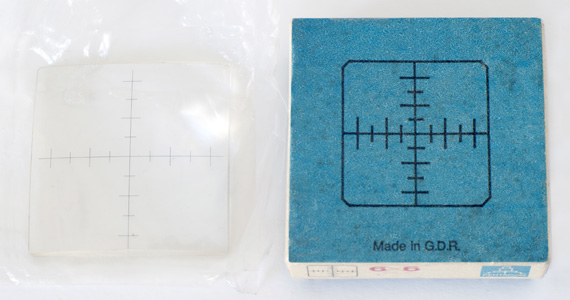 The clear glass screen with hairline cross and 5mm gradation [klar5mm.jpg] |
English description (from
1974 English catalogue) Clear glass area with hairline cross and 5mm graduation (Part Number 207350) (subsequently re-numbered 207355) Intended use: “Special focussing screen for loupe, microscope and astronomical (telescope) photography, for spectroscopic and endoscopic (medical) photography, clear glass, so that focussing can be carried out with greater accuracy using the bright aerial image” (translation of the German below). Deutsch (von „Pentacon
Zubehör für Spiegelreflexkameras“ 1975)
Vergesehene Benutzung:
(vom Prospekt „Pentacon Zubehör für
Spiegelreflexkameras“ 1975) |
This screen is sometimes referred to as
“PENTACON SIX KLARLUPE + FADENKREUZ 5mm” A
description of it in a (West) German catalogue from the
1970s says that this screen is “especially suited to the
micro-range (perhaps macro photos, but especially photos
through a microscope) and for the photography of objects
with a fine structure)”.
| Other information
W G Heyde, in seinem „Praktisix
Buch“ (1964) schreibt (page 149):
W G Heyde, „Pentaconsix
Praxis“ 3., verb. Auflage, Leipzig 1980
(Seite 194): Ursula Petsch, in ihr
Buch „Pentacon Six“ (Leipzig, 1986),
schreibt (page 210): |
My English translation
W G Heyde, in his „Praktisix
Buch“ (1964) writes (page 149): In his book „Pentaconsix
Praxis“ 3rd, improved edition, Leipzig
1980 (page 194) he writes: Ursula Petsch, in in her
book „Pentacon Six“ (Leipzig, 1986),
writes (page 210): |
7) Fresnel
screen
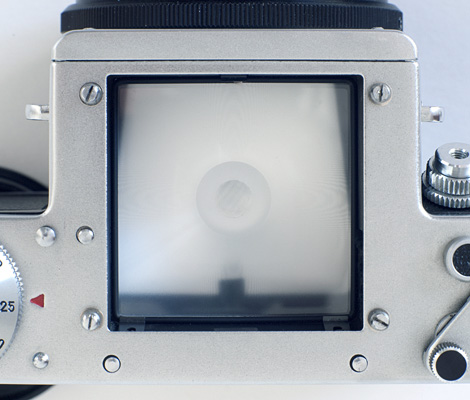 The fresnel screen installed in a late-production Pentacon Six TL [fres_top.jpg] |
English description (from
1974 English catalogue) Fresnel lens (Part Number 207251) (subsequently re-numbered 207261) Intended use: “image-brightening fresnel lens with focussing aids (Ground glass surface ring and microprisms)”. Deutsch (von „Pentacon
Zubehör für Spiegelreflexkameras“ 1975)
Vergesehene Benutzung:
(vom Prospekt „Pentacon Zubehör für
Spiegelreflexkameras“ 1975) |
Important note: the image
resolution, my computer screen and the dimensions of the
fresnel rings on this focussing screen are combining to
display an irregular pattern on my monitor. Such
a pattern is not visible on the fresnel screen
itself; it is merely a result of the interference
caused by the sizes of the pixels and the computer
screen resolution in relation to the fresnel rings.
(For the same reason, this moiré
interference may not be visible on your monitor either.)
 Substantial enlargement of part of the fresnel screen [frescent.jpg] |
The substantial enlargement on
the left of a part of the fresnel focussing
screen shows the three sections of the screen:
a) the central disk with microprisms to aid focussing b) the clear ground glass ring around it to aid focussing c) the fresnel rings on the rest of the screen, which give a bright image right into the corners. You can see further pictures of
the fresnel screen here.
Brightness and focussing compared very well with the focussing experience with the high quality 35mm camera that I had at the time, a Minolta SR-T 101. However, in my opinion, better screens were subsequently developed for both 35mm and Medium Format cameras. One such better screen is described next. |
Other Screens
Some other screens are sometimes available for the Pentacon Six.
"Mystery" screen
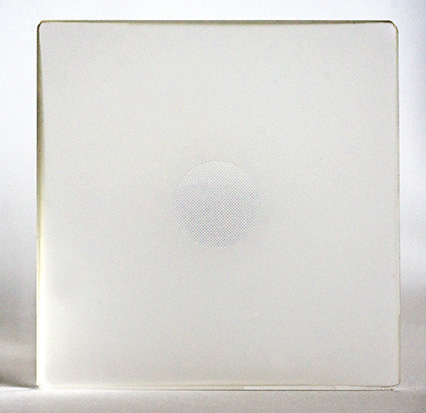 "Mystery" screen [mysscrn2.jpg] This screen
doesn't appear in any catalogue or book that I
have seen, and unfortunately it came without a
box, so I don't have a part number.
|
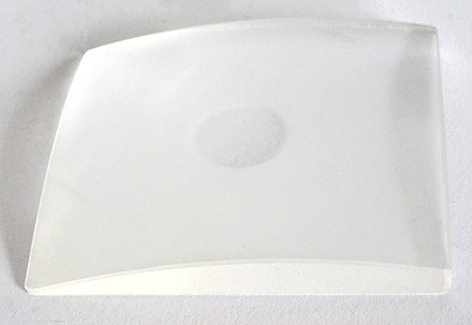 [mysscrn1.jpg]
The screen has the same "wedge"
shape as all the GDR screens for the Pentacon Six
except the fresnel screen (see higher up on this
page), which is flat.Most of the screen consists
of a ground-glass surface, just like the
standard Pentacon Six screen and most of the
other East German screens shown above.
|
 [mysscrn3.jpg]
By looking at a massive
enlargement of the centre of the screen (and
increasing the contrast of the image!), we can
see that the central area consists of
microprisms that are designed to facilitate
focussing.
|
Perhaps this was a prototype that was never marketed.
The Exakta 66
Mk 2/Mk 3 Rollei screen
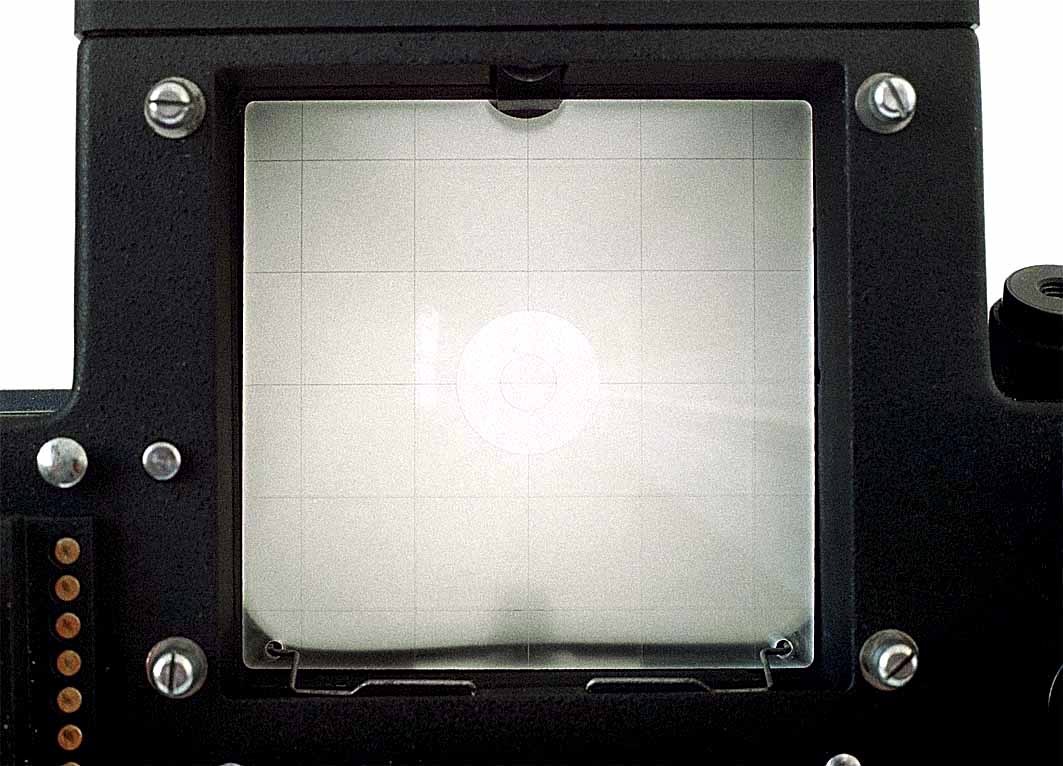 The Rollei MKPG screen for the Exakta 66, installed in one of these cameras [C387_30A.jpg] |
This is the screen that was
supplied with some Rollei cameras from the 1980s
on and was supplied as standard with the Exakta
66 Mk II and Mk III (from about 1989).
According to the Exakta 66 Technical Data Sheet dated January 1990 (“EXAKTA 66 Technisches auf einen Blick”), the letters that are often given as the screen name, MKPG, are an abbreviation for “Messkeil, Mikroprismenring, Gitterraster”, which means “Rangefinder wedges, Microprism ring, gridlines”, which is a reasonably accurate summary of the features of this screen. It is a fresnel screen of approximately the same brightness as the GDR Fresnel screen (no. 7, above), but in my opinion the addition of rangefinder wedges inside a ring of microprisms makes focussing easier in most circumstances. The faint gridlines are aids to keeping the camera horizontal, vertically parallel to the subject, etc. and in my opinion do not detract from the viewing experience. The screen needs to be bought with the correct retaining wire, screw and clip (see below). It also fits the Pentacon Six perfectly. More information on this screen can be found, with details of suppliers, here. Note: |
Additional pictures of the MKPG Rollei
screen for the Exakta 66
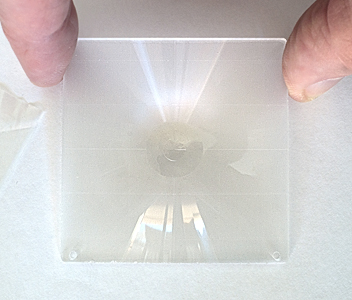 The top of the Rollei MKPG screen for the Exakta 66 The gridlines, which appear white (and hard to see) in this image and the next one, show up as faint dark lines when the subject is viewed on the screen in the camera. [mkpg3c.jpg] |
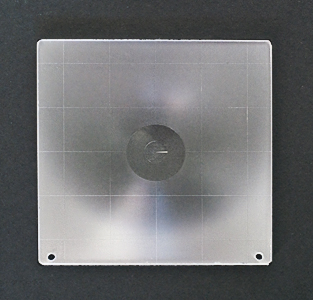 The underside of the same screen Here I have put it on a dark background and sharpened the image on the computer, to make it easier to see the grids and rangefinder wedges. [mkpg7.jpg] |
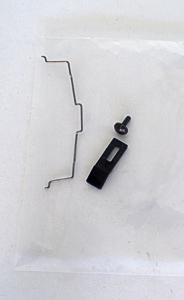 The fixing wire, clip and bolt required for this screen [mkpg1.jpg] |
The Kiev 60 screen
The screen that is supplied with the Kiev 60 camera is brighter than the standard Pentacon Six screen, but it is not the right size for this camera. If you are considering buying one, it is essential to be sure that it has been cut down to the right dimensions to fit the Pentacon Six. Also check that it is supplied with something suitable to hold it in place in the Pentacon Six. I would advise against trying to cut a screen down to size oneself, as they are so fragile that they can be easily damaged or can shatter.
To see a review of a focussing screen from Kiev, click here. I am not sure whether this is a cut-down standard Kiev 60 screen, a Kiev 88 screen, or a totally different screen.
Dimensions of camera top cover focussing screen opening
Pentacon Six: 51.69 mm
(left-right) × 51.86 mm (front-back).
Kiev 6C: 54.38 mm (left-right) ×
52.89 mm (front-back). (The dimensions of this
opening on the top plate of the Kiev 60 would appear to
be the same as on the Kiev 6C, since the same
waist-level finders and prisms are equally usable on
either camera.)
These dimensions are approximate, but were
derived from repeated measurements with an electronic
digital calliper. Naturally, the dimensions of the
focussing screen in each case will be somewhat smaller
than the opening.
Other screens
At various times some other screens are offered for the Pentacon Six. Maxwell screens have a deservedly high reputation, but I don’t know if one has ever been offered for the Pentacon Six. They are also usually quite expensive. I have received negative reports on some other screens, but have no personal experience of them in a Pentacon Six.
To see notes on how to change focussing screens, click here.
To go to introduction to the cameras, click here.
To go back to the section on viewing aids, click here.
To choose other options, click below.
Home
© TRA First published: November 2011,
latest revision: January 2016