| Square Format ... | 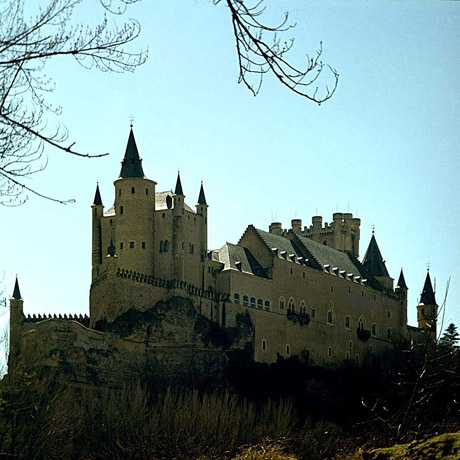 |
The Alcázar, Segovia, Spain Pentacon Six with 80mm Biometar lens & Panagor 2× converter 1/125 f/5.6 Agfa CT18 |
|
by TRA How can I make panoramic photographs with my Pentacon Six? |
|
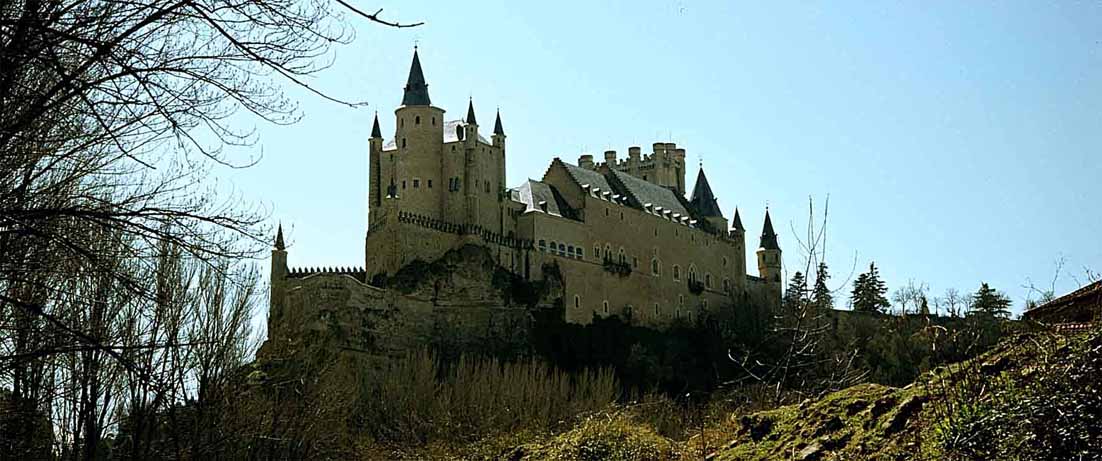
... or P a n o r a m i c ! The Alcázar, Segovia, Spain Pentacon Six with 80mm Biometar lens 1/125 f/9.5 Agfa CT18 |
| With the Pentacon
Six you can
have it both ways:
square and panoramic, without changing cameras or film backs or having to remember to push any special buttons. The angle of view that we obtain with most cameras when using a “standard” focal length is often not wide enough. So we put on a wide-angle lens. This will give us the horizontal (or alternatively vertical!) spread that we require, but we are often disappointed to see in our pictures vast areas of boring foreground or sky. What we need on these occasions is a panoramic format. Fortunately, the large frame size of Medium Format cameras is excellent for the taking of panoramic images. The Horizon/Horizont Alternative solutions, such as the Russian Horizon/Horizont cameras, use 35mm film and a rotating 28mm lens that gives an enormous horizontal angle of view of 120°. These cameras produce negatives or slides that are 24mm high × 58mm wide (a format ratio of 2.41:1). This will normally give you 21 images on a 36-exposure film, or 15 images on a 24-exposure film. Dramatic images can be produced with these cameras (and I have enjoyed using one in the past!), but there are a number of limitations:
The Pentacon Six way Using the Pentacon Six overcomes all these problems. You do not modify the camera in any way. Merely compose with the desired panoramic format in mind. Ignore unwanted foreground or sky that you will not use for the end image. Expose for the area that you are composing for. In all other respects, use the camera as normal. If you are shooting negative film, you can compose your prints (onto paper in a darkroom, or onto a computer screen if you have scanned the image in) to the desired format, cropping out unwanted areas. (Or get a flexible processing laboratory to enlarge the section that you require to the desired format and size.) If you are shooting slide film, cut the frame as appropriate and put in suitable mounts. Obviously, you obtain 12 images (at least!) on 120
film. In fact,
in my most cost-effective use of the Pentacon Six to
achieve this format,
I was able in a slide show to fade from an image of a
clown in the Moscow
State Circus to a shot of the laughing crowd – with both
slides cut from
the same frame, one above the other!
|
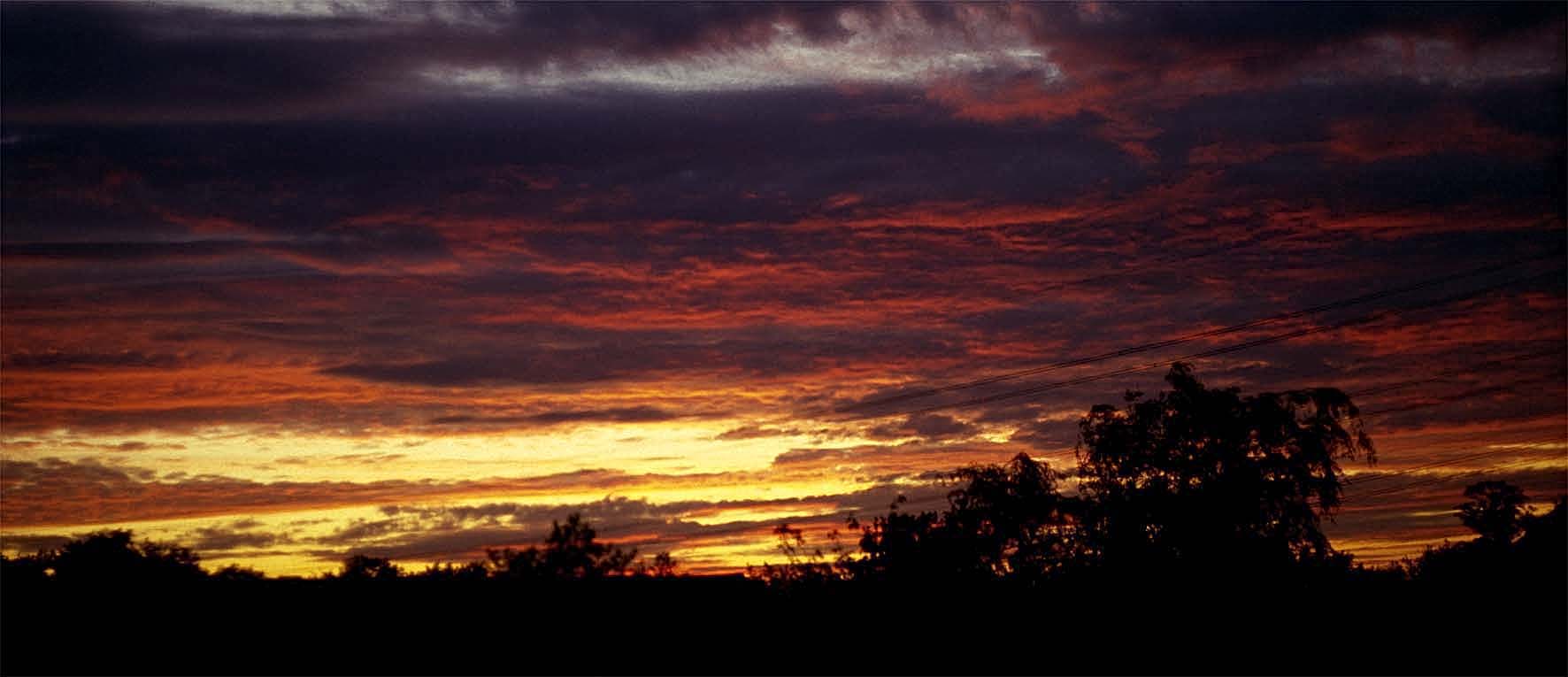
Suburban sunset Pentacon Six 80mm Biometar 1/60 f/2.8 Kodak Ektachrome Professional 100 |
| I mount slides in widescreen mounts which have the
standard Medium
Format external dimensions of 7cm × 7cm and thus can
be projected
with any “6×6” Medium Format projector. The image area
in the
mount is 24mm × 58mm, and the images from the Pentacon Six
are therefore
24mm high × 56mm wide (the full frame width of most “6×6”
cameras
– some have an actual format size of 54mm × 54mm).
This provides
a format ratio of 2.33:1, virtually the same as the Cinerama
format of
2.35:1. These mounts are available from The
Widescreen Centre in London.
The Hasselblad XPAN panoramic camera The XPAN is an excellent camera, but it is limited to three lenses only (all of them extremely expensive): 30mm, 45mm (“standard”) and 90mm. Lenses with these same focal lengths are available in the Pentacon Six mount. The XPAN has a slightly wider format, 65mm wide (× 24mm high), so it will give you a slightly wider angle of view than the Pentacon Six with lenses of the same focal length, but in real-life photography you are not likely to notice this difference, and you are likely to find that buying projectors for this format is difficult and also extremely expensive. Another advantage of using the Pentacon Six as a basis for panoramic images is that you have an enormous range of lenses at your disposal! The commonly-available 45mm lenses will give a horizontal angle of view of approximately 65°, which will be more than adequate for most occasions, and of course there are versions of this lens with a shift capability, if required. With the Pentacon Six, you are not limited to the focal lengths mentioned above! You can also shoot a panoramic-format image of a distant scene with a 180mm, 300mm, 500mm or even longer lens! Telephoto panoramics Some of my favourite panoramic shots were taken of lions that were not in cages, for which I used the 500mm Pentacon lens poking through the open (!) window of a stationary car. |
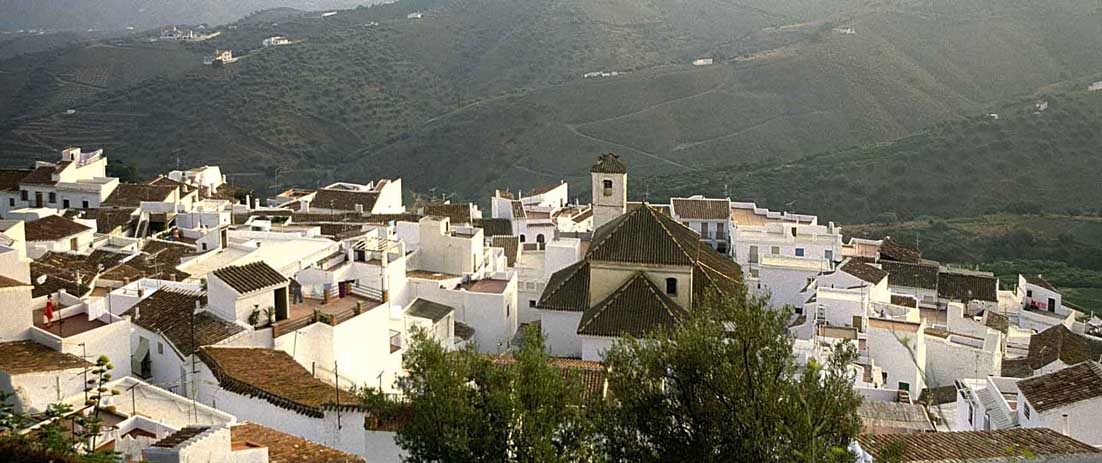
Spanish village Pentacon Six |
| Every lens can be
a shift lens!
It is also worth bearing in mind that as you can select
the image area
for the panoramic format from as high or as low as you
wish within the
56mm × 56mm area of the full frame, you have the
equivalent of
a very large amount of shift available to you with every
lens!
Instead of tilting the camera up to avoid a boring
foreground – and getting
converging verticals on buildings (the building appears to
be falling over
backwards!) – you can hold the camera straight, and later
crop out the
unwanted foreground from the print or slide. If this
does not give
enough height, use a wider lens or even an actual
shift lens
(see here). Where
else can you
get a shift lens for a panoramic camera?
(Answer, on some
Noblex cameras, but they have a single, fixed lens, and
introduce all the
distortions that arise with swing-lens cameras.)
|
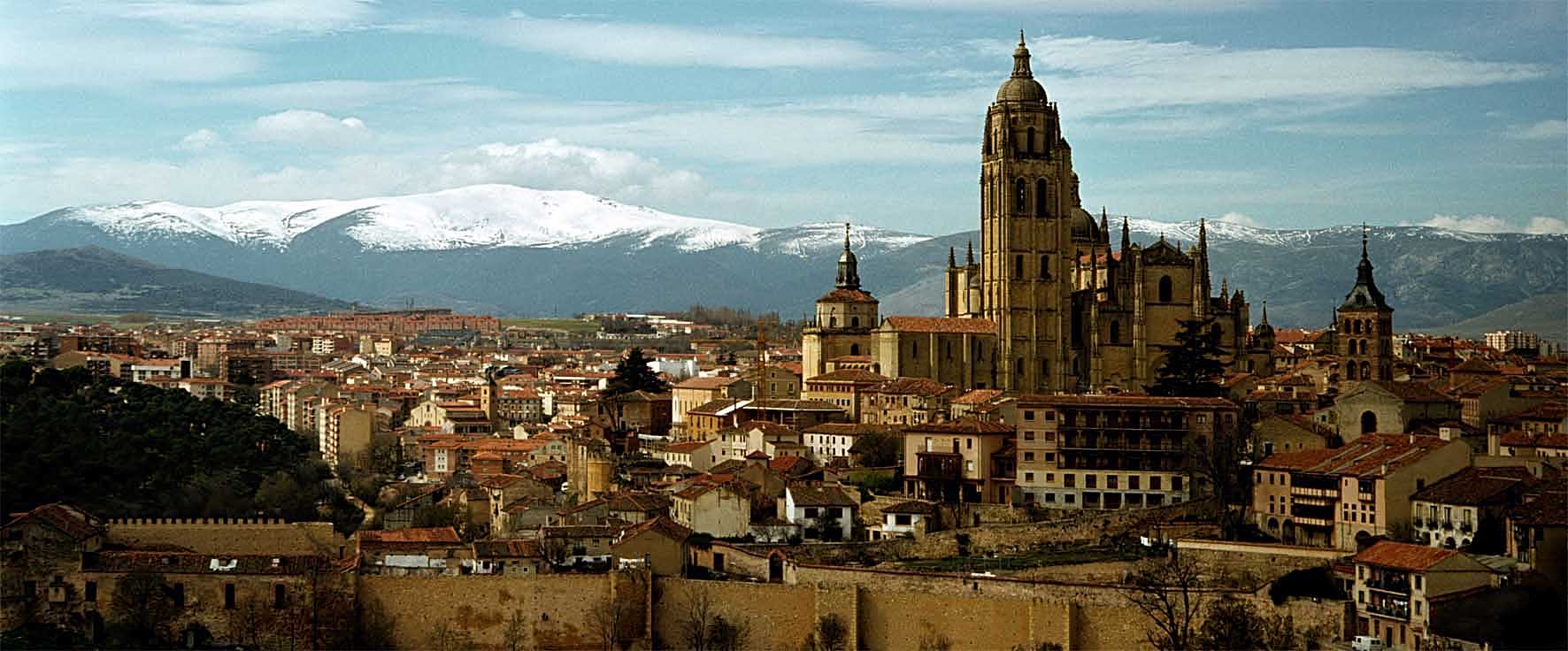
Segovia cathedral and town Pentacon Six 80mm Biometar 1/125 f/11 Agfa CT18 |
| Naturally, I also have a number of vertical panoramic pictures, although I don’t use this format for slides. You can see a vertical Pentacon Six shot here (at the bottom of the page), although it is not a panorama. |
On the possibilities of producing panoramic photographs by using
35mm film in the Pentacon Six, see here.
To go back to the Frequently-asked Questions front page, click here.
To contact me, click here.
© TRA March 2006, Latest revision: June 2026