Norita bodies bear no faceplate name, although on the back are
the words “NORITA KOGAKU MADE IN JAPAN”.
The two types of prism and the waist-level finder bear the logo
“NORITA” or (in the USA) “GRAFLEX NORITA”. However, boxes
and some literature bear the logo “NORITA 66” or “GRAFLEX NORITA
66”.
Pentacon Six or Norita?
One question I have been repeatedly asked is, “Should I buy a
Pentacon Six or a Norita?” In fact, I asked myself this
question in the 1970s.
How do these two camera systems compare?
The Norita was designed on the same principles as the
Pentacon Six: to be a 6 × 6 (2¼ square) Medium Format camera that
handled like a 35mm SLR. In fact, some would claim that it
was inspired by – or even copied from – the Pentacon Six and
Praktisix, which had first appeared about 13 years earlier
(Praktisix 1957, Norita, early 1970s). However, its
supporters would claim that the design of the Norita was an
improvement on the Pentacon Six. Let us compare them.
The bodies
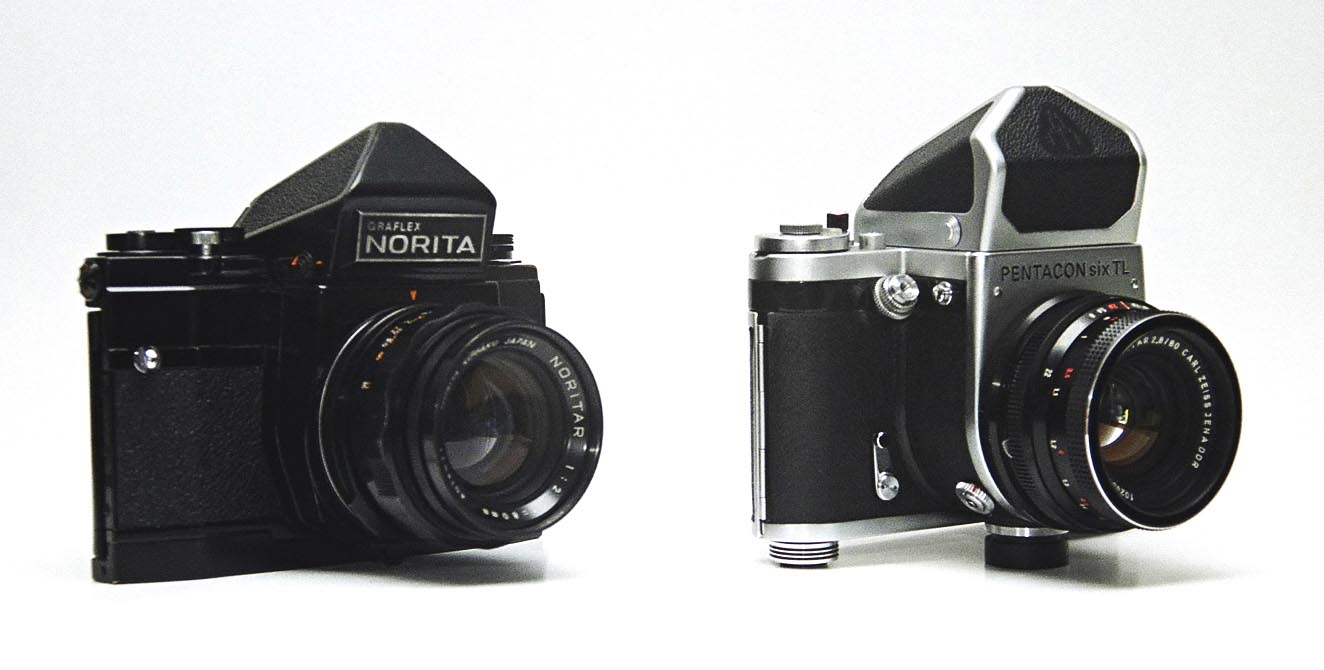
[C356-8]
The similarities between the Pentacon Six and the Norita
66 (marketed in the USA as “Graflex Norita”) are obvious
in this picture.
The shape of the plain prism seems closely inspired by
the Pentacon Six plain prism – although there are
constraints on the possible shape of any pentaprism!
Note the absence of a delayed-action lever on the
Norita.
The “third foot” that you can
see under the Pentacon Six in the photo to the
left here was supplied with the carrying
cradle for the Exakta 66. That can be
seen here: http://pentaconsix.com/cases.htm
This locking bolt is in fact a little too long
for the Pentacon Six, as the rubber covering
on the other two “feet” of the Exakta 66 makes
them thicker than the two spool retaining
knobs of the Pentacon Six (see item 14 here: http://pentaconsix.com/parts.htm).
A careful look at the photo here and lower
down on this page shows that the two spool
retaining knobs are not quite touching the
surface on which the camera is standing, and
there is a shadow under them.
Some people have found a suitable knob from
the top of a tripod or from a camera case that is not
needed. However, I am not aware
that Pentacon ever made an accessory expressly
designed for this function.
The Norita was originally marketed as the Rittreck (or Warner
Rittreck in the USA), but apart from a few cosmetic details
(difference of name plate, chrome instead of black standard lens),
this was essentially the same as the Norita. It was very
much in the style of the 1970s Japanese 35mm SLRs, and included
some improvements on the Praktisix/Pentacon Six:
Unusually for Medium Format SLRs at the time, it had an
instant-return mirror (even the Hasselblad didn’t have that!).
The advance lever protruded beyond the back of the top plate,
and was easier to operate than on the Praktisix and Pentacon Six
– BUT the big minus was that it didn’t advance the film
in one swing; it had to be advanced approximately 1½ times!
There were, however, a couple of other minus points:
The Praktisix and the Pentacon Six had a top speed of 1/1000
sec. The Norita had a top speed of 1/500 sec.
The Norita’s all-black body was considered by some more
stylish than the chrome and black finish of the Praktisix and
the later Pentacon Six. However, the black paint soon wore
off the corners and base plate, and most Noritas available now
suffer from severe “brassing” of the corners.
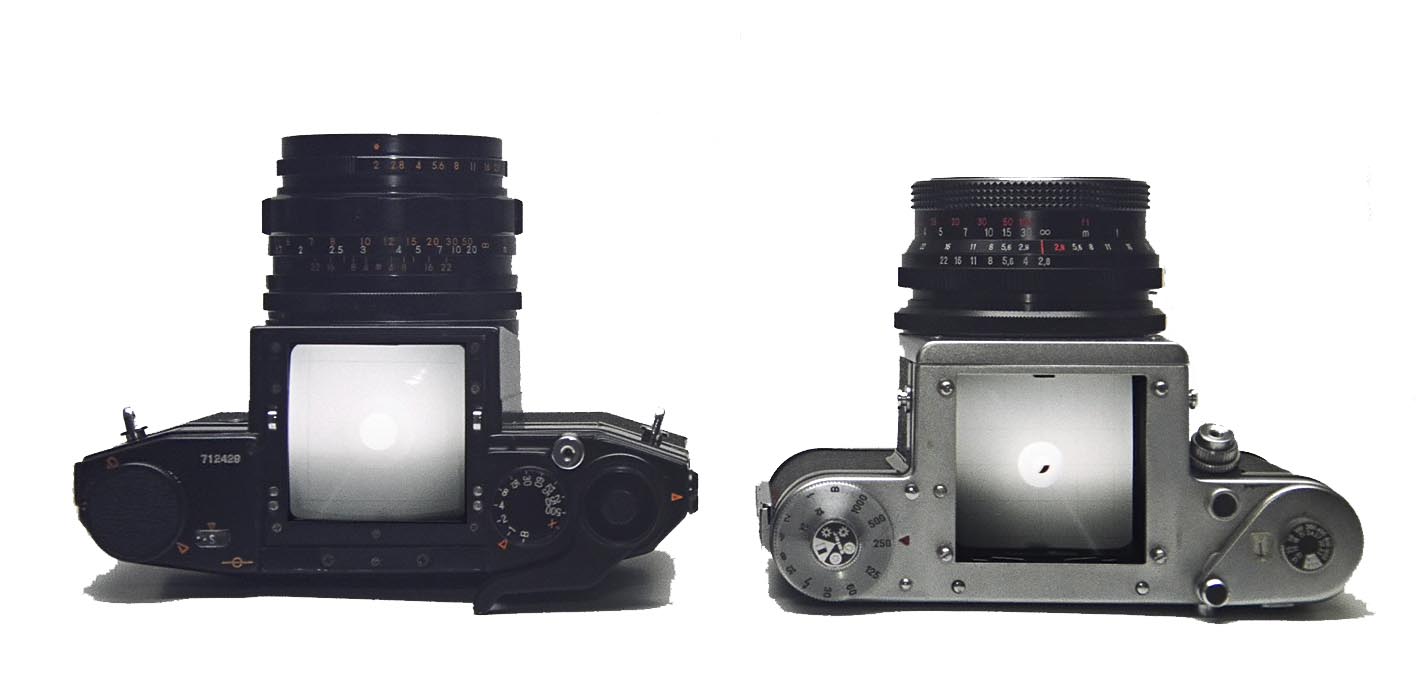
[C356-10]
The top plate of the Norita follows very much the layout
standard on 35mm SLRs at the time.
One innovation in the Norita: the orange triangle at
the right-hand end of the top plate points to a dial on
the side that enables the user to engage a
double-exposure facility, so that it is possible to cock
the shutter without advancing the film.
To operate this correctly, it is also necessary to move
a lever at the other end of the top plate, so that the
counter doesn’t advance. The user must remember to
return both controls to the Normal position after use!
The viewfinders
Most Noritas seem to have been sold with a non-metering prism,
although by the late 1970s (approximately ten years later than for
the Pentacon Six TL!) a metering prism appeared.
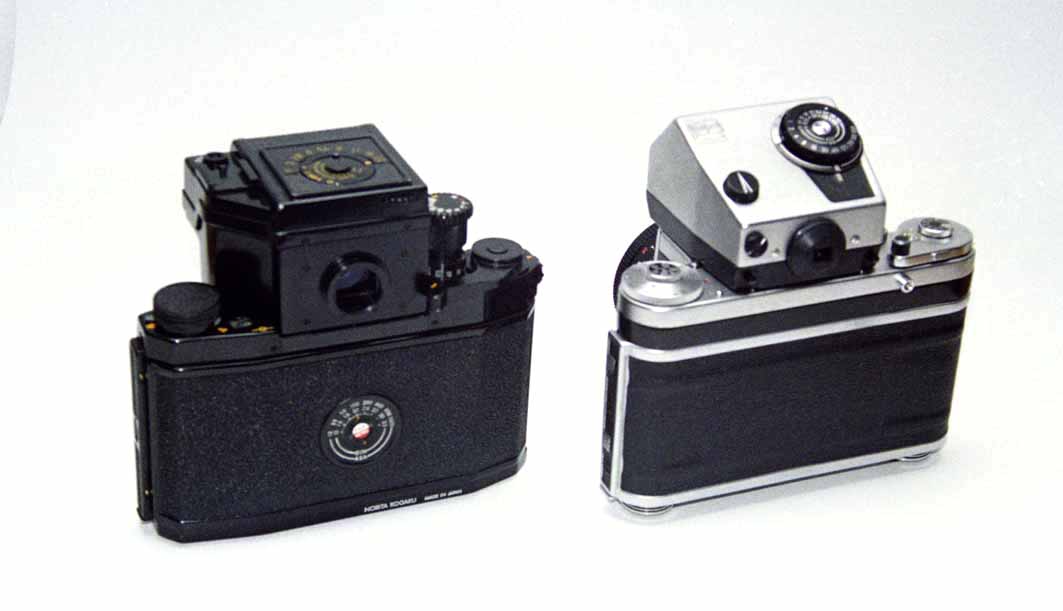
[C356-35]
This had one major advantage, compared to the Pentacon Six, and
three disadvantages.
The advantage was that it was coupled to the shutter speed
control of the camera (but not to the aperture of the lenses!).
The disadvantages were:
It could not be mounted on the camera without having the
camera’s shutter speed knob changed – a job for a professional
camera repair person familiar with Noritas and in possession of
the appropriate spare part!
The metering prism was extremely bulky and heavy, adding
substantially to the size and weight of the camera.
The front of the ever-ready case could not be used with the
metering prism in place.
[C356-37: Especially from behind, the Norita 66 with metering
prism looks enormous compared with the Pentacon Six.
It also weighs a lot more!]
The lenses
The good news was:
The standard 80mm lens had a maximum aperture of f/2,
unheard-of for a lens on a Medium Format camera at the time.
There was a quite compact 40mm ultra wide-angle lens for the
system.
The bad news was:
The range of lenses was extremely limited. The Norita never
really took off in the market place, and, up until January 2016 I
was only aware of just one lens produced by a third-party
manufacturer in the Norita mount: Zoomar’s 170 – 320mm f/4
lens. Apart from this, users were restricted to the limited
range produced by Norita Kogaku of Japan. The following lenses
were offered by them:
Focal Length
Aperture Range
Elements / Groups
Closest Focus
Filter Size
Weight
40mm
f/4 – f/22
9 / 8
1 ft (0.3m)
77mm × 0.75
22.5 oz (640g)
55mm
f/4 – f/22
9 / 9
1.5 ft (0.45m)
62mm × 0.75
13.75 oz (390g)
80mm
f/2 – f/22
6 / 4
3 ft (0.85m)
62mm × 0.75
15.5 oz (440g)
160mm
f/4 – f/22
6 / 5
7 ft (2m)
62mm × 0.75
23 oz (650g)
240mm
f/4 – f/22
6 / 5
12 ft (3.5m)
77mm × 0.75
40.5 oz (1150g)
400mm
f/4.5 – f/22
6 / 7
21 ft (6m)
95mm × 0.75
80 oz (2300g)
The 400mm lens was advertised by a German supplier in 1975/6 but
is not listed in most Norita literature that I have, although I
have found reference to it in a recently-acquired brochure.
In June 2006 one of these lenses was sold on eBay for US$966.56
(approx EUR 750.00) – not within the price range of most amateurs
for a rarely-used lens (unless one specialises in wildlife
photography or various types of sports photography). Another
one of these lenses was sold on eBay in February 2010 for US$799
(approx Eur 584.45 or GBP510.74).
In addition, a very interesting special lens was produced for the
Norita 66: a 70mm lens with built-in leaf shutter. This
enabled flash sync at all speeds. Details are as follows:
Focal Length
Aperture Range
Elements / Groups
Closest Focus
Filter Size
Weight
70mm
f/3.5 – f/22
7 / 5
2.7 ft (0.8m)
77m × 0.75
34 oz (980g)
For all other lenses, the X setting on the shutter speed dial is
selected. This provides a nominal 1/40 sec sync,
fractionally faster than on the Praktisix and Pentacon Six.
At the time that I was looking at the Norita (mid-to-late 1970s),
none of the lenses was multi-coated. However, Selmar Meents
in Holland e-mailed me in December 2005 saying:
“I have owned two multicoated 40mm lenses for the Norita
66. These lenses were marked as such and the focusing ring
was covered with diamond grid rubber as opposed to the
metal focusing rings of the single coated version.
“Other owners have reported that they owned MC 240mm and
MC 55mm lenses. These lenses were probably made in small
numbers at the end of the production period of the Norita
66 system and are very rare.”
In fact, in 2006 I acquired a 160mm Noritar that is labelled “MC”
and has the same type of diamond grid rubber focussing ring. I
have also seen a picture of an 80mm Noritar MC, which therefore
accounts for all of the lenses other than the 70mm leaf-shutter lens
and the rare 400mm lens.
The British photographic journal “Amateur Photographer” reviewed
the Norita with standard lens and plain prism in its issue dated
27th October 1971, and reviewed the 40mm, 55mm, 160mm and 240mm
lenses the following week (3rd November 1971). While it went
out of its way to welcome the system and be positive where
possible, it is clear that many of the lenses produced images that
were not very sharp, especially at the larger apertures, and
revealed problems with flare.
Lenses from other
manufacturers
Two reasons contributed to there being very few lenses from other
manufacturers offered for the Norita/Rittreck:
lenses for Medium Format systems have often been limited to
those produced by or for the manufacturer of the camera in
question
this camera was available on the market for a relatively short
period of time, compared with some other Medium Format cameras,
which were often marketed for a decade or even decades with few
or even no changes.
Kilfitt
However, that remarkable lens manufacturer, Kilfitt of Munich
(which subsequently became the Zoomar company), did offer a Norita
mount for at least some of its Medium Format lenses.
I am grateful to John, who told me in January 2016:
“There
are at least 4 very rare Zoomar lenses with Norita
mounts and/or Killfit Zoomar adapters.
2 – Zoomar 250/4 mirror lens
– can be adapted to Norita
3 – Zoomar 500/5.6 mirror lens
–which you picture in your Pentacon Six reviews [here] – a Norita adapter
exists
4 – Zoomar 1,000/8 mirror lens – I
own this lens in C mount + a Norita adapter.”
Thank you, John!
In December 2016 I heard from Jonathan, who told me:
“I
just wanted you to know that in addition to the other
Kilar lenses your friend told you about, I also had a
90mm Macro-Kilar in Norita mount. Maybe it was spelled
Makro-Kilar, I can't remember. I think it was F2.8. It
focused from infinity to 1:1 with multiple telescoping
helical tubes to get there. Aperture was totally
manual. I didn't use it much because it wasn't very
sharp, even stopped down.
My wife and I
really loved the two bodies and six Noritar lenses. We
shot a lot of weddings with them, and some of my favorite
photos from the 1970s and 1980s were taken with them.”
Thank you, Jonathan, for this interesting information.
Visitors to this page can read a review of the
Macro-Kilar/Makro-Kilar (on a Pentacon Six, naturally!) here.
In April 2017 John sent me some more information:
“I just acquired a Graflec Norita brochure listing the standard40, 55, 70, 80,
160, and 240mm Noritar lenses.
In addition - Accessory lenses available for Graflex Norita cameras - called Graflex/Zoomar:
90mm, f/2.8 Super Macro-Kilar
f/2.8 - f/32 closest focus 5 1/2" 300mm, f/4 Pan-Tele-Kilar Pano
f/4 - f/32 closest focus 5 1/2' 300mm, f/4 Pan-Tele-Kilar Panso — with focusing leverf/4 - f/32 closest focus 4 1/2' 500mm, f/5.6 Sport Reflector — with focusing lever
f/5.6 closest focus 18' 1000mm, f/8 Sport Reflector — with focusing lever
f/8 closest focus 30’
Other Accessories listed:
Waist Level finder Auto extension tubes (set of 3) - for Noritar 40mm to Zoomar 300mm Pentaprism with Meter Graflex Norita Copy Stand
Corrective Diopters (availability to be announced) Microscope Attachment w/o shutter (availability to be announced) Microscope Attachment with shutter (availability to be announced)
In this brochure Graflex offered a two year warranty on all cameras,
lenses, and accessories from date of purchase.”
John, thank you for this further information. The lenses here
called Graflex/Zoomar were previously sold under the name
Kilfitt. Kilfitt provided camera mounts for a wide range of
cameras, so it is clear that a mount for Norita cameras was
produced. The one mount would apparently have fitted onto the
mount base of all these lenses, which in most cases would have been
a WE base, although many of these lenses were previously
produced with the AN base. I have updated my
introduction to Kilfitt lenses, with information on the
interchangeable camera mounts. See that here. Patrice-Hervé Pont’s
book, which is referred to there, reports (p. 49) that the mount for
Norita/Rittreck cameras had the code WERI.
Like most lenses designed in the 1950s or early 1960s, most if not
all Kilfitt lenses designed for Medium Format cameras do not have
any sort of auto-aperture mechanism, and this is the case with the
170-320mm Zoomar, which is reviewed with a Praktisix/Pentacon Six
mount here. Naturally, mirror
lenses cannot be stopped down anyway. Of course, in the 1950s
and 1960s most Medium Format cameras did not have any mechanism to
stop down lenses, so there just was not a need for lens
manufacturers to incorporate any sort of auto-aperture
mechanism. In fact, the Praktisix was one of the first
Medium Format SLRs with a mechanism to stop down the aperture of
the lens automatically.
Novoflex
The Novoflex lenses for Medium
Format cameras were available for many medium format cameras
with focal plane shutters. See the report on these
lenses, in the Praktisix/Pentacon Six mount, starting here. These lenses
consisted principally of two components: a focussing mount
which was known as the "PIGRIFF" and the two Medium Format
Noflexar lens heads, the 240mm and the 500mm, which needed
to be inserted into the PIGRIFF. In February 2016
Martin Grahl, who is the Sales Manager at Novoflex, wrote to
tell me that "The PIGRIFF 6×6 was
available only briefly with the Norita breech lock bayonet mount
in the mid 1970s".
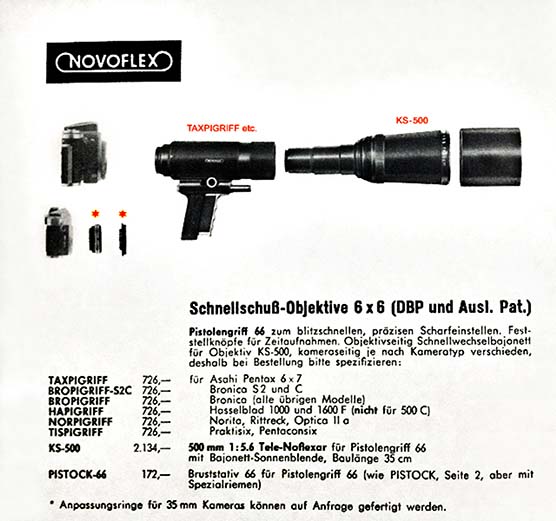
Here is a copy of the relevant
page of the Novoflex price list from 1975, which Martin
e-mailed to me:
[nov75pl.jpg]
Thank you, Martin, for this information!
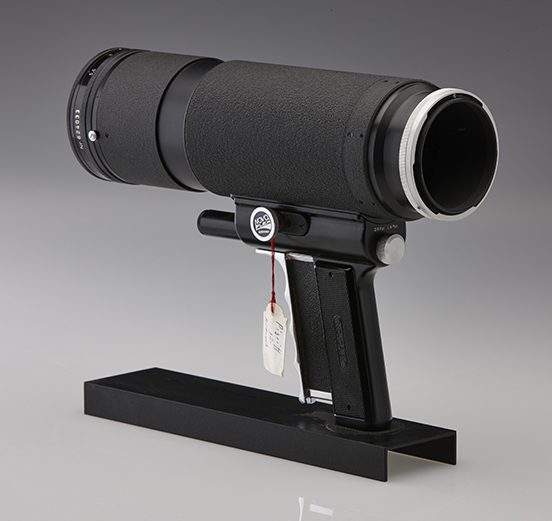
And here is a rear view of the
PIGRIFF, clearly showing the Norita mount!
[novnormnt.jpg]
The PIGRIFF here has the 240mm lens head in place.
It is here mounted on a display stand.
This superb picture was taken in 2016 by the Novoflex staff
photographer.
Reproduced by permission.
The
accessories
Very few accessories were ever produced for the Norita. I
am only aware of the following:
A waist-level finder, occasionally supplied with the camera
A magnifying hood
A set of extension tubes
A flash shoe for the standard prism
A carrying cradle, which was quite a clumsy contraption that
was needed with earlier Noritas, which did not have strap lugs
An ever-ready case (which is, however, fouled by the strap
lugs on the later cameras, and cannot be fitted to the camera
without being cut!)
In a Norita brochure I have recently seen
a right-angle finder
two microscope attachments, one with a Copal shutter, and the
other without a shutter.
However, I have never seen any of these three items for sale, and
conclude that at best they must be extremely rare. They may
even enter into the category of items that were advertised but never
entered serial production, not uncommon with camera manufacturers,
as will be clear from other parts of this website!
There were no bellows (unless someone can prove me wrong, and I
have been looking for years!)
There were no 2× converters, additional focussing aids or other
accessories.
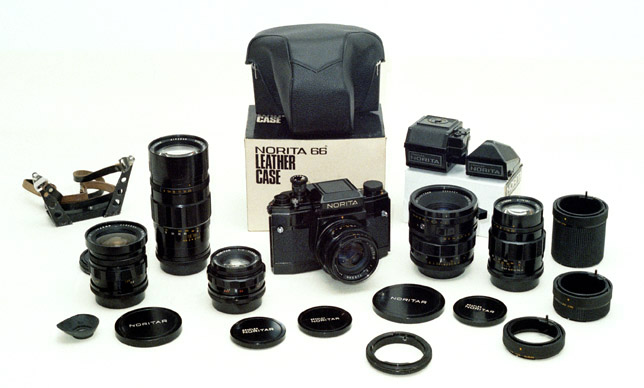
[C418-29A] A comprehensive Norita outfit:
At the back: the ever-ready case (which won’t fit the camera because
of the strap lugs!) and to its right the metering and non-metering
prisms
In the next row: the rather awkward carrying cradle, the 240mm lens,
a Norita body with standard lens and the rare waist-level finder in
place, with the extended shutter speed dial for the metering prism
protruding up above everything. Then comes the 70mm
leaf-shutter lens, followed by the 160mm lens, and on the right the
set of 3 auto extension tubes.
Next row: the 40mm lens in front of the carrying cradle, and the
55mm lens between the 240 and the body, then various lens caps.
The “mystery ring” in front of the largest lens cap is described on
the next page, here.
Virtually nothing is missing from this shot: just the super-rare and
hyper-expensive 400mm lens, some lens shades and the extremely rare
microscope adapters.
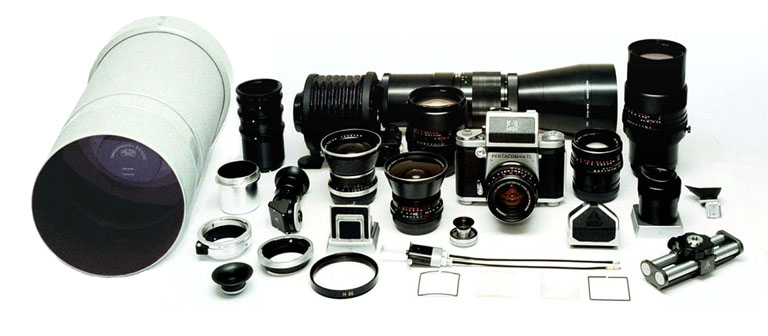
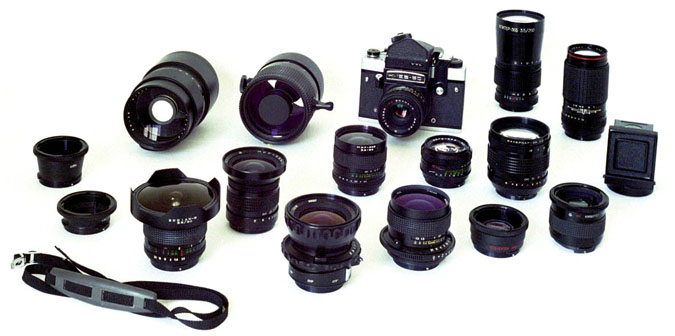
For variety of lenses and accessories, this outfit does not
compare well with the outfits on offer from:
Pentacon
Pentacon Six outfit
[C311_1w1000.jpg]
Arsenal
Kiev 60 outfit
[C373-27Anew.jpg]
Exakta
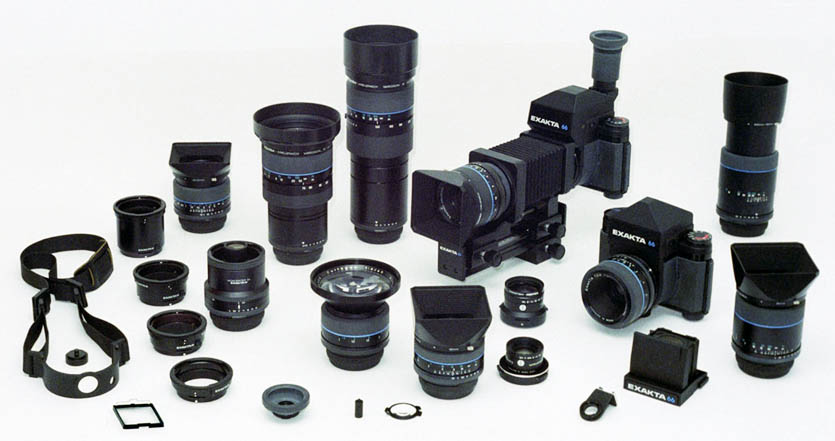
Exakta 66 outfit
[C373-19Anew.jpg]
In fact, the comparison is overly favourable to the Norita, since
a non-Norita item is included in the Norita outfit shot, and
various items are missing from the photos of the other three
outfits: Cases, lens caps and lens hoods (shades) from the
Pentacon Six and Kiev 60 outfits, plus specialised focussing
screens for the Pentacon Six. More focussing screens were
available for the Exakta 66, plus more macro lenses and the
elusive tilt-shift Super-Angulon. What’s more, of course,
the lenses and most of the accessories from each of these three
systems can also be mounted on the other two cameras! Of
course, the Exakta 66 was not available in the 1970s when I took
my decision, and little was known about the Kiev 60 in the West,
but the Pentacon Six outfit with its lenses from Carl Zeiss Jena,
Meyer-Optik and many other manufacturers was readily available.
Most important, there was always a niggling doubt about the
design and the quality of the Norita range. In my limited
experience, this appears to have some basis in fact. A few
years ago I bought the Norita extension tubes. For some
strange reason, however the three tubes are combined, there are
gaps in the range – certain magnifications that are just not
possible, no matter how much you adjust the focussing ring of the
lens. This is just carelessness at the design stage.
Further, the aperture pin in Norita lenses moves sideways, as
with some other cameras, but unlike the in-out movement of the pin
on Pentacon Six lenses. In order to transfer this sideways
motion with the tubes, the designers have resorted to a
double-tube construction, with an inner tube and and outer
tube. Firstly, this makes the tubes extremely heavy.
The three Norita tubes weigh 545 grams or 1lb 3¼ oz, while
the four Pentacon Six tubes weigh little more than half
this, at 330 grams or 11½ oz.
Secondly, the inner and outer tubes are in contact at many points,
which results in friction when the inner tube is called upon to
rotate and stop down the lens diaphragm. Ball-bearings
between the inner and outer tubes are designed to minimise
friction, but I found the movement was not smooth, and do not
doubt that on many occasions the lens will not have stopped down
to the desired aperture by the time the shutter fires.
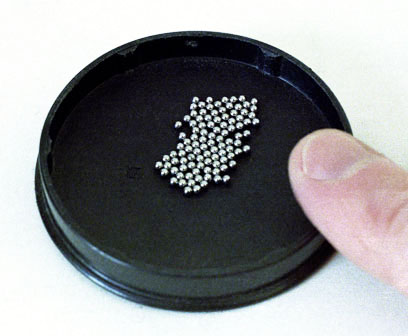
Worse, even though the tubes appeared new and unused, one day
when I was trying them out, there was a grating noise, and all the
ball-bearings fell out of one of the tubes, which is now
useless! I shall have to see if my repairer is prepared to
take a look at it. In contrast, the Pentacon Six tube design
is simple and light-weight. Above all, it just works without
problems, year after year.
The ball bearings from a Norita close-up tube
[C418_37A.jpg]
Update, July 2008
My regular Pentacon Six technician, Tom Page, agreed to have a
look at the faulty Norita tubes. He was not impressed with
the design. Only one ball race in each of the tubes, even
the longest one, means that movement is not as smooth as it should
be. After lubricating and replacing the ball bearings, he
sealed the locking ring, aiming to make it tight enough to prevent
the ball bearings getting out again, but not so tight that it
would slow down the rotation of the inner tube that stops down the
aperture. Long-term reliability does not appear likely with
this design.
Rittreck/Warner 66
Differences from Norita/Graflex Norita
John, who wrote to me in January 2016, also gave me the following
information:
“I
would point out the superiority of the
Rittreck/Warner designs over the later
Norita/Graflex Norita:
1- Earlier cameras both had mirror lockup while the
later versions did not.
2 - The chrome trim on the earlier versions totally
prevents the wear to the black finish of the later
models.
3 - An adapter maker continues to tell me that he
will produce an adapter allowing the use of Pentacon
mount lenses on the Rittreck/Warner/Norita.
I shoot Rittreck and Warner cameras, but practically
never the later editions.”
Thank you again, John!
My decision
I took the decision to go for the Pentacon Six in 1977 for the
following reasons:
It was available, both new and second-hand in the UK.
The Norita was not available new and was extremely difficult
to find second-hand.
I wanted a top shutter speed of 1/1000 sec.
I was impressed by the range of lenses and accessories
available for the system.
The Norita lenses did not seem to be up to the standard of
the Carl Zeiss Jena lenses available for the Pentacon Six.
I have not regretted that decision since, and what we know now
confirms that it was right (for me and many other users, at least):
The Pentacon Six continued to be available new until 1990,
whereas the Norita disappeared by the end of the 1970s.
A more sophisticated successor to the Pentacon Six – the
Exakta 66 – appeared in the mid 1980s, and continued to be
available new until about 2000.
The Pentacon Six proved so popular and successful in many
countries, that the mount was adopted by other manufacturers,
first Arsenal in Kiev, then Hartblei and others who modified
Kiev 88 cameras to take Pentacon Six lenses.
A range of manufacturers produced a much wider range of
lenses in the Pentacon Six mount – including zooms and even
shift and tilt lenses at accessible prices!
In contrast, practically no MC (multi-coated) lenses are
available in Norita mount – it had virtually ceased production
before this advance in lens coating was developed.
Pentacon Six mount cameras and lenses are still available new
today!
The Norita was clearly inspired by the Praktisix/Pentacon Six.
It did not succeed, in my opinion, because people who wanted a
Medium Format SLR in enlarged 35mm style, but didn’t want to buy a
product from communist East Germany, went for an alternative
Japanese model: the Pentax 6×7. Why didn’t I?
To see a brief overview of the Pentax 6×7, compared to the
Pentacon Six, click the following link. Pentax 6×7
To see more information on the “mystery ring” in the Norita
outfit picture, click here.
To return to the section on the pentaprisms, click here.
To return to the Frequently-asked Questions, click here.
To go back to the introduction to the cameras, click here.
To return to the interview with the author, click here.