by TRA
Pentacon Six Lenses
The
Kilfitt Pan-Tele Kilar
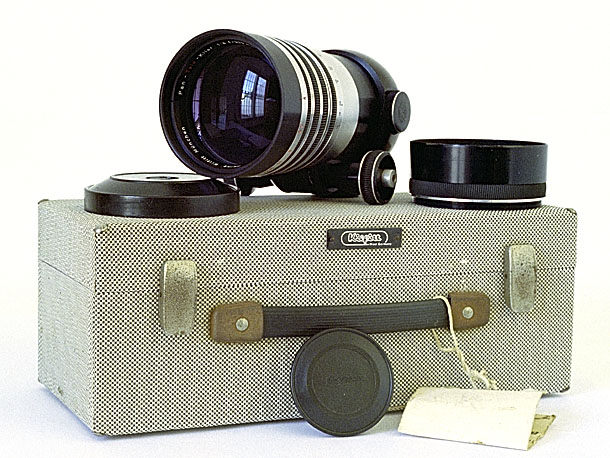
The 300mm f/4 Kilfitt Pan-Tele Kilar lens with caps,
lens hood and case
[C475_10A.jpg]
The small, specialist company of Heinz Kilfitt manufactured a range of lenses in Munich, (then) West Germany from at least the 1950s to the 1970s. They were available in a wide range of mounts including Medium Format and 35mm cameras, as well as for movie cameras, and were very highly esteemed. The Pan-Tele Kilar was designed with exceptional features. It therefore merits – even requires! – a much more detailed description than would be expected for a normal lens.
Description of
the Pan-Tele Kilar
| The Kilfitt 300mm Pan-Tele-Kilar
is an f/4 lens that was supplied with a
removable lens shade, front and rear caps and a
mount for the camera of one’s choice in a sturdy
wooden case that included a test negative that
had been shot in the factory on a glass plate,
as film was not considered to be reliably flat
enough for testing purposes.
The lens has a manual pre-set aperture that stops down to f/32 with a détente (click) at each full stop. After having chosen your aperture, you can swing the aperture ring to return to full aperture for focussing and composition, and then swing it back down to the pre-selected aperture without needing to take your eye away from the viewfinder. A sturdy ring clasps the lens near the back and has sockets for ¼" and 3/8" tripod screws. This ring is lockable, but can also be slackened off in order to rotate the camera, if the tripod or the ground in which it is standing is not quite level. When my Pentacon Six is mounted on the lens, the combination is perfectly balanced on the base-plate of this ring. Nice attention to detail.
|
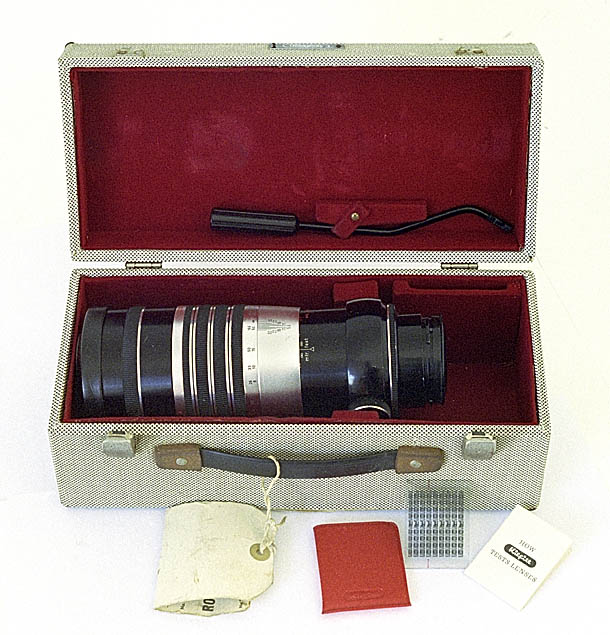 Note glass plate with test shots, plastic pocket for this and the slot in the case to hold it and the explanatory leaflet. In the top of the case can be seen the focussing lever, which is described below. [C475_35A.jpg] |
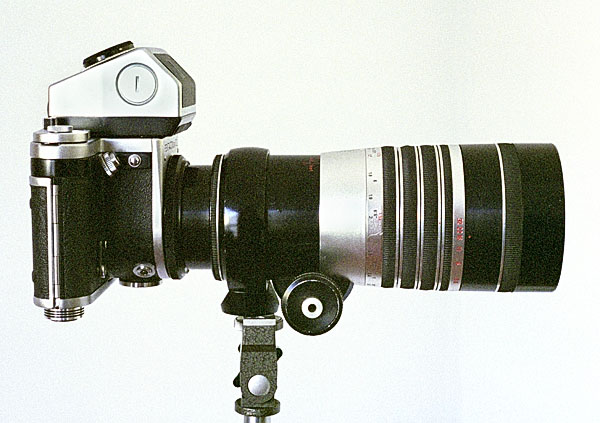
Normal focussing is via either of two wheels mounted near the back of the lens. These move the front of the lens straight forward, without rotating it, and permit focus from infinity down to 9'6" (2.8m), shown on an engraved scale that is painted white. This is known as rack focussing.
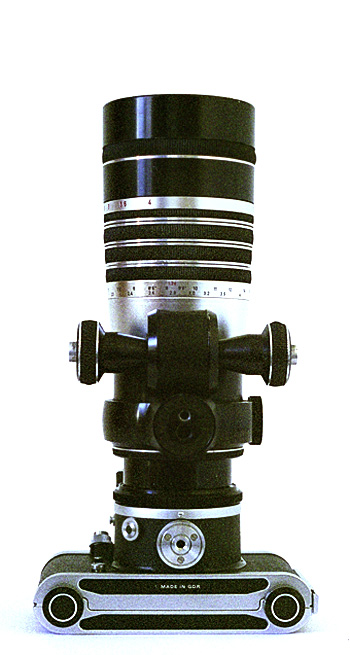 [C475_3A.jpg] View of the underside of the lens, showing the tripod screw sockets and the two focussing wheels. |
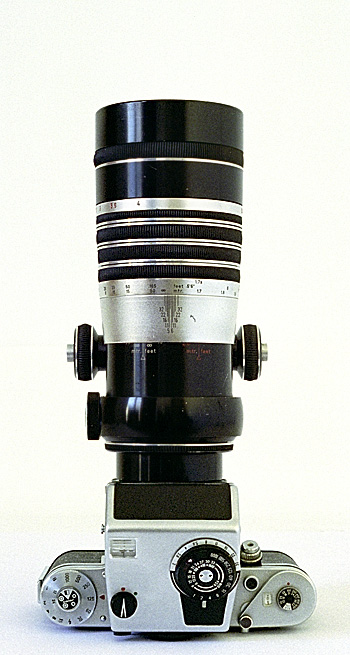 [C475_7A.jpg] Top view. Infinity focus |
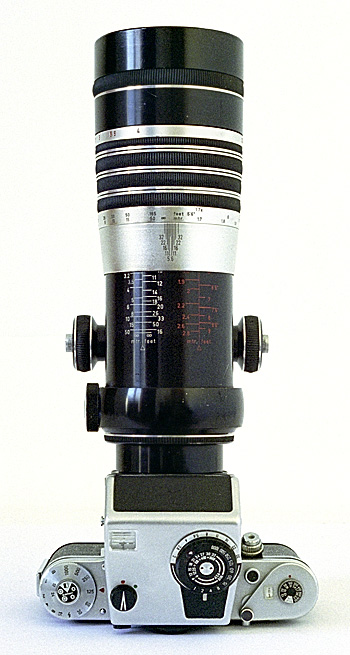 [C475_6A.jpg] Top view. Lens fully racked forward by focussing wheel (helical at minimum) |
| In itself, this is already very
close for a 300mm lens. Other lenses of
this focal length for Medium Format cameras
typically focus down to 4m (e.g., Zeiss Sonnar),
3.6m (Meyer-Görlitz/Pentacon) or at most 3m
(“Soviet” Tair).
But the Pan-Tele-Kilar does not stop there; then the Heinz Kilfitt magic begins! You can now rotate the front section of the lens – just as you would when focussing with most other modern lenses for Medium Format and smaller cameras, using a helical (rotating) focussing action. This brings the minimum focus down to approx 5'8" (approx 1.7m). |
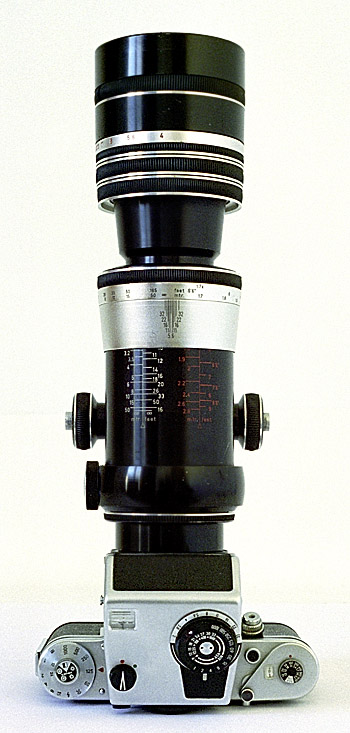 Maximum lens extension, both rack & helical [C475_5A.jpg] |
If you know that you are going
to be working close-up, you can reverse the
procedure: leave the focussing wheels on
infinity and wind out the front of the lens (the
helical focussing) to its maximum extension
(minimum focussing distance). This, too,
will set the focus at 9'6" (2.8m). Then
turn one of the focussing wheels to bring your
subject into focus. When working this way,
the focussing distance is read from a separate red
scale on the lens barrel.
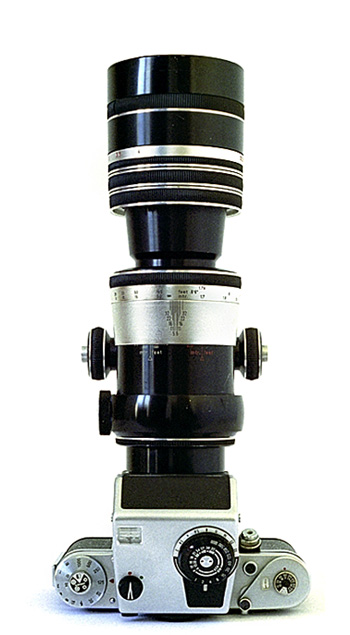 Helical focus at maximum extension, rack at minimum: ideal for precise adjustments of focus in close-up photography [C475_8A.jpg] |
In other words, with the Pan-Tele Kilar use the white scale when the helical focussing is fully in and the red scale when it is fully out.
At maximum extension of both the rack and
helical focussing controls, the subject is a mere 56"
(1423mm) from the front of the lens shade – incredibly
close for a lens of this focal length. My 24"
computer screen more than fills the frame of my Pentacon
Six at this distance.
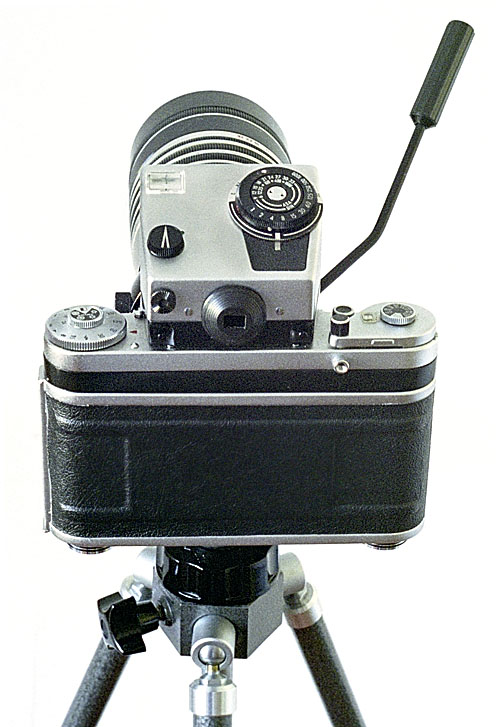
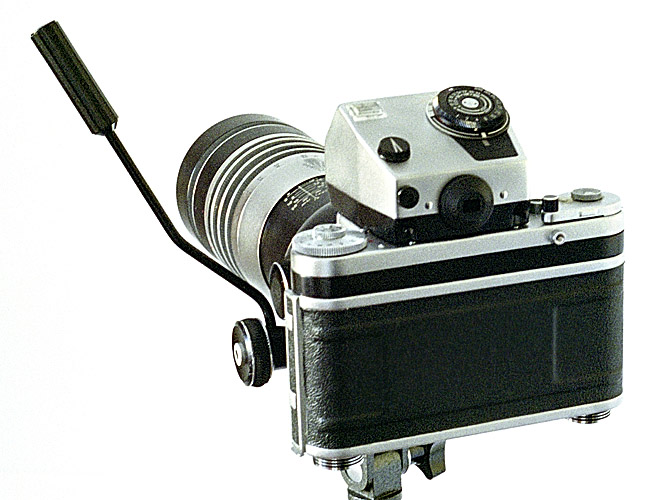
| When new, the lens was supplied
with a focussing lever that could be clipped
into either of the focussing wheels, although on
most occasions these days when this lens comes
up for sale, the lever appears to have been lost
– or perhaps it has just been missed out by
someone who does not know the lens or realise
that the lever is part of it. The length
of the lever results in easy, precise,
finger-tip control of exact focus.
|
 ... and on the right-hand one [C475_32A.jpg] |
Given the extreme degree of extension that is possible, for speediest operation through-the lens stop-down metering is recommended, as it will be necessary to increase exposure to compensate for maximum extension, as with any lens that is extended this far from the camera. If TTL stop-down metering is not available, the user can be guided by the exposure factors marked on the focussing distance scale printed on the barrel: at 9'6" / 2.8 m, increase exposure by 1.3×, at 6'6" / 2m by 1.5× and at the closest focussing distance of approx 5'8" / 1.7m increase exposure by 1.7×.
Field of view
Any 300mm lens will give a magnification
factor of 3.75 in comparison with the standard Medium
Format 80mm lens. Used on a 35mm camera, the
factor is even greater: 6× compared with a standard
focal length of 50mm. Here are some examples of
what this looks like, taken on a Pentacon Six, of
course.
|
|
|
|
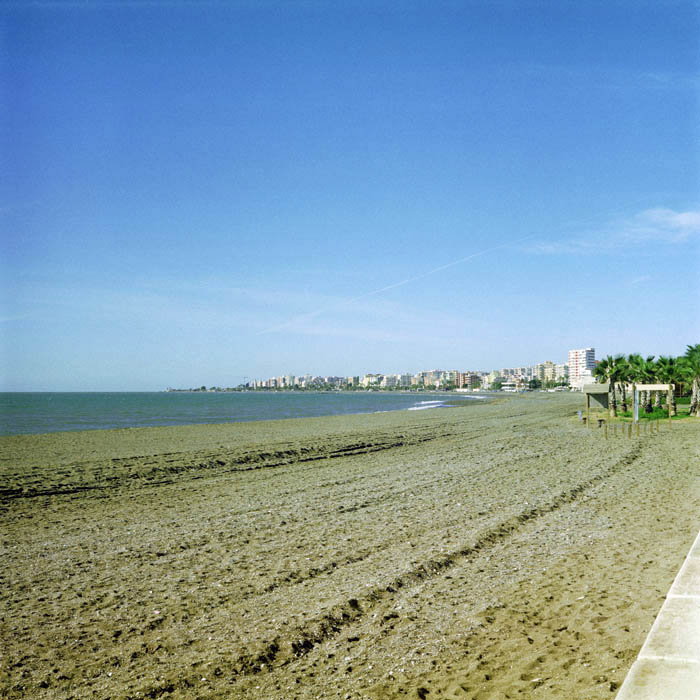 Fujicolor PRO 160 1/250 f/11 Infinity focus [C476_16.jpg] |
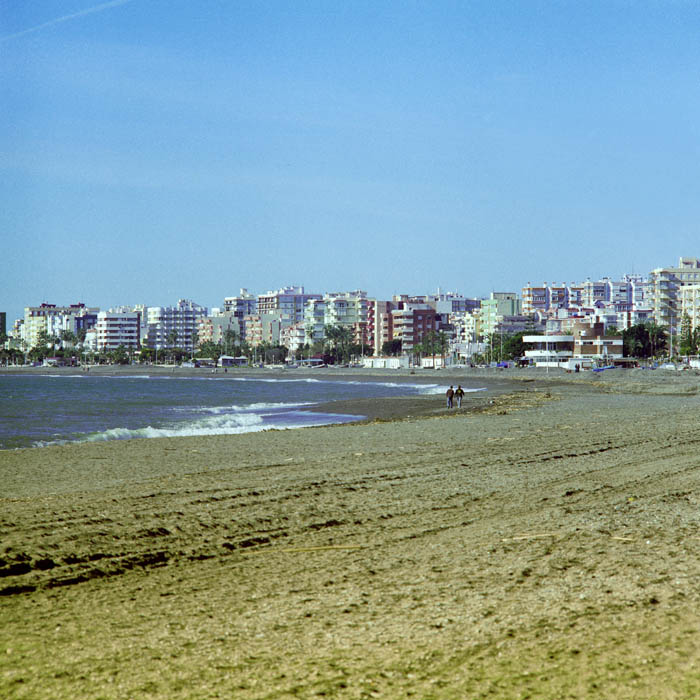 Fujicolor PRO 160 1/250 f/11 Infinity focus, from same position as previous image Variations of colour are due to processing in the scanner and computer. [C476_14.jpg] |
|
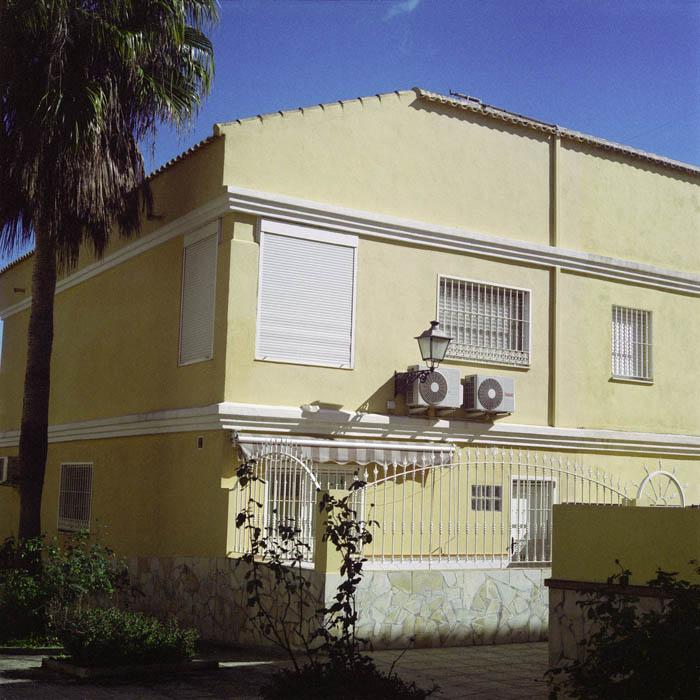 Fujicolor PRO 160 1/250 f/16 Focussed on approx 15m/50 feet [C476_10.jpg] |
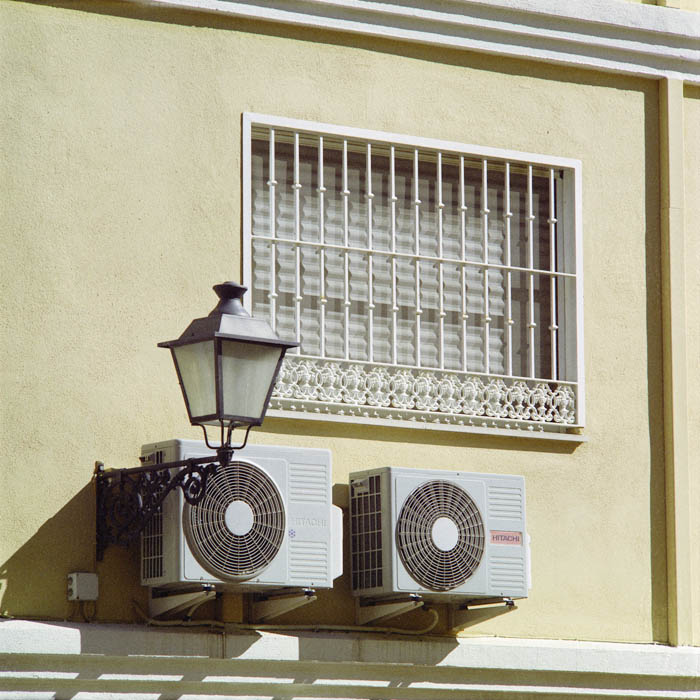 Fujicolor PRO 160 1/250 /16 Focussed on approx 15m/50 feet, from same position as previous image [C476_11_12.jpg] |
Panchromatic correction
The name ring on the front of the lens includes a symbol consisting of three rings side by side. On the lens that I have, by the light of my study, they appear to be blue, red and yellow in colour. I think that in fact they are cyan, magenta and yellow, the so-called “subtractive” primary colours. This was Kilfitt’s symbol to indicate that the lens had been corrected at the design stage to reduce chromatic aberrations to an absolute minimum. Hence the lens was a “panchromatic” lens, thus the title Pan-Tele Kilar. Let us see how it performs in reality.
Results
Here is a more than 10× enlargement from
a small section of each of the above two Pan-Tele Kilar
images. (A small amount of sharpening has been
applied to these two enlargements only, to compensate
for the softening introduced by the scanner.)
 A 300mm lens brings the image in much closer. This Pan-Tele Kilar shot reveals a remarkable degree of detail. [C476_14_crop.jpg] |
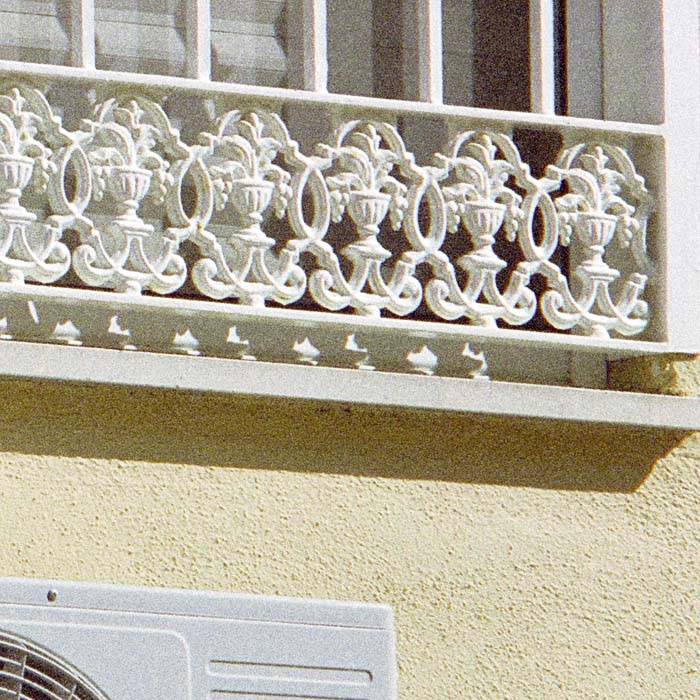 Resolution is exceptional. The vertical bars reveal a tiny amount of chromatic aberration that would not be visible at normal degrees of enlargement and viewing distances. [C476_11_12_crop.jpg] |
Users of this lens praise its quality, both mechanically and optically. In his review for www.shutterbug.net of a later version of this lens, Roger W Hicks, writing in 2003, asks “Is it the Acme Of German Engineering?” and answers by saying, “it is unparalleled for rapid focus adjustments” ... “it is a staggeringly desirable lens for medium format” ... “no one would make a lens of this mechanical quality today: and if they did, no one could afford to buy it. At a guess, you couldn’t build it to sell for much less than $5000.” ... “It doesn’t have Leitz or Zeiss engraved on it, but it is rarer and (dare I say it) better made than many things that do bear those desirable logos.” (See http://www.shutterbug.net/equipmentreviews/classic_historical/0703sb_classic/)
Closest focus
At closest focus, the special qualities
that distinguish the Pan-Tele Kilar from other 300mm
lenses are clearly seen. With the image on the
left, as I had decided to use the lens at its closest
focus, I mounted it onto the focussing slide (German:
“Einstellschlitten”), to allow precise adjustment of
focus. For the second shot, I had not packed the
focussing slide in my bag at day, but with care was able
to move the tripod to the exact position.
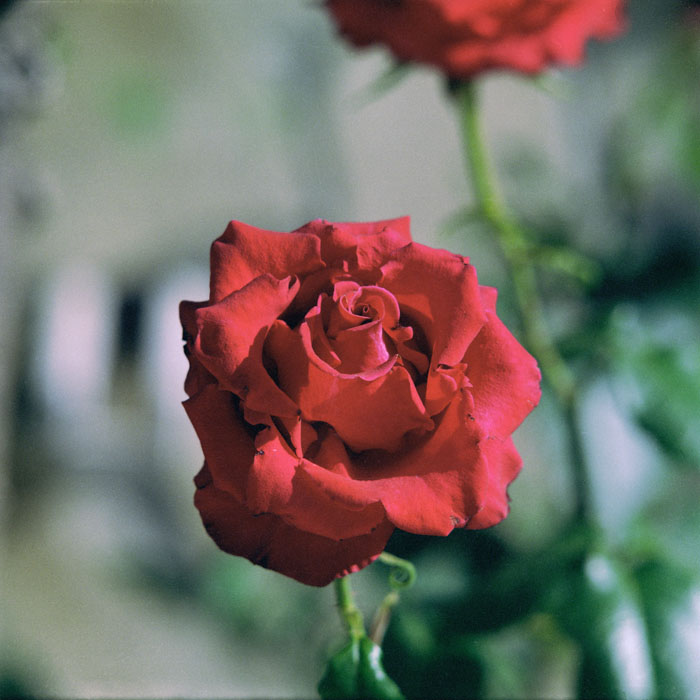 This rose was past its best when I photographed it, but it does serve to show the field of view covered by the Pan-Tele Kilar at its closest focussing distance. Equipment used: Tripod, focussing slide Fuji Superia 100 1/250 f/8 Shot in a light wind! Pentacon Six TTL meter reading at working aperture. [C477_7.jpg] |
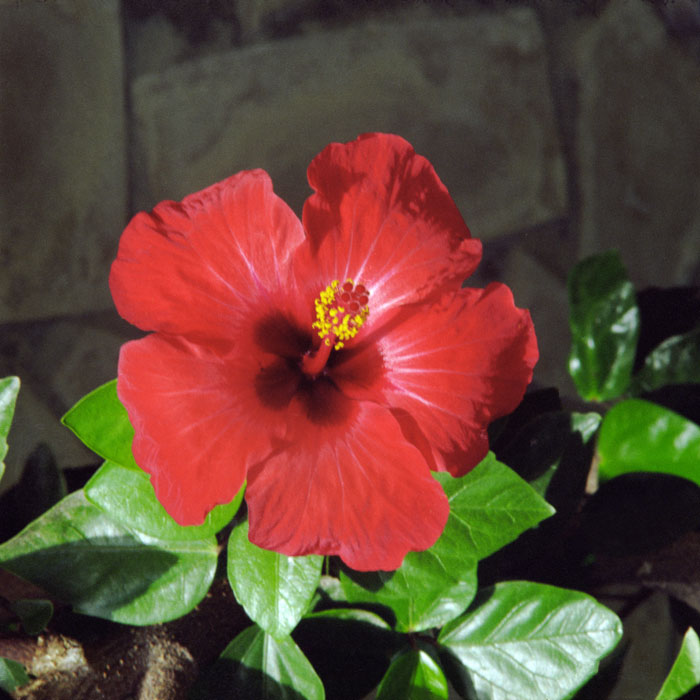 Closest focus. Equipment used: tripod. Fuji Superia 100 A wind-free day enabled me to shoot at 1/4 sec, f/32 Lunasix reflective reading, no compensation for lens extension. If I had been shooting slide film, I would not have got away with this. [C477_19.jpg] |
|
The recommended retail price of the Pan-Tele-Kilar in West Germany in October 1959 and in July 1966 can be seen here. (Look for West Germany, 1959 and 1966, and then see the right-hand column.) Conclusion The Pan-Tele Kilar is an
outstanding lens for macro work. It is
also outstanding for any other telephoto work,
especially when tripod-mounted, which is the
only time that using the focussing lever is a
practical option. For information on using the
Pan-Tele Kilar with the Kilfitt Multi-Kilar lens
converter, and results obtained with this
combination, see here.
|
|
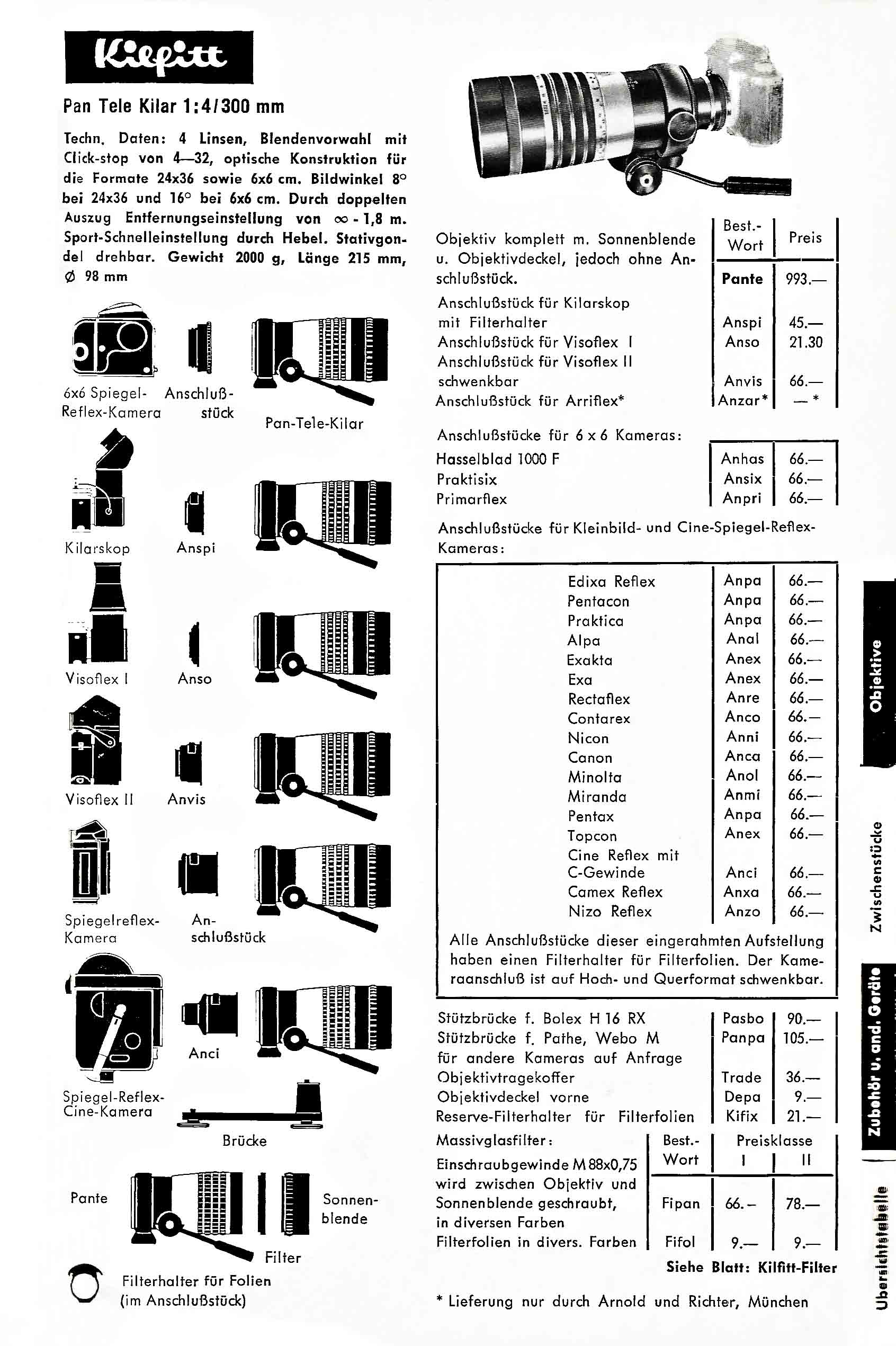 [61_Kat_PANTEs.jpg]
|
Next section: The Three Versions of the Pan-Tele Kilar
To go on to the next lens test
section, click below.
Next section
(500-560mm)
To go to the beginning of the lens tests section, click here.
To go to back to the data on Kilfitt lenses, click here.
To choose other options, click below.
Home
© TRA September 2010, Latest revision:
February 2022