The Pentacon Six System
by TRA

Lens Data Summary

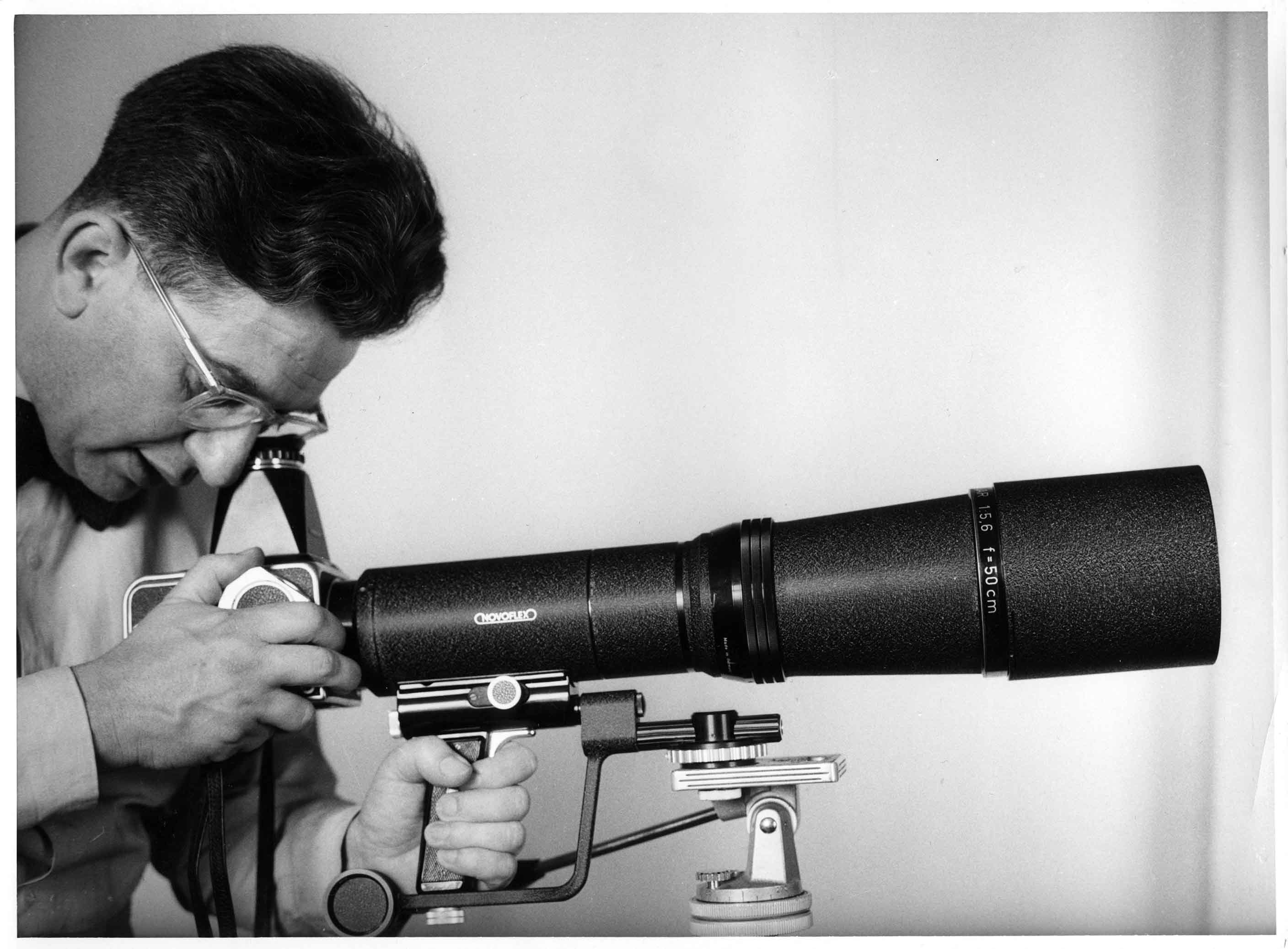
Review of the 500mm Tele-Novoflexar Lens


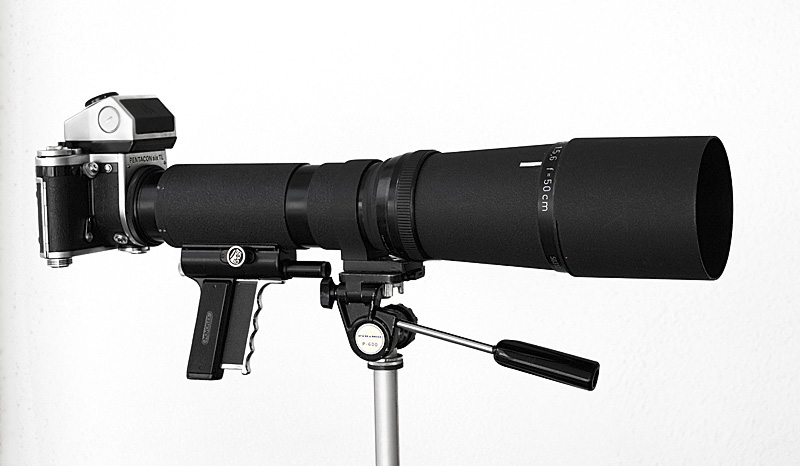
The Tele-Novoflexar mounted on a tripod.
Note that I have had to use the tripod platform back-to-front,
in order to prevent the tripod pan and tilt lever from fouling the Novoflex pistol grip.
[novo500.jpg]

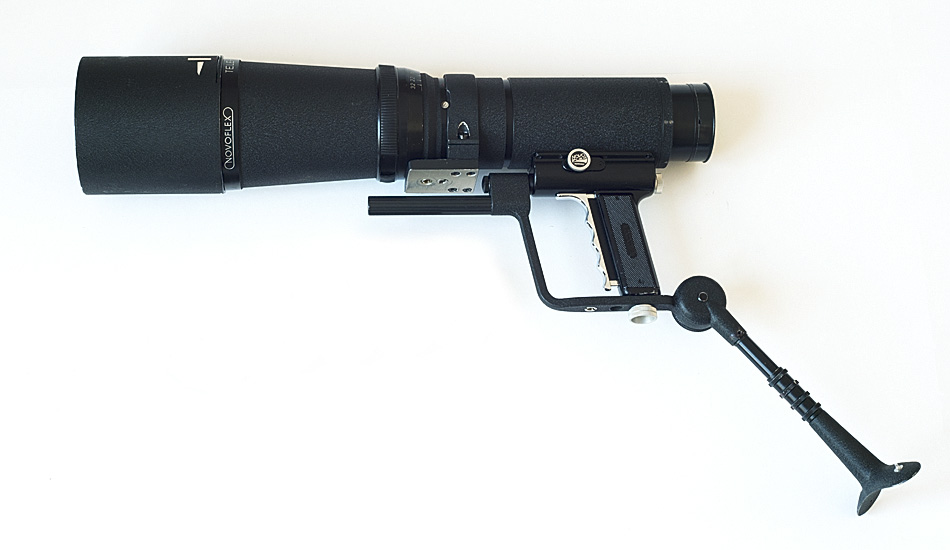
The Tele-Novoflexar is supplied with a lens hood with a bayonet mount that enables it to be put in place extremely quckly and easily.  It is a long, straight tube, and is mounted onto the lens in reverse position for storage.  A screw-in metal front lens cap is also provided.  A standard plastic rear cap covers the back of the lens.

Aperture control

This is manual aperture lens: there is no auto diaphragm stop-down operation, nor even a “pre-set” lock, in contrast to the pre-set lenses from Meyer-Optik and some other manufacturers; however, there are détentes at each full stop position, so you do not need to be looking at the aperture ring; you just count the clicks to stop down:

In fact, the aperture ring will click one more position beyond the minimum marked aperture of f/32.  This corresponds to approximately half an aperture stop (giving an aperture of f/38).  The next full aperture position would have been f/45 (which would have transmitted half the light of aperture f/32).

Focussing

Having squeezed the focussing trigger to achieve the desired focus, you can lock it in place with the other hand, using a locking knob which is situated on each side of the lens to enable operation with either hand.  Then you need to stop down and then fire the shutter.  With three things to do and only two hands, you can choose which two are critical in the particular shooting situation:

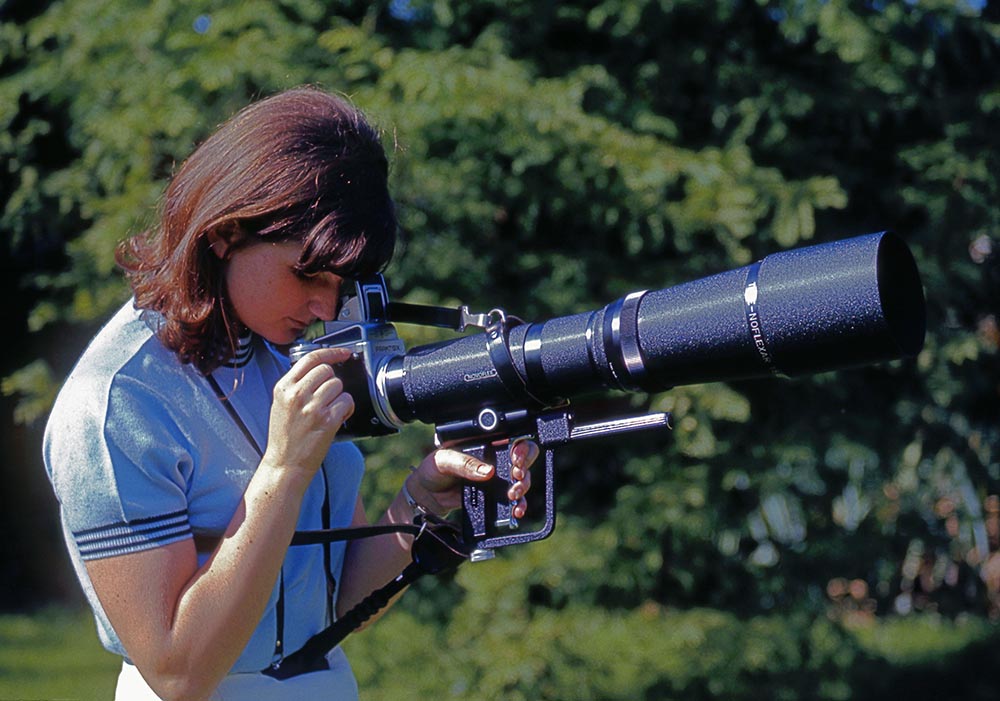
Of course, especially with the 500mm lens hand-held you would be advised to use a shutter speed of at least 1/500 sec and – depending on the sensitivity of the film and the prevailing lighting conditions – you might need to work at maximum aperture, in which case you only have two things to do, and operation is easy and fast.  You can easily adjust the focus constantly as required and fire the shutter at the decisive moment.

As stated in the review for the 240mm Novoflexar, focussing with the pistol grip is much faster and easier than by rotating the grip on a standard focussing helical ring, as is found on most lenses, and can be continuously varied as required when tracking a moving object such as a bird or other wild life – or even a footballer or players in other sports, cyclists, car or horse races, etc.  For all of these subjects, and many others, the 500mm Tele-Novoflexar is ideal.

Changing lens heads


The lens head is released from the pistol grip by pushing the little arrowed button forward
and then rotating the lens anti-clockwise about 1/6 of a turn to remove it from the bayonet mount inside the pistol grip.
[11122215.jpg]


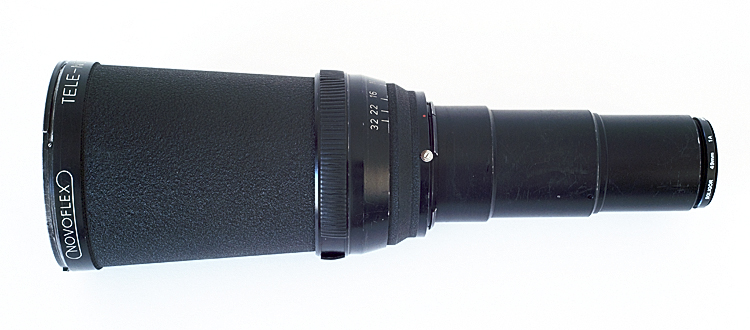
The 500mm Tele-Novoflexar lens head with a 49mm UV filter fitted at the back.
[11122212.jpg]

If swapping the two lens heads, it will be necessary to re-focus, even if the lens pistol grip has been locked onto infinity with the previous lens.

Durability

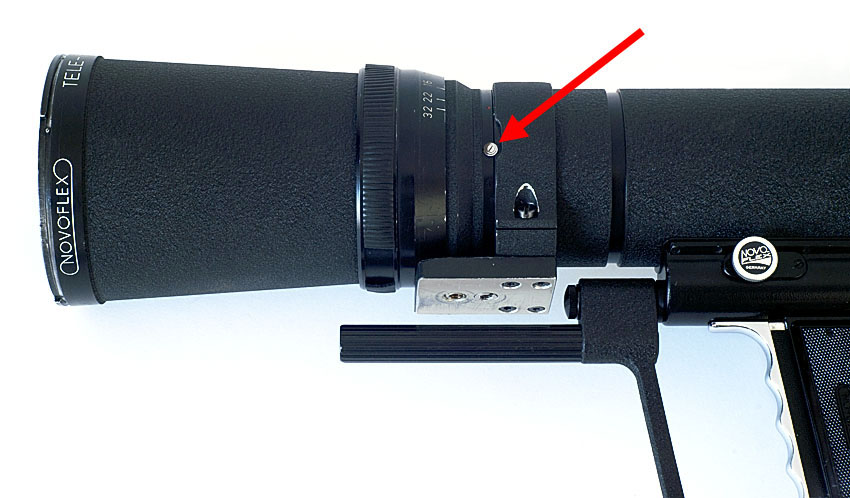
Some 50 or more years after manufacture, the lens is optically as good as new, as are the aperture blades.  The metal parts of the lens barrel also show minimal signs of wear - an indication of the quality of manufacture and the care taken by the previous owner(s).  However, the rubber ring that is recessed into (and extends above) the aperture control ring is beginning to perish in some places, as may be visible in the above two photos.  (Look at the underside of the lens, where there is a missing section of rubber, and one end is coming away.)  Fortunately, it is possible to obtain suitable replacement material for this, but I wanted you to see the original before I changed it.

Minimum focus

A possible defect in some situations is the limited minimum focus.  I have measured the minimum focus with the 500mm head and the standard rifle stock at 12580mm, measured from the focal plane of the Pentacon Six.  That is over 12½ meters or a little over 41 feet!  Gillespie gives the distance as being 38' 9", which probably comes from Novoflex literature.  That will be fine if you are at one goal mouth shooting the action at the other goal, or of course in many wildlife or celebrity shoots.  However, it is not a lens designed for use indoors.

With the 240mm minimum focus is a much more normal 2895mm (nearly 2.9 meters) / 9½ ft.

For both lens heads, the minimum focus can be reduced (i.e., you can get closer to the subject) by replacing the short tube that connects the pistol grip to the camera with the special bellows which were offered by Novoflex but are rarely seen in the Pentacon Six mount.  The bellows have the manufacturer’s code “TISBIG-U” and Dieter Gabler states in his “Vollendete Spiegelreflex-Fotografie mit Novoflex” (1973 edition) that the pistol grip (code name “TISPIGRIFF”) has to be returned to Novoflex for this to be fitted (p.77).  In fact, it appears that all you need to do is to loosen six screws (technically, tiny bolts) to remove the camera mount, then tighten the same screws onto the front of the bellows unit.  As an alternative, one could purchase the grip itself with the bellows already mounted onto it.  This had the manufacturer's code name “TISPIGRIFF-U”.  This appears to be equally rare in the 21st century.

The shoulder/chest rifle stock
 
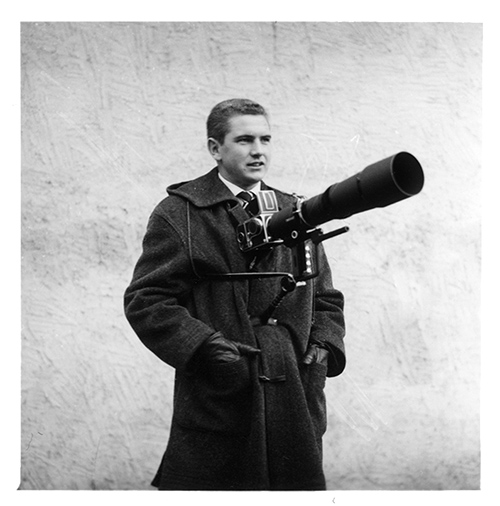
For hand-held operation there is a very impressive chest or shoulder support (called “PISTOCK-66” by Novoflex).  The rear section, which has been folded down to an approximately 45° position in this photograph, can be locked at any suitable angle. When pressed against the chest, it can held at a suitable height by placing round one’s neck a leather strap that connects to eyelets at the back of the stock but that is not attached from this photo.

By rotating the butt of the stock and raising it to approximately horizontal position, it can be pressed against the front of the shoulder, without the need for a strap.

It will be clear that the front grip/support tube on the rifle stock prevents the tripod plate on the lens barrel from being used, but in practice one will presumably either use a tripod or use the rifle stock, so this should not be a problem.  If one wants to have both available, it is easy to unscrew and remove the grip/support tube in order to use the tripod plate.

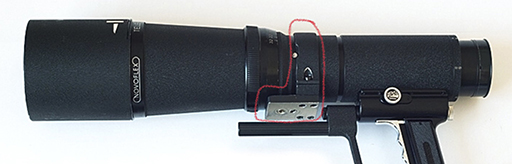
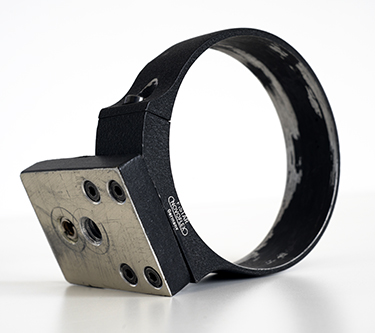
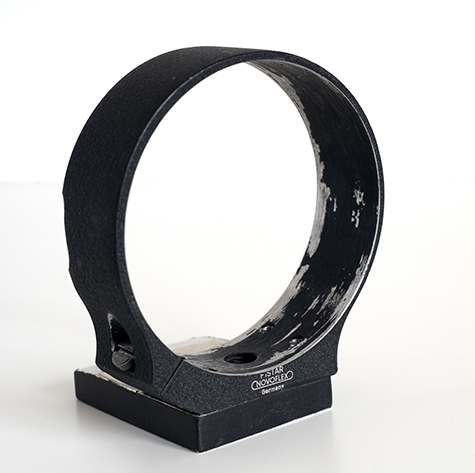
Alternatively, should one wish to retain the grip/support tube in place for rapid hand-held use, one can rotate the tripod plate on the lens through 90° and shoot on the tripod with the lens on its side, which is not a problem when working with a square-format image.  A large flat-ended screwdriver will be required to slacken off and then re-tighten the tripod plate collar.  When rotating the collar, it can be moved slightly back in order to clear the lens head release button.


[novostok.jpg]

As a further alternative, there is a small tripod socket on the base of the rifle stock (visible in the above image), although this is quite near to the bolt that locks the stock to the base of the focussing grip, which may make it difficult to use the mounting platform on the top of some tripods, if this platform is quite large.

In the book referred to above, Dieter Gabler explains (p.36) that what I have called the “grip/support tube” is designed to enable one to rest the outfit on a convenient fence, wall, branch, etc.  The design of the tube enables the lens to be moved backwards and forwards both without scratching the lens and without preventing rotation of the aperture ring or movement of the large front section of the lens as focus is changed. (p.37)  It is a component of the “PISTOCK”, but if lost (or presumably damaged), it was possible (at least, in the 1970s!) to order a replacement without the need to replace the whole rifle stock.

 
Size and weight

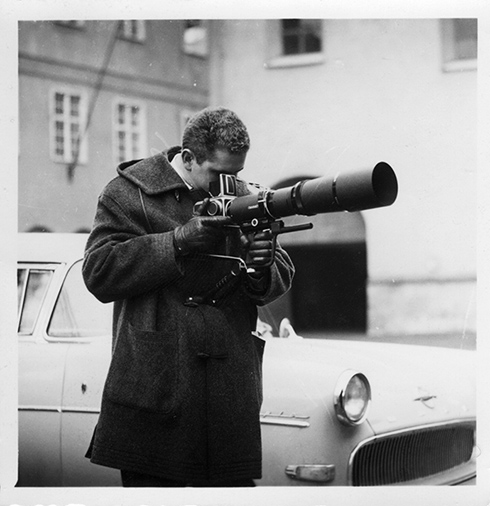
The Tele-Novoflexar is a very large and heavy lens, especially if we add the rifle stock.  However, professional sports and wildlife photographers, and others, found over many years that it was precisely this rifle stock that enabled them to shoot sharp pictures hand-held with this 500mm lens, without blur due to camera movement, while having total control over focus throughout guaranteed an in-focus image even in the most difficult situations.


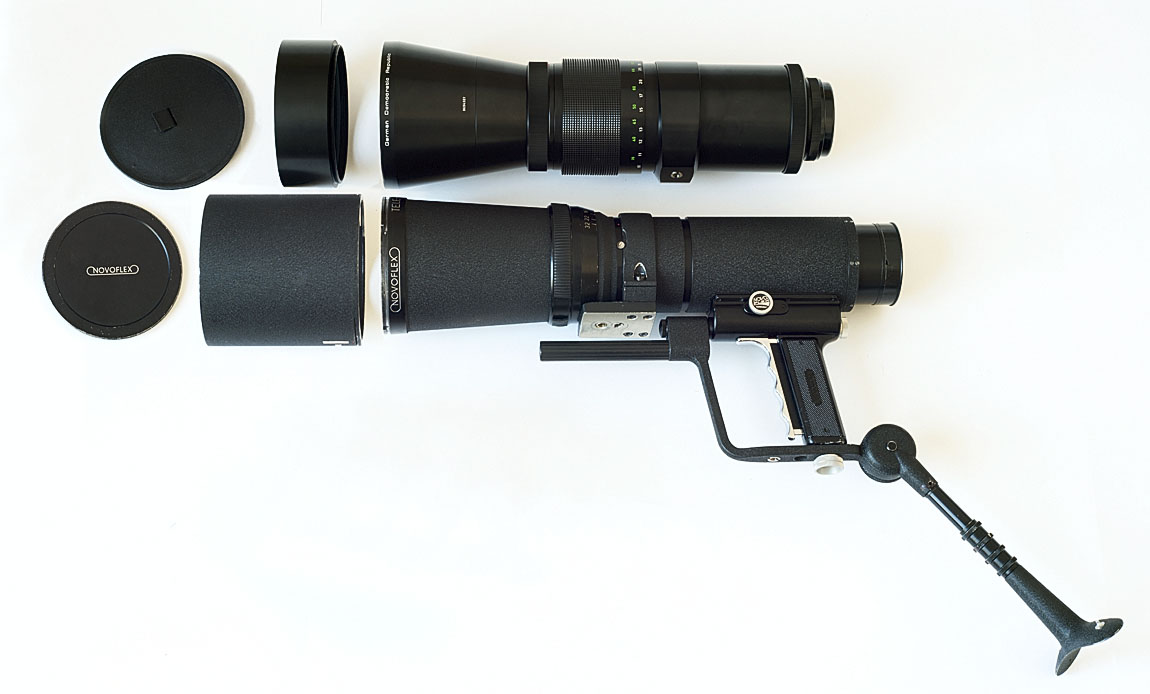
Comparison of 500mm Tele-Novoflexar with 500mm Pentacon lens, both focussed at infinity.
There is scarely any difference in the lengths of the two lenses, although the Tele-Novoflexar has a much longer - and therefore more effective - lens hood.
[11122206inf.jpg]

The Performance

[results of tests]

To be completed

To go back to the review of the 240mm Novoflexar, click here.

To return to the overview of Novoflex lenses, click here.

To go on to the next section, click below.
Next section (Shift & Tilt lenses)

To go back to the beginning of the Lens Data section, click below and then choose the range of lenses that you want to read about.
Back to beginning of the Lens Data section

Home

© TRA  January 2012, revised April 2012