by TRA
Lens Data Summary
Enna-München
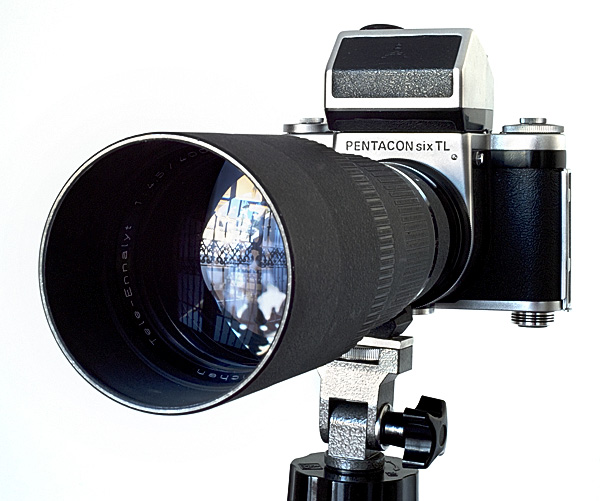
The 400mm Tele-Ennalyt in
Praktisix/Pentacon Six mount
[enna_10.jpg]
Dr W G Heyde’s book “Das Praktisix Buch”,
published in 1964, refers to an f/4.5 / 400mm
Tele-Ennalyt. In October 1972 Cambridge
Camera Exchange was advertising this lens for
US$132.50. Sam Sherman of New Jersey tells me that
“It focuses with a single helix and has reasonable
sharpness for a 400MM lens.”
| Lens name | Max aperture
& focal length |
Type | Angle of view
degrees 1 |
Min aperture 2 |
Closest focus
m |
Front filter thread
3 |
Length incl hood mm 4 |
Max dia mm |
Weight g 5 |
| Tele-Ennalyt | f/4.5 / 400 | Manual | Diag: 12° Horiz: 8° |
32 | 4.75 | 95mm × 1 |
289 | 100 | 1884 |
Notes
1 Not measured; taken from data
for the Norita 400mm lens
2 See more information in
description below
3 See more information in
description below
4 Length without lens hood: 238mm
5 Weight without lens hood: 1750g
This lens was produced over a number of years with slight variations of cosmetic finish. This may have resulted in slight variations of weight and dimensions. I give here the weight of the lens reviewed on this page, with standard lens hood and front lens cap, but no rear cap, as in use on the camera it will not have a rear lens cap. The imperial weight equivalent is 4lb 2¾ oz.
Description
The first thing that one notices when seeing and handling this lens is the finish. It consists of an extremely fine-grained mottled effect, which is totally matt, easy to hold and does not show finger-prints. In consequence of this finish, the colour looks like a mid-tone grey, except for the aperture and focus index rings, which have a shiny black finish.
Focussing ring
The focussing ring is marked in metres and feet. From infinity to closest focus it rotates through approximately 320°. Rotation is extremely smooth, although there is a higher degree of resistance than is common with most lenses. The reason for this will become clear in the next section.
Aperture ring
The aperture ring has click stops at 5.6, 8, 11, 16, 22 and 32. However, it also moves well beyond the f/32 position. Tests have revealed the following:
- click stops for apertures down to f/22 inclusive are accurate.
- These click stops also correspond to the aperture markings on the aperture ring.
- The click stop after f/22 occurs when the aperture ring is half way between the f/22 and the f/32 markings on the aperture ring.
- Checking the value at this click stop position confirms that it is effectively half a stop smaller than f/22 (f/27).
- Moving the aperture ring to the position where the f/32 marking is aligned with the index mark does indeed result in an aperture of f/32 - but there is no click stop in this position.
- The aperture ring can be moved a considerable way beyond this position, to the end of its travel.
- At that position, an exposure reading shows that the aperture has been stopped down by a further two stops after f/32, to an effective aperture of f/64
- There is, however, no détente (click stop) between f/32 and f/64 (or even at f/32). A potential détente at the next full f/ stop (which would be f/45) does therefore not exist on the example of the lens that was the subject of this test.
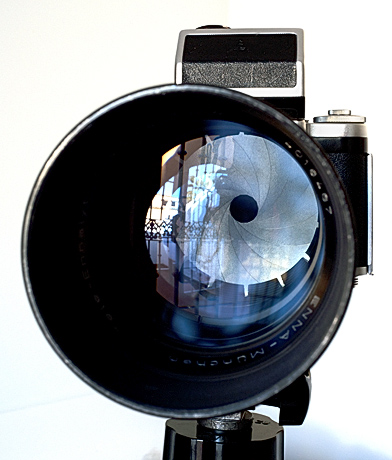 The Tele-Ennalyt with the aperture ring at the last click stop (f/27) [enna_08.jpg] |
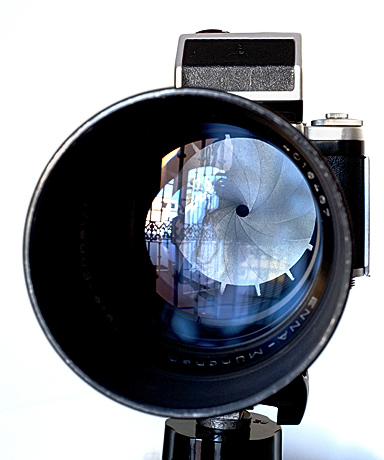 The Tele-Ennalyt with the aperture ring at the end of its travel (f/64) [enna_07.jpg] |
In fact, most of this is pretty
academic. Tests were carried out with a calibrated
prism at an ISO setting of 160/23 (“ASA/DIN”), on a
bright sunny day, with part of the image being of a
brightly-painted building in the sun, and the rest being
clear blue sky, so this was a brighter-than-average
scene. The correct exposure at f/11 required a
shutter speed of 1/500 sec. This is an excellent
combination for a lens of this focal length, as for
hand-held use one would be advised to use 1/500 as the
slowest speed, and f/11 is generally the aperture at
which many lenses give their best results.
Choosing smaller apertures for this ISO setting and
scene brightness would result in the following
combinations:
|
|
|
|
|
|
|
|
|
|
|
|
|
|
|
|
|
|
|
|
|
|
|
|
Of course, if your camera and lens are mounted on a tripod, you can certainly use the smaller apertures, with the appropriate slower speeds. However, unless the people in the image are also mounted on tripods and the branches of the trees are held fast in giant “plamps” (plant clamps), you are going to see movement in the resultant images. Naturally, if you are shooting a picture of a series of buildings that are receding into the distance at an angle, you may be delighted to have the option of an aperture as tiny as f/64, in order to increase the depth of field (and you may wish to have moving objects rendered as a blur).
Like the Novoflex lenses, this is manual aperture lens: there is no auto diaphragm stop-down operation, nor even a “pre-set” lock, as is normal with lenses from Meyer-Optik and some other manufacturers; there are détentes at each full stop position (and at f/27), so you just count the clicks to stop down.
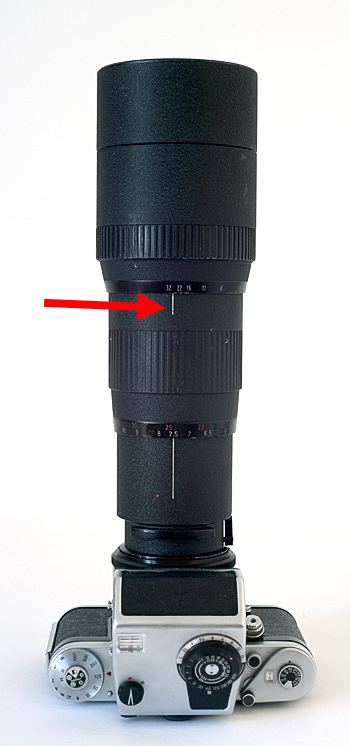
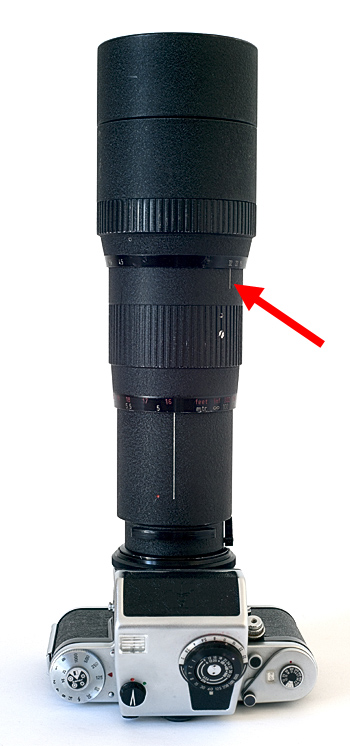
The aperture ring and index line are
located forward of the focussing ring, and the whole of
the forward section of the lens rotates as one focusses,
taking the aperture ring and aperture index line with
it. In consequence, when the lens is focussed at
certain distances, they are no longer visible from the
normal operating position above the lens. However,
Enna have thought of this and have provided a second
aperture index line on the barrel and a separate set of
aperture values on the aperture ring at 180° from the
primary points. Concretely, at a focussing
distance of 7.5 metres the secondary aperture index line
is centred on the top of the lens (in line with the
focussing index line), with the full set of aperture
values visible again. In practice, at intermediate
distances there should be little difficulty in seeing
one or other of the aperture index lines and the
aperture numbers.
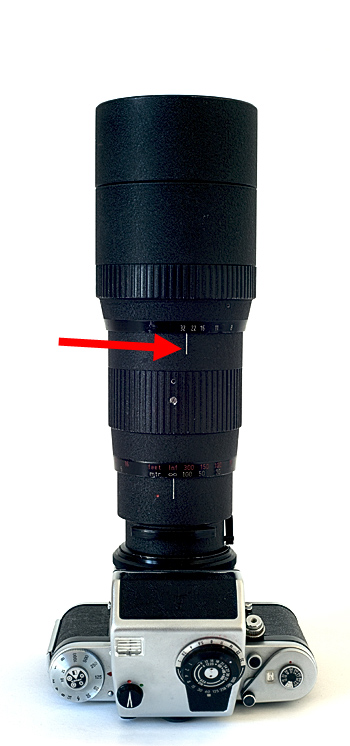 Lens focussed at infinity The primary aperture index line is indicated by the arrow. [enna_11.jpg] |
 Lens focussed at 7.5m The secondary aperture index line is indicated by the arrow. [enna_12.jpg] |
 Lens focussed at closest focus The primary aperture index line is indicated by the arrow (as it re-appears round the right-hand edge of the lens). [enna_13.jpg] |
When turning the aperture ring, one must be careful to prevent the whole of the front section of the barrel from turning slightly, which would change the focus. In practice, this proves to be easy to achieve, by simply placing a hand under the barrel so that it rests on the palm while one rotates the aperture ring with the forefinger and thumb of the same hand. The in-built resistance in the focussing mechanism also makes unwanted change of focus improbable.
Fourteen aperture blades produce a totally round iris that reportedly delivers beautiful bokeh (out-of-focus highlights).
Filters
Tests in September 2019 with a 95mm × 1 ring just received from SRB show that the filter thread is 95mm with a pitch of 1.
However, there is a drawer in a slot near the back of the lens for accommodating much smaller filters. I have measured the circular hole for the filters, and it has a diameter of 33.15mm, so presumably filters with a diameter of 34mm would fit well, although I have not yet had a chance to check this. It is obviously essential that this drawer be in place at all times, as otherwise light would get into the lens from the empty slot. The lens reviewed here was also supplied with a curved piece of plastic that effectively covers the slot, although from a style point of view it seems strange that this is grey in colour.
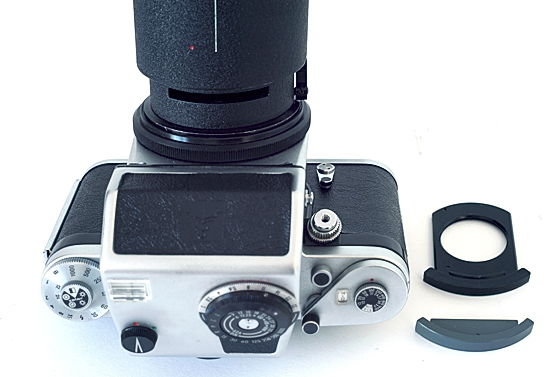 The empty slot for the filter drawer can be seen in this image. The filter drawer and the drawer-opening cover can be seen on the right. [enna_16.jpg] |
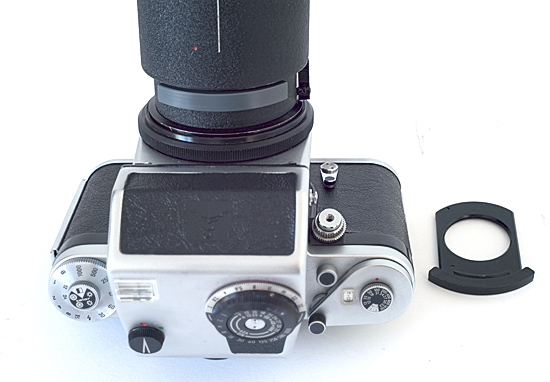 The drawer-opening cover has now been inserted into the filter drawer slot, and the filter drawer itself can be seen on the right. [enna_17.jpg] |
Kilfitt had a similar system, but it was
principally used on their lenses for 35mm cameras, as
well as on their 6×6 format Multi-Kilar converter (see here) and on one version
of their 6×6 format 500m Sport-Reflectar (see here), as in the case of
many of their lenses for 6×6 cameras there was not
enough space at the back of the lens to allow for such a
drawer.
| Tripod
bush
The lens reviewed here has a 3/8” tripod bush to which a 3/8 to 1/4” adapter had been fitted. The bush is in a small platform that provides good, positive contact with the tripod head, preventing unwanted movement.
|
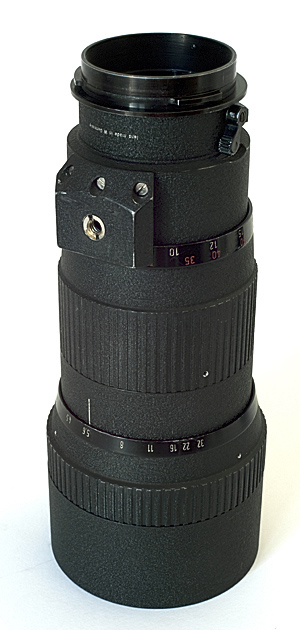 The Tele-Ennalyt tripod platform [enna_18.jpg] |
The tripod bush is mounted on a part of the lens that does not rotate, but by moving a small lever at the back of the lens into a vertical position, one is able to rotate the camera mount in order to level the camera. Returning the lever to its initial position (approximately horizontal) locks the lens in the desired orientation.
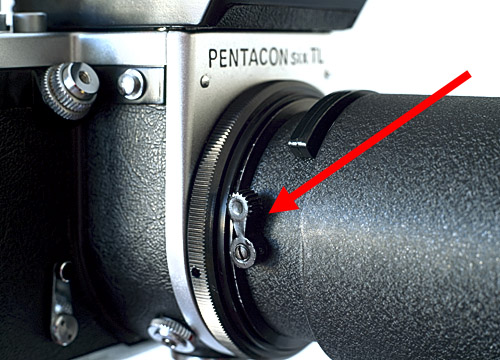 The mount rotation locking lever (arrowed) in unlocked (vertical) position [enna_04.jpg] |
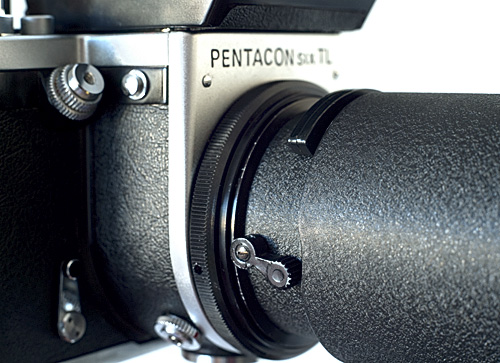 The mount rotation locking lever in locked (approximately horizontal) position [enna_03.jpg] |
| Size
& weight
This lens meets the definition for a genuine telephoto lens, i.e., it is physically shorter (and considerably so) than its optical focal length. This picture provides a comparison of 300mm – 500mm Medium Format lenses offered by their manufacturers in Pentacon Six mount. From L to R: |
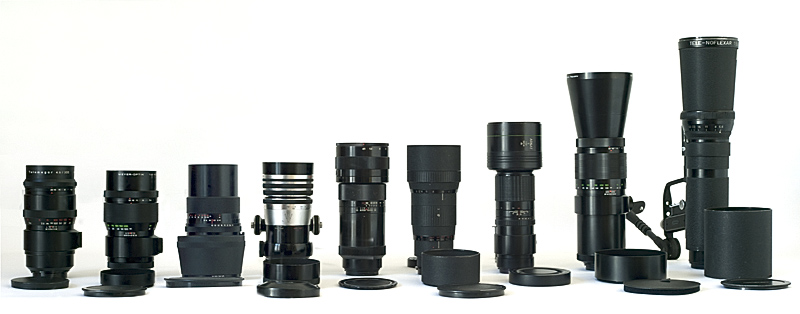 300-500mm lenses, focussed at infinity with front and rear caps off (rear caps not shown) and lens hoods off where possible (the Tair and the Arsat APO have retractable lens hoods that cannot be removed) There is no lens hood for the old Meyer Telemegor. [enna_2126.jpg] |
| In fact, the
Tele-Ennalyt is shorter than some 300mm lenses, as
can be seen from these two pictures. It is
also lighter than several of them. The Tele-Ennalyt fills a gap between 300mm and 500mm lenses with the Pentacon Six mount. In fact, few Medium Format cameras from other manufacturers had a 400mm lens in their line-up. There had been a 400mm f/5.5 Telemegor from Meyer-Optik, Görlitz, but it appears that this had ceased production by the mid 1960s. (CHK!) (Norita also theoretically had a 400mm lens, but the 400mm Noritar must have been produced in extremely low quantities and must now be viewed as an extremely rare lens.) The 400mm Tele-Ennalyt was supplied, at least sometimes, in a shiny light-tan leather case with strap, although the one reviewed here came (second-hand) in a standard GDR case (347mm long × 140mm dia) which is obviously not original, as Enna was a West German company based in Munich. The lens reviewed here also had a GDR front lens cap. This lens was also sold re-badged (and not with a Praktisix/Pentacon Six mount) as “Revue”, the brand name used by the West-German firm Foto-Quelle of Nürnberg. |
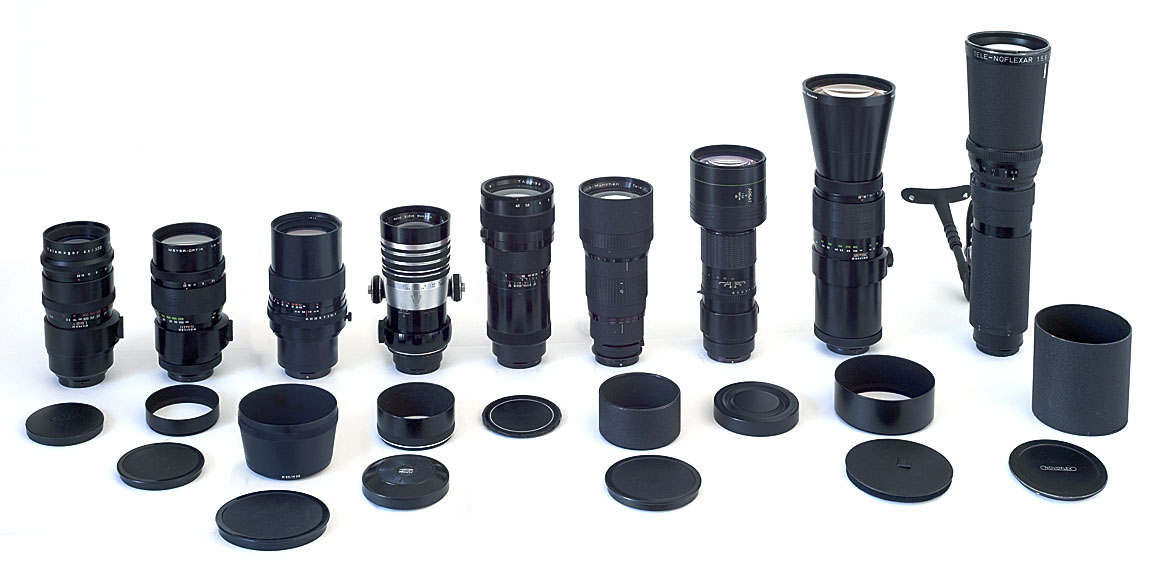 Lenses ranged in
the same order as in the previous photograph.
The 400mm Tele-Ennalyt is slightly shorter than the 300mm Tair, which is standing to its left, and only a little larger than the 300mm Kilfitt Pan-Tele Kilar, which is to the left of the Tair. [enna_2429.jpg] |
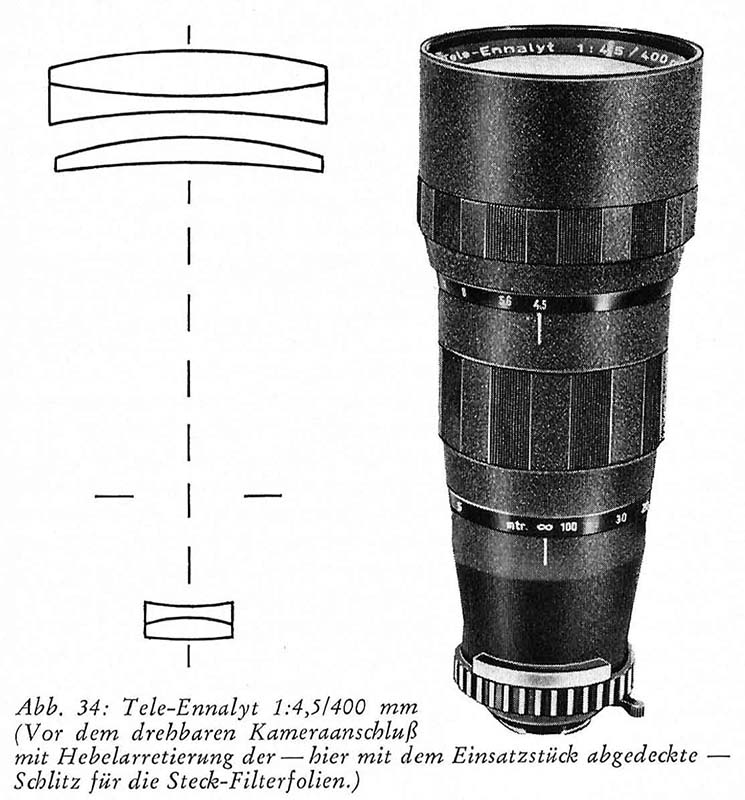
| To the right we
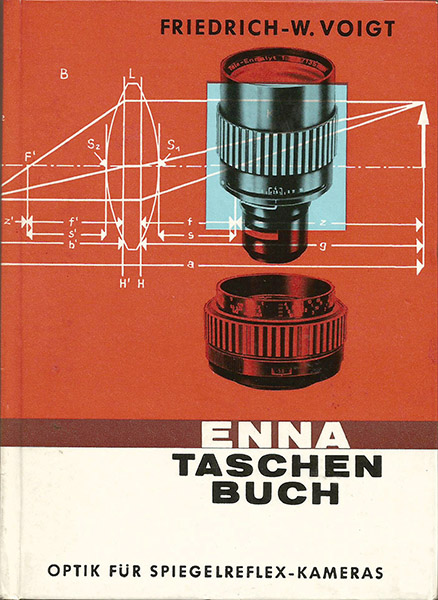
reproduce the diagram for this lens, along with a
picture of the lens, from the book on Enna lenses,
“Enna Taschen Buch” (“Enna Pocket Book”) by
Friedrich-W Voigt (the same author who wrote the
Novoflex Pocket Book, described here). We
can see that the 400mm Tele-Ennalyt has five
elements in three groups. The text states “In front of the rotatable camera mount with locking lever, the slot – here covered with the insertion piece – for the insertable gelatine filters”.
|
|
 [Ennalyt_diagrc.jpg] |
Performance
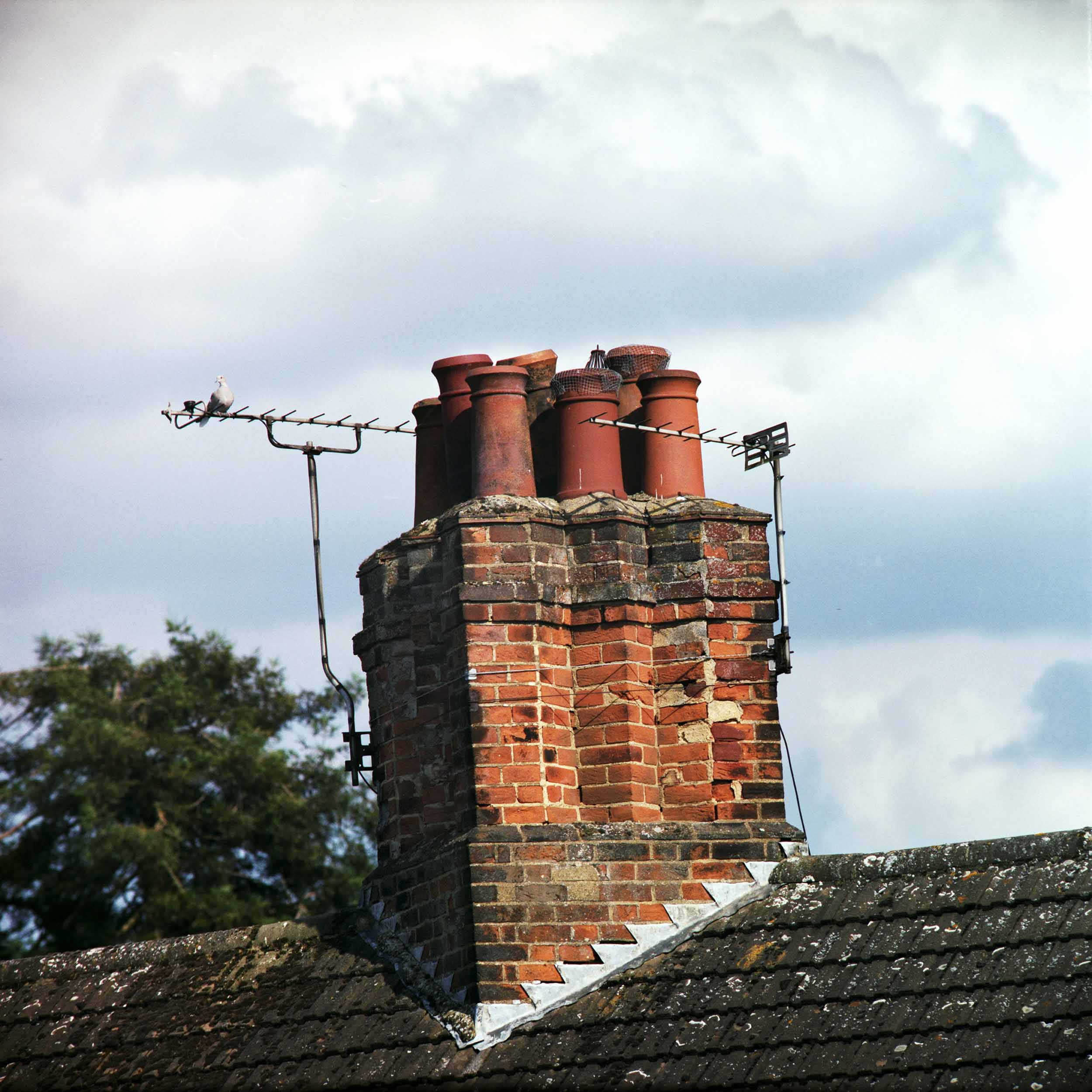
| To the right I
reproduce a test picture taken with this
lens. I used a Pentacon Six with a Pentacon
metering pentaprism that I had not previously
used, and I think that it was under-exposing by
about half a stop. The camera was on an
Arca-Swiss B1-G aspherical monoball head on a
Berlebach tripod. The head and the tripod
can be seen here.
The film was Fuji PRO400H and the exposure was
1/250 at f/16. The lens provides very good coverage of 6 × 6 format, with perhaps a hint of a reduction in brightness in the corners, but still totally acceptable. The image is very sharp. Click on the image to the right to see it larger. With most browsers, a second click on the enlarged image will enlarge it still more.
|
 [C571_7_Ennas.jpg] |
The recommended retail price of the 400mm
Tele-Ennalyt in West Germany in July 1966 can be seen here. (Look for
West Germany, 1966, and then see the right-hand column.)
To go on to the next section, click
below.
Next section
(Hartblei lenses)
To go back to the beginning of the Lens
Data section, click below and then choose the range of
lenses that you want to read about.
Back to beginning
of the Lens Data section
To see a square filter system mounted on
this lens, click here.
Click the following link to go on to the Lens Test section.
© TRA, January 2012, revised October 2019