
[C301-7: Carl Zeiss Jena 300mm Sonnar at f/11 + Panagor 2×
converter. 1/60 sec 400ASA film]
600mm
There are two ways to achieve this focal length: the 300mm f/4 Carl Zeiss Jena MC Sonnar + a 2× converter, and the hard-to-find 600mm Arsenal mirror lens. (There is also a manual, pre-set Meyer/Pentacon 300mm lens, which can be used with a 2× converter. This lens is not included in these tests.)
2 × 300mm
At the time of the tests, only the 300mm Sonnar and a converter were available to me. I used the Panagor 2× converter, and if I had had the results of the other tests with this converter, I would obviously have used the far superior Arsenal 2× converter, which produced excellent results with a series of lenses. (The front element of the Schneider 2× converter extends too far forward to be used with the Zeiss 300mm Sonnar, the rear element of which is very close to the mount.)
As we would now expect from the Panagor, at maximum aperture image definition away from the centre is poor. At f/11 there is quite considerable improvement, though the very edges and of course the corners do not match the sharpness seen in most other shots. Tests of this Sonnar on its own show what it can achieve. Coupled with the Arsenal 2× converter, I would expect excellent results.
[C301-7: Carl Zeiss Jena 300mm Sonnar at f/11 + Panagor 2×
converter. 1/60 sec 400ASA film]
The 600mm Mirror
lens
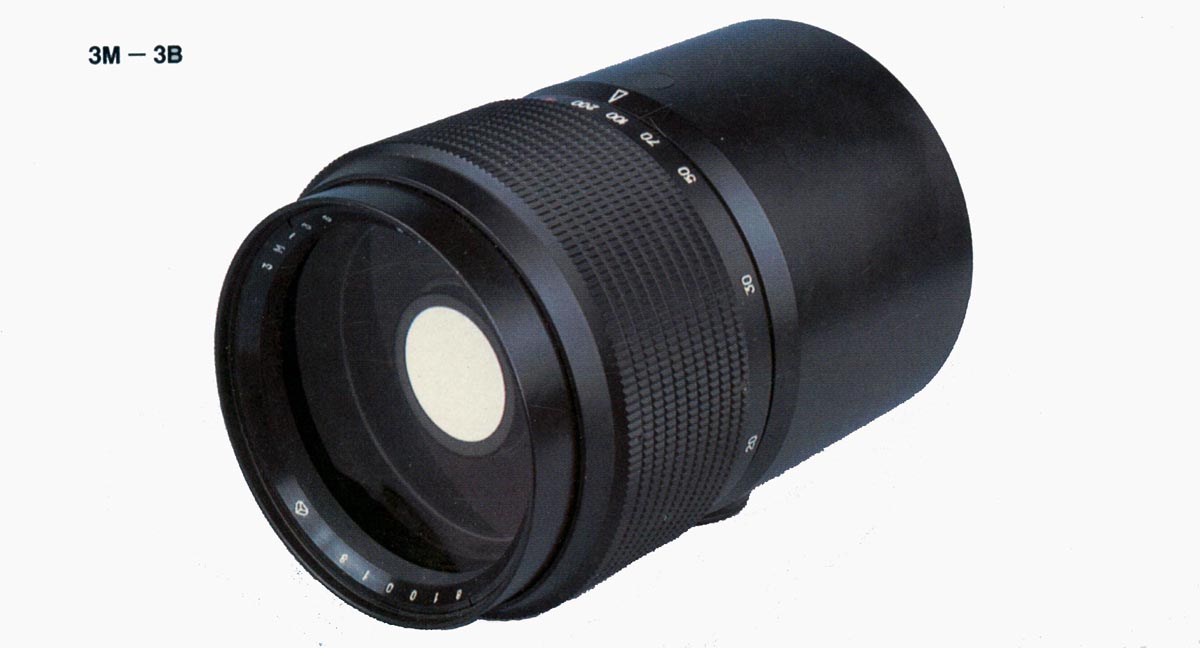
[600mmTechno1: The illustration of the 600mm mirror lens in the
Technointorg, Moscow catalogue]
Subsequent to completing the original lens tests in Hitchin, I purchased the 3M-3B Arsenal 600mm f/8 mirror lens. It does not have the cosmetic finish of the lens in the picture in my 1989 Technointorg catalogue from Moscow, which shows the standard pyramid studded ribbing that has been common on most lenses for the past 30-odd years. Instead, it has fine straight fluting (narrow straight lines) running along the length of the wide focussing ring. Some other MF lenses that I own have this finish.
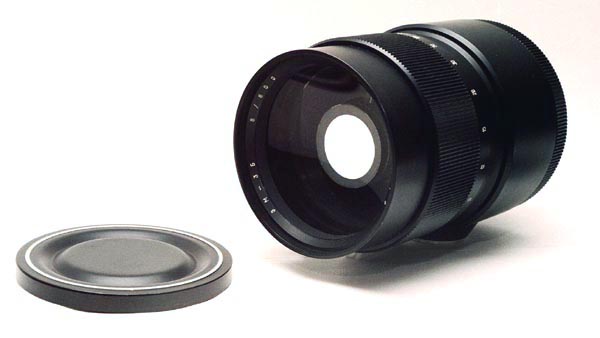
[C306-13: The version that I have of the 600mm f/8 mirror
lens and front lens cap]
According to the serial number, it was manufactured in 1974, but it looks brand new. It has a 52mm × 0.75 rear-fitting filter in place. The filter is not labelled, but I assume it is UV. It is in a standard filter mount, with (as is normal with filters) a female thread on the front surface. This is turned round, so that it points backwards when mounted. A narrow retaining ring is screwed into the 'front' thread of this filter. The ring has a wide ribbed flange that facilitates attaching the filter onto the back of the lens. It would be easy to replace the particular filter that is in my lens with another filter of one’s choice (for instance, ND).
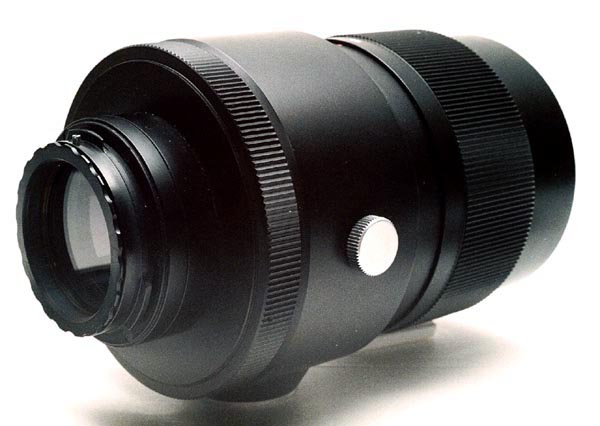
[C306-14: Rear view of the 600mm mirror lens, showing the UV
filter retaining ring]
The lens has a metal front lens cap which looks just like the cap on my 150mm Kaleinar lens – though much larger, of course. My camera repairer, Tom Page of Wickford Cameras, Kent, has looked at the lens and says that it is in excellent condition. A lens hood was not supplied with the lens. SRB, formerly of Luton and now located in Dunstable, are (I believe) the U.K.’s principal supplier and manufacturer of filter and lens mount adapter rings. They had not previously seen one of these lenses, and had no data on it, but their measurement showed that the front filter thread is 98mm × 1 and they made a ring to enable me to mount the Hasselblad Professional lens shade 93 (Hasselblad reference 40726) on this lens. The Hasselblad shade has a mounting ring for 86mm lenses, and so fits the Carl Zeiss Jena 180mm and 300mm Sonnars, as well as the CZJ 50mm and 65mm Flektogons and the Joseph Schneider Variogon M 5.6/140-280. (See Links to contact SRB or Wickford Cameras.)
The front of the 3M-3B rotates when focussing (the same as both Variogons), so I will need to investigate the bracket which Hasselblad make for use with the 50mm Distagon, which also has a rotating front element. The Hasselblad bracket is designed to locate with the slot on the left hand side of the camera (viewed from above and behind), but I imagine it could be modified to locate with the tripod bush of each of these lenses. (Each of these lenses has a 3/8 inch tripod bush, so a standard 3/8" to ¼" adaptor is needed for most people’s tripods.)
On this lens (but not the Variogons), the tripod bush is in a
rotating lockable collar, which is particularly useful if one
decides to use the lens on a 35mm camera, or on a Kiev 88-6 or
88CM with a 645 back (or a Kiev 60 modified for 6 × 4.5). However,
it can also prove handy for minor adjustments of angle if the
tripod (or the ground on which it stands) is not quite level
The lens has an aperture of f/8, one stop smaller than the Pentacon 500mm f/5.6, and this difference is clearly visible in the viewfinder, with the two lenses mounted side by side on a Pentacon Six and an Exakta 66, each with its TTL prism. Having a Rollei focussing screen in each of these cameras gives the equivalent of about 1+ more stop viewfinder brightness, but if I put a Kiev 60 TTL prism (via the Baierfoto adapter) on the camera with the mirror lens, this provides the equivalent of at least a further one stop of brightness, evening up the viewfinder brightness of the two lenses. (Baierfoto can be contacted on www.baierfoto.de)
Of course, the Kiev 60 prism also shows the whole focussing screen, which the Pentacon Six and Exakta 66 prisms do not. This is generally considered a good thing, although it does take away the “safety factor” margin to allow for unavoidable cropping in most enlargers and slide mounts or the avoidable (?) cropping by most labs.
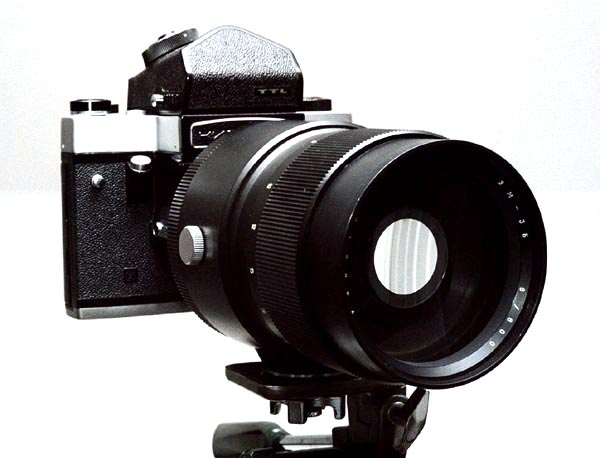
[C306-8: the 600mm mirror lens mounted on a Kiev 60]
“3M-3B” or “ZM – 3B”?
The “3M-3B” should perhaps be called “ZM – 3B”, if you
“translate” the first symbol, which I believe is actually a letter
of the Russian alphabet, not the numeral 3. I have also
transliterated to “B” the final letter of the lens name. This is
the Russian capital “b” – similar to a Roman alphabet lower case b
with a bar across the top to the right from the vertical upright.
This equals a “B” in English. This is the symbol used by the
manufacturers to designate lenses with a Kiev 6C / Kiev 60 / Kiev
90 / Pentacon 6 mount (also subsequently the Exakta 66). For
lenses with the Salyut / Kiev 80 / Kiev 88 lens mount, they use
the Russian letter which looks like “B” and is in fact the
equivalent of the Roman alphabet letter “V”. You can see why I
always specify the CAMERA that the lens is to be used on, as well
as the designation – one could so easily end up with the wrong
mount, through a misunderstanding! You can see a further
explanation of this, with illustrations of the letters, here (near the bottom of the
page).
|
“Z or 3”?
Sixteen years after writing the above,
I am interested to discover another case of confusion
between “Z” and “3”, in another area of Soviet
technology: space exploration. The Wikipedia
article on the Soviet-era N1 rocket reports as
follows:
It is interesting that even Russian sources get
confused here. Naturally, the Russian letter
“Z” does not get confused with the numeral, when it
is part of a word, and the numeral “3” does not get
confused with the letter, when it is part of a
sequence consisting entirely of numerals. The
problem can arise with product codes, such as with
this lens and with the above rocket, which are
likely to contain an unpredictable combination of
letters and numerals. The website address is https://en.wikipedia.org/wiki/N1_(rocket).
This paragraph is near the end of the article.
I consulted it on 6th February 2018. |
| “... regarding the confusion with the 600
mm mirror lens naming ("ZM" vs. "3M"). Actually, the name of the lens is "ZM", which is short for "Zerkalny Maksutova" that means "Mirror-type by Maksutov", the latter being the name of the designer of this lens (as well as of a number of astrotelescopes made in the former USSR). ... My best wishes to you from Moscow, J” Thank you, J! |
|
Versions of this lens This lens was manufactured at irregular intervals over a
period of approximately 20 years, to judge from the serial
numbers (in which the first two digits show the year of
manufacture). One would have expected that the
earlier lenses would have had the fluted design to the
focussing ring (as in the lens illustrated in my photos
above) and that the later lenses would have had the
pyramid studded finish that was illlustrated in the 1989
Technointorg catalogue from Moscow. However, a study
of the serial numbers that have been seen for this lens
indicates that the style switched backward and forward
without any obvious pattern. I would suspect that
components that were not required for an early batch of
the lenses were stored, and subsequently rediscovered and
used, even after some lenses with the pyramid studded
finish had been introduced. |
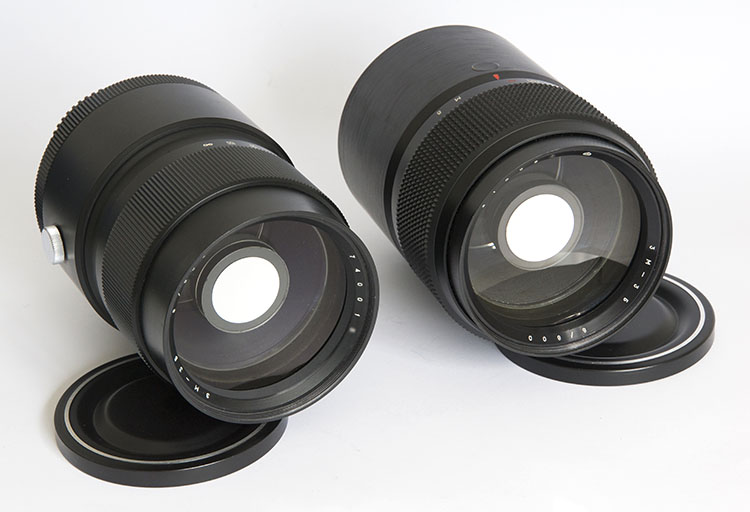 The 1974 lens is on the left, the 1981 lens on the right. A view of the underside of the two lenses (image to the right) reveals that they both have a tripod mount of essentially the same design, with a round plate of sufficient width to ensure a good trip on the tripod. The screw thread is the “Continental” 3/8" and on the older lens I have added a conversion bush down to the ¼" that is common in the UK and the USA. The presence of this socket is important, since all lenses of this focal length should normally be used on a tripod. And like all 600mm lenses, whether or not they are mirror lenses, the 3M-3B is heavy, so the camera’s own tripod socket should not be used. The front caps for the two lenses are identical. The rear caps are different, but I suspect that they are not the original caps that were supplied with the lenses when new, since the left-hand rear cap is of a newer design than the right-hand one. (For more on lens back caps, see here.) For the large ring, see comments above and below on this page. It is not an original component of either lens. |
|
As well as the difference between the
straight "fluting" on the focussing ring in the 1974 lens
and the diamond/pyramid studded focussing ring on the 1981
lens, there are a number of other significant differences. Perhaps the first difference that one notices is the chrome locking knob on the left of the older lens (as viewed from the front). This enables one to rotate and then lock a collar which contains the tripod mount. No such locking knob exists on the 1981 lens because the tripod mount is attached directly to the lens, without a rotating collar. This reduces the complexity of the components of the lens and will have simplified manufacture. Perhaps the change was introduced to reduce costs. Or perhaps a rotating tripod mount was considered unnecessary for a lens that was designed for use on square-format cameras. In the photo to the left, it is just about possible to see the Arsenal logo on the name ring of the 1981 lens (just after “12.00 o'clock”). There is no logo on the 1974 lens. 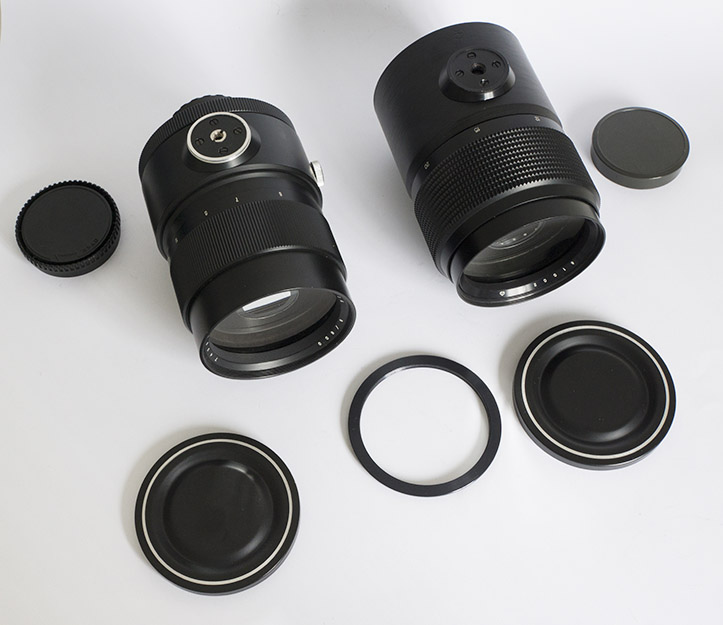 The underside of the two lenses |
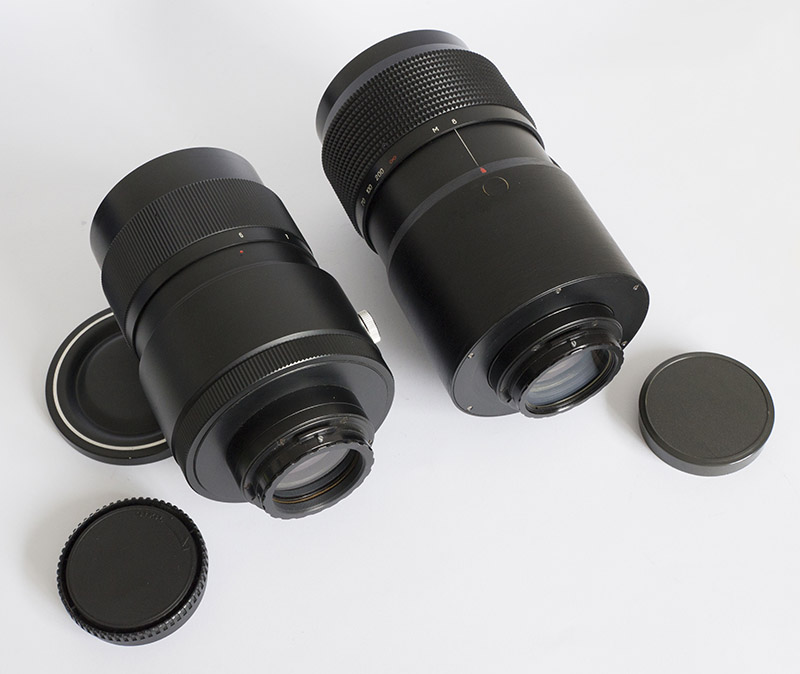 With the two lenses at the closest-focussing distance, the 1981 lens (the top lens in the picture to the right) is significantly longer than the 1974 lens. In fact, between the infinity setting and its closest focus of 6 metres, the 1974 lens only increases in length by approximately 4 millimetres, whereas in the 1981 lens increases in length by 27mm (just over 1"). The 1974 “ZM-3B” or “3M-3B” focuses both down to 6 meters and “beyond infinity”, so I thought that perhaps with the smallest Pentacon Six extension ring one might still get infinity, as well as getting closer focussing. This is the special one-off ring that is smaller than the shortest one in the set of four. Unfortunately, one can’t quite focus to infinity with this ring in place, although very nearly so, definitely close enough to have quite distant objects in sharp focus. (By the way, I couldn’t get this ring to go onto my Kiev 60, even though the others do fit, so I did this test using the Pentacon Six.) The “infinity” end stop on the 1981 lens is a lot closer to infinity than it is on the 1974 lens. This means that in the case of the 1981 lens true infinity focus is achieved with a fractional turn of the focussing ring, whereas a somewhat greater turn is required to achieve infinity with the 1974 lens. The 1974 “ZM – 3B” (or “3M – 3B”?) has a much narrower diameter for the last 19.3mm before the mounting surface that mates with the camera. The diameter drops from a fraction under 115mm to 72mm. This means that the lens mounts easily on all bodies that one might reasonably expect it to fit – Pentacon Six (therefore also Praktisix), Kiev 60 (therefore also 6C), my Kiev 88 with P6 mount (Brenner’s “B.i.G. Six”) and – most significantly – the Exakta 66, even with the Schneider TTL prism in place, although this prism projects forwards a long way from the front of the camera. As will be clear from the photograph to the right, on the 1981 lens that section with the narrower diameter is a lot shorter than it is on the 1974 lens. In fact, it is 10.67mm, not enough for the back plate of the lens to clear the metering prism on the Exakta 66. For the record, the diameter of the rear section of the main barrel on the 1981 lens is a fraction over 114mm, essentially the same as on the 1974 lens, to within a fraction of a millimetre. Also as with the 1974 lens, the diameter of the rear section behind the back plate is approximately 72mm |
From the angle of view in the
picture to the left, we can observe further similarities and
differences:
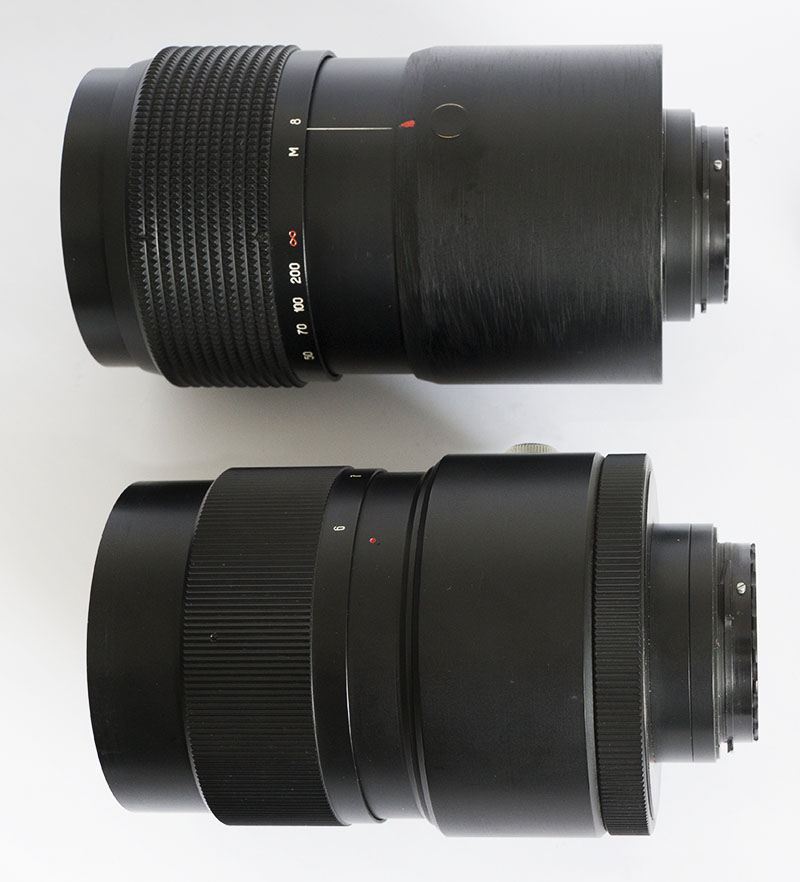 The two lenses at their closest focus |
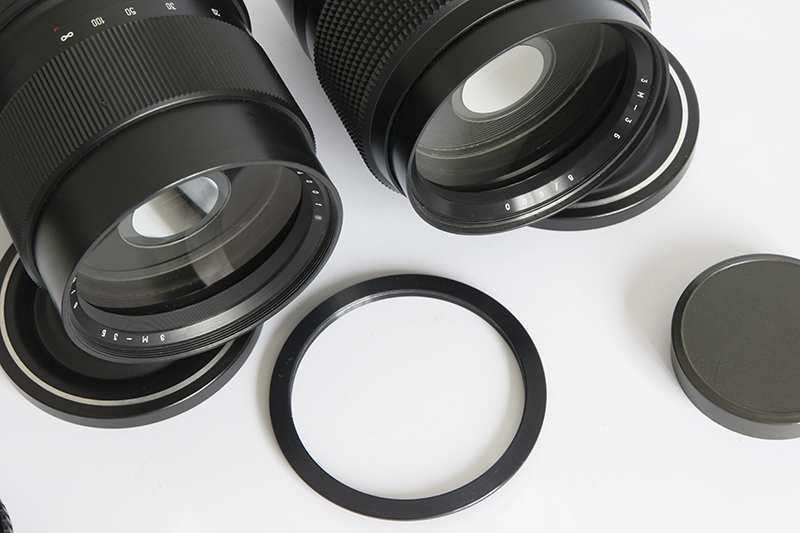 Here the 1974 lens is on the left and the 1981 lens is on the right. In the enlarged section of this picture that is reproduced to the right, I have rotated the image through approximately 180º to make it easier to see the details. In that picture, the 1981 lens is therefore on the left of the picture and the 1974 lens is on the right, as indicated by the captions in the photo. |
The image on the left here enables us to
observe two further differences between the two versions of
this lens. First, let us look at the ring that is in front of the two lenses. This is the adapter ring that was custom-made for me by SRB. It has an outer thread of 98mm × 1 pitch and an inner thread of 86mm × 1 pitch. As explained (above) and illustrated (below) on this page, it enables me to mount the Hasselblad Professional lens shade 93 (Hasselblad reference 40726) on the 1974 version of this lens. In the image on the left it is just possible to see the thread in the front of the 1974 lens. The 1981 lens does appear to have the same thread, which is required to take the name ring. However, the thread stops a couple of millimetres before the front of the lens. This is clearer in the following enlargement of a section of the same picture. 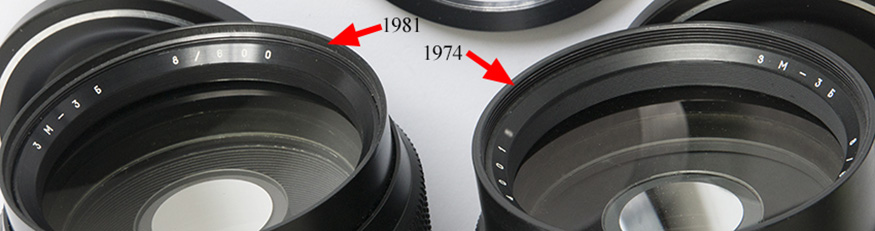 The ring from SRB has a "lip" which projects beyond the threaded section, ending flush with the outside of the the 1974 lens, making it easy to mount the ring onto the lens:  The depth of the threaded portion of this ring is exactly right for the 1974 lens, but it is not deep enough to engage with the thread in the 1981 lens, which starts further down; a ring with a longer step portion would be required – not a problem, of course, for experts like the people at SRB. |
||
|
It may be that the detail revealed in these photographs
shows that it should be possible to mount a
suitable, custom-manufactured ring to the
front of the newer versions of this lens. Or of
course it may be that the lens that my correspondent had
acquired did not have even this small amount of thread in
front of the name ring, in which case, his solution with a
thick piece of black paper and a rubber band is the way to
go in order to get a lens shade! |
|||
The other difference between the two lenses is also visible in these photos. The shape of the letters on the 1974 lens indicates that we should indeed call it “ZM-3B” (in English script), while the shape of the letters on the 1981 lens indicates that the lens was by then designated “3M-3B” (the same as in the 1989 Technointorg catalogue from Moscow). |
|||
Test results
The mirror lens has yet to be tested in the same setting as the other lenses, although I have taken tests in a different location. Here are my findings.
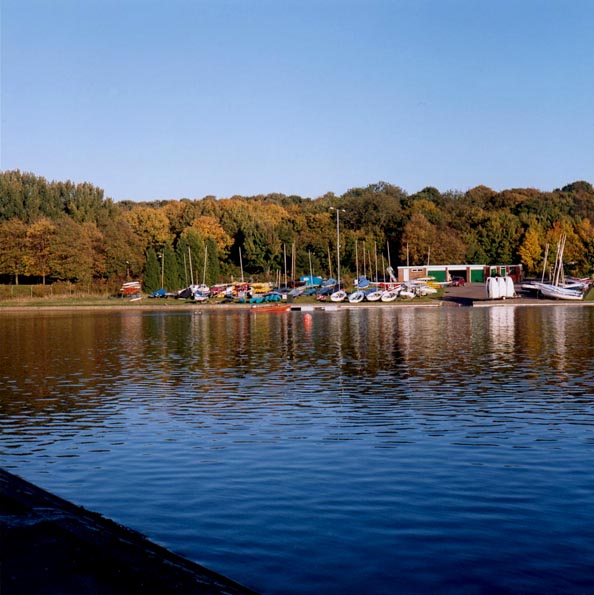
[C305-16: Pentacon-Six with 80mm Biometar standard lens at f/8
1/250]
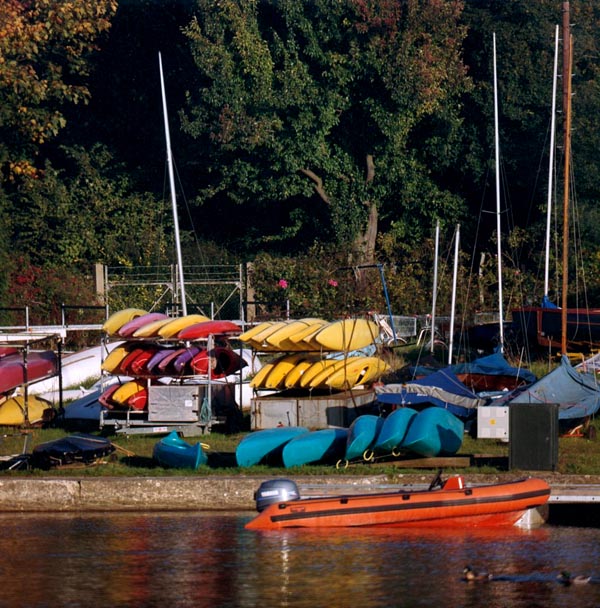
[C305-17: Picture taken from same viewpoint. Pentacon-Six
with 600mm Mirror lens. 1/250]
This lens is capable of producing EXTREMELY sharp images, but of course the depth of field is quite limited, so precise focussing is essential. I tested for flare by shooting pictures of a lake with the sun reflecting off the water into the lens. This worked quite well, but reflections from the water of direct sun shining into the lens produces totally unacceptable arc-shaped reflections. This lens really does need an efficient lens shade for use when shooting towards the sun or other bright light sources.
This is what it looks like with the Hasselblad Professional lens shade 93 fitted via the SRB adapter ring:
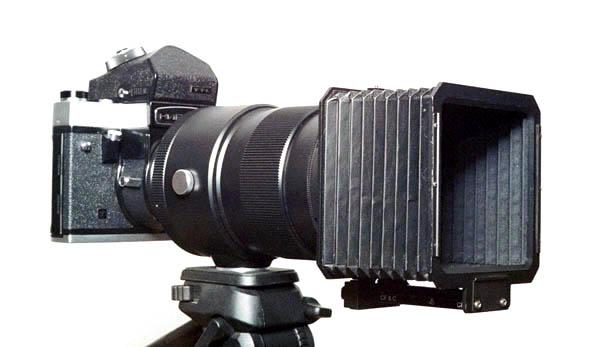
[C309-2A]
Shielding for the lens can be further improved by adding a mask to the front of the lens shade. My shade came with masks for 120/150mm and 250mm lenses. It will not be difficult to modify one of these masks (by reducing the opening) to give maximum shading for the 600mm lens. When doing this, I plan to mount the lens on the Kiev 88-6, with the ground-glass screen and magnifying hood in place of the film magazine, to eliminate any possibility of viewfinder error. The next image shows the masks as supplied.
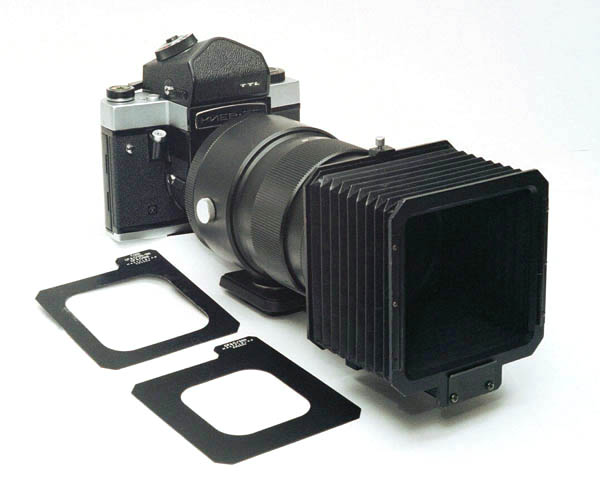
[C309-5A]
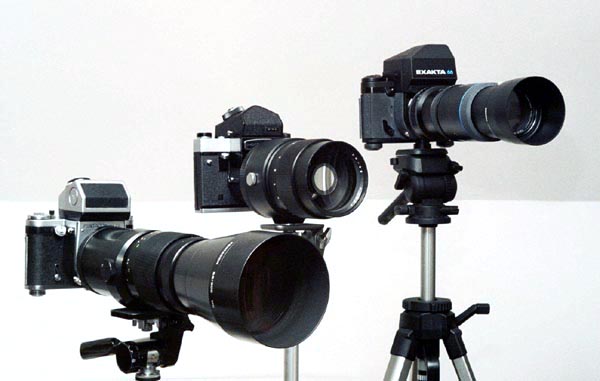
[C06- 2: 500-600mm: what they look like together.
From left to right: Pentacon 500mm on Pentacon Six, Arsenal
600mm on Kiev 60, Schneider 250mm + 2× converter on Exakta 66]
To go on to the next section, click below.
Next section (further 500-600mm tests)
For the results obtained with the Kilfitt 150mm
Tele-Kilar used with the Kilfitt Multi-Kilar variable converter
at the 4× setting and the Kilfitt 300mm Tele-Kilaar used with
the Kilfitt Multi-Kilar variable converter at the 2× setting,
see here.
To go back to the beginning of the lens tests, click below and
then choose the focal length that you want to read about.
Back to beginning of lens tests
© TRA January 2002, Latest revision: March 2024